




How Does AI Cost Optimization Help Reduce Operational Expenses?

Blog Summary:
As intelligent systems continue to scale, managing rising operational costs has become a critical business priority. This blog explores AI Cost Optimization by covering market growth trends, hidden cost factors, and why cost control matters across business functions. It outlines proven optimization strategies and essential metrics to track spending effectively. The blog also highlights how organizations can improve efficiency and ROI through structured, sustainable cost management.
As organizations scale their digital initiatives, managing rising technology expenses has become just as critical as driving innovation. Advanced models, complex data pipelines, and high-performance infrastructure often promise efficiency—but without disciplined cost control, they can quietly drain budgets.
This is where AI Cost Optimization becomes a business necessity rather than a technical afterthought.
Enterprises today are under pressure to balance experimentation with accountability. While intelligent systems can streamline operations and unlock new revenue streams, they also introduce hidden and ongoing costs associated with data processing, model training, infrastructure usage, and governance.
Leaders are now looking beyond short-term savings toward sustainable cost structures that support long-term growth and resilience.
Cost-aware strategies align closely with broader transformation goals pursued by many organizations, including enterprise digital transformation and SaaS cost optimization.
By embedding financial visibility and accountability into intelligent systems from the start, businesses can improve AI cost efficiency without slowing innovation or compromising performance.
This blog explores how organizations can take a structured, practical approach to managing costs of intelligent systems—covering growth trends, overlooked expenses, proven strategies, and measurable metrics—so every investment delivers clear, defensible value.
Market Growth & Future Outlook of AI Cost Optimization
The rapid expansion of intelligent technologies is significantly reshaping enterprise spending patterns. According to Fortune Business Insights, the global artificial intelligence market, valued at over USD 233.46 billion in 2024, is projected to grow from USD 294.16 billion in 2025 to USD 1,771.62 billion by 2032, exhibiting a CAGR of 29.20% over the forecast period, driven by the rise of data-driven decision-making.
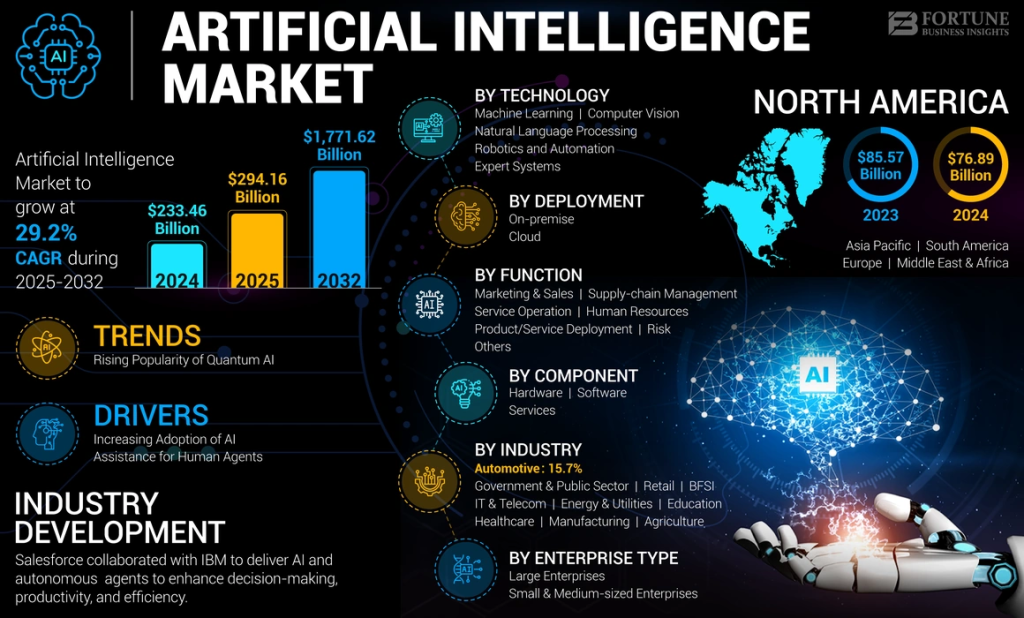
As organizations scale advanced models, generative systems, and cloud-based infrastructure, operational costs related to compute, storage, and talent continue to rise. This accelerating spend has made AI Cost Optimization a strategic priority for businesses aiming to sustain innovation without financial inefficiencies.
Key market signals shaping cost optimization focus include:
- Rapid growth in generative systems requires high computing and energy consumption
- Increased enterprise adoption across banking, healthcare, retail, and manufacturing
- Rising investments in specialized hardware and cloud infrastructure
- Higher operational costs due to model training, retraining, and deployment cycles
- External pressures, such as hardware supply constraints and global trade regulations
Looking ahead, organizations are expected to shift from reactive cost control to proactive optimization models. As intelligent systems become core to business operations, companies will focus more on improving ai cost efficiency through structured governance, predictive cost monitoring, and scalable optimization frameworks.
This forward-looking approach will help enterprises align long-term growth with sustainable and accountable spending.
Why AI Cost Optimization Matters for Businesses?

As intelligent systems become a core part of business operations, managing their financial impact is just as important as improving performance. Many organizations invest heavily in advanced models, cloud infrastructure, and automation without full visibility into long-term costs.
AI Cost Optimization helps businesses maintain control over spending while continuing to innovate and scale responsibly. It ensures growth is sustainable, predictable, and aligned with measurable business outcomes, rather than driven by unchecked experimentation.
Boosts Profitability
Effective cost optimization reduces unnecessary spending on compute resources, data storage, and underutilized models. By identifying inefficiencies and eliminating waste, businesses can lower operational expenses without compromising output quality. This allows organizations to protect profit margins even as usage scales.
Over time, optimized spending directly contributes to healthier financial performance. It also enables teams to reinvest savings into higher-impact initiatives. Profitability improves not by cutting innovation, but by using resources more intelligently.
Ensures Sustainability
Sustainability depends on the ability to scale systems without constant budget overruns. Cost-optimized architectures are designed to scale in a controlled, predictable manner. This prevents sudden financial strain when workloads increase or new use cases are added.
Organizations can maintain long-term initiatives without frequent course corrections. Optimization also supports responsible resource consumption, which is increasingly important for environmental and regulatory reasons. Sustainable spending ensures continuity and stability across operations.
Drives ROI
Return on investment becomes clearer when costs are tied directly to business outcomes. Optimization enables organizations to track how much value each model or use case delivers relative to its cost.
This helps decision-makers prioritize initiatives that generate measurable impact. Underperforming projects can be improved, paused, or retired before costs escalate further.
Over time, this improves capital efficiency across the portfolio. Better ROI builds confidence in future investments in intelligent systems.
Optimizes Resource Allocation
Not all workloads require the same level of computing power or infrastructure. Cost optimization helps organizations allocate resources based on actual usage and business priority. High-impact applications receive the resources they need, while low-value processes are scaled back.
This improves overall AI cost efficiency across teams and departments. It also reduces internal competition for resources. Balanced allocation leads to smoother operations and better system performance.
Manages Complexity
As systems grow, costs become fragmented across data pipelines, models, tools, and platforms. Without structured oversight, this complexity leads to hidden and duplicated expenses. Optimization introduces transparency across the entire lifecycle. It helps teams understand where money is being spent and why.
Clear visibility reduces confusion and improves coordination between technical and business stakeholders. Managing complexity becomes easier when costs are centralized and measurable.
Enhances Strategic Decision-Making
Accurate cost insights empower leaders to make informed, forward-looking decisions. Organizations can evaluate whether to scale, optimize, or pause initiatives based on real financial data. This reduces reliance on assumptions or short-term metrics.
Cost intelligence also supports better forecasting and budgeting. Leaders gain confidence in aligning technology investments with long-term goals. Strategic decisions become more data-driven and less reactive.
Inventory & Supply Chain
Cost optimization plays a critical role in controlling expenses across inventory and supply chain operations. Intelligent forecasting models can be expensive to run if they are over-trained or poorly scaled. Optimization ensures models use the right amount of compute while still delivering accurate demand predictions.
This reduces excess inventory, storage costs, and supply chain disruptions. Businesses can balance operational efficiency with controlled spending. Optimized systems help avoid both stock shortages and unnecessary capital lock-in.
Marketing Efficiency
Marketing teams increasingly rely on intelligent systems for audience targeting, personalization, and campaign optimization. Without cost oversight, experimentation across multiple channels can quickly inflate budgets. Optimization helps teams understand which models and campaigns deliver real value.
Resources can then be focused on high-performing initiatives, while low-impact efforts are scaled back. This improves campaign outcomes while maintaining budget discipline. Marketing investments become more predictable and outcome-driven.
Error Reduction
Errors in data processing, model predictions, or system configuration often lead to rework and additional costs. Optimized systems are monitored more closely, reducing the likelihood of costly mistakes. Early detection of anomalies helps prevent unnecessary retraining or infrastructure overuse.
This minimizes downtime and operational inefficiencies. Over time, fewer errors translate into lower support and correction costs. Cost optimization strengthens reliability while protecting budgets.
Predictive Maintenance
Predictive maintenance systems rely on continuous data ingestion and model updates, which can be resource-intensive. Optimization ensures these systems operate efficiently without excessive compute or storage usage. By aligning model complexity with actual maintenance needs, organizations reduce unnecessary processing.
This lowers operational costs while still preventing equipment failures. Optimized predictive systems extend asset life without inflating expenses. Maintenance becomes proactive, efficient, and cost-controlled.
Need Better Visibility Into Your AI Spending?
Identify hidden cost drivers and optimize resources with a structured AI Cost Optimization approach tailored to your systems.
Hidden AI-Related Costs Organizations Often Miss
Many organizations underestimate the true cost of running intelligent systems by focusing only on visible expenses such as infrastructure and tools. In reality, several indirect and ongoing costs quietly accumulate over time, reducing overall value.
Identifying these hidden elements is essential to effective AI Cost Optimization, as they often account for a significant portion of long-term spend and directly impact scalability and performance.
Data Preparation and Quality
Preparing data for intelligent systems is often more expensive than anticipated. Costs arise from data cleaning, labeling, validation, and ongoing quality checks. Poor-quality data increases retraining cycles and reduces model accuracy, leading to repeated processing costs.
As data volumes grow, these expenses scale rapidly. Without proper governance, teams spend more time fixing data issues than generating insights. Data readiness is a major but frequently overlooked cost driver.
Talent Acquisition and Retention
Skilled professionals required to build, maintain, and optimize intelligent systems command high salaries. Beyond hiring, costs include onboarding, continuous training, and retention efforts. As technologies evolve rapidly, teams need continuous upskilling to remain effective.
High attrition can further increase costs through repeated recruitment cycles. These human capital expenses are ongoing and often underestimated during planning. Talent-related costs directly influence long-term AI cost efficiency.
Integration with Legacy Systems
Integrating modern systems with existing infrastructure introduces hidden complexity and cost. Custom connectors, data migration, and compatibility adjustments require additional development effort. Legacy environments may also limit optimization opportunities, increasing compute and maintenance expenses.
Integration delays can cause parallel systems to run longer than planned. Over time, this increases both operational and support costs. Seamless integration is critical but rarely inexpensive.
Inefficient Model Training Cycles
Frequent retraining without performance justification leads to unnecessary resource consumption. Inefficient experimentation, oversized models, or poorly tuned parameters increase compute usage. Many teams retrain models by default rather than based on measurable need.
This inflates cloud and energy costs without improving outcomes. Optimizing training frequency and scope is essential to control spending. Training inefficiencies are a silent but significant cost factor.
Human Oversight and Change Management
Despite automation, human involvement remains necessary for review, validation, and governance. Costs arise from monitoring outputs, managing exceptions, and ensuring compliance. Change management efforts are also required when systems are updated or expanded.
Training teams to adopt new workflows adds further expense. These activities are ongoing and scale with system complexity. Human oversight is essential but must be planned for financially.
Ongoing Maintenance and Monitoring
Once deployed, systems require continuous monitoring, updates, and performance tuning. Maintenance costs include bug fixes, version upgrades, security patches, and infrastructure adjustments. Monitoring tools and alerting systems add to operational expenses.
Neglecting maintenance can lead to performance degradation and higher future costs. Regular upkeep ensures stability but represents a long-term financial commitment. Maintenance is often underestimated during initial budgeting.
Proven AI Cost Optimization Strategies to Apply Today
Organizations looking to control intelligent system expenses need practical, repeatable strategies rather than one-time cost cuts.
These proven approaches help businesses optimize AI costs while maintaining performance, scalability, and innovation. When applied consistently, they create long-term financial discipline across the entire system lifecycle.
AI Resource Audit
A comprehensive resource audit helps organizations understand where and how costs are being incurred. This includes reviewing compute usage, storage consumption, model deployments, and inactive resources. Many systems continue running even when they no longer deliver value.
Audits identify underutilized or redundant assets for optimization or retirement. Regular reviews improve visibility and prevent unnecessary spending. This forms the foundation for informed cost decisions.
Usage Monitoring Optimization
Continuous monitoring ensures resources are aligned with real-time demand. By tracking usage patterns, organizations can detect spikes, idle capacity, and inefficient workloads early. Monitoring also helps teams adjust configurations before costs escalate.
When combined with alerts and thresholds, it prevents uncontrolled resource consumption. This approach improves predictability and supports better budgeting. Effective monitoring is essential for maintaining AI cost efficiency.
Training Inference Optimization
Model training and inference are among the most cost-intensive activities. Optimizing batch sizes, training frequency, and model complexity reduces excessive compute usage. Inference costs can be controlled through caching, batching, and right-sizing deployments.
Not every use case requires high-performance configurations. Aligning model performance with business needs avoids over-engineering. Efficient training and inference directly lower operational expenses.
Demand-Based Infrastructure
Demand-based infrastructure scales resources up or down based on actual workload requirements. This prevents overprovisioning during low-usage periods and ensures availability during peak demand. Automated scaling improves flexibility without manual intervention.
Organizations pay only for what they use rather than maintaining constant capacity. This approach supports growth while controlling costs. It is especially effective for variable or seasonal workloads.
Tool Platform Consolidation
Using multiple overlapping tools increases licensing, integration, and maintenance costs. Consolidation helps reduce complexity by standardizing platforms across teams. Fewer tools mean lower training and support requirements. It also improves visibility into system performance and spending.
Consolidation simplifies governance and reduces duplicated functionality. Streamlined toolsets contribute to more predictable cost management.
Cost Allocation Control
Clear cost allocation assigns expenses to specific teams, projects, or use cases. This transparency encourages accountability and responsible usage. Teams become more aware of the financial impact of their decisions. Allocation also helps leadership identify high-cost, low-value initiatives.
Over time, this supports better prioritization and budgeting. Controlled allocation turns cost data into actionable insights.
Essential AI Cost Metrics to Track Regularly
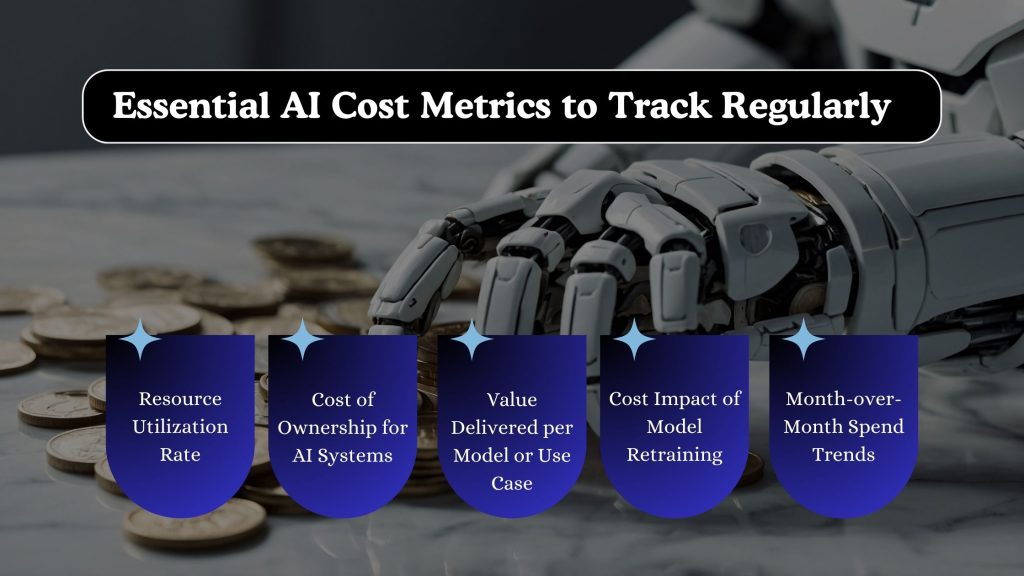
Tracking the right metrics is critical to maintaining financial control as intelligent systems scale. Without consistent measurement, costs can drift away from business value, making optimization reactive instead of proactive.
These metrics help organizations evaluate performance, identify inefficiencies, and strengthen AI cost optimization efforts over time.
Resource Utilization Rate
This metric measures how effectively compute, storage, and infrastructure resources are being used. Low utilization often indicates overprovisioning or idle workloads. By tracking utilization rates, organizations can identify waste and resize resources accordingly.
Consistent monitoring helps align capacity with actual demand. Improved utilization directly supports better cost efficiency. It also prevents paying for unused or underused infrastructure.
Total Cost of Ownership for AI Systems
Total cost of ownership extends beyond infrastructure to include data preparation, tooling, talent, maintenance, and integration. This metric provides a holistic view of the true cost of running a system over its lifecycle.
Tracking TCO helps organizations avoid underestimating long-term financial commitments. It also supports better budgeting and forecasting decisions. Understanding TCO ensures investments are evaluated realistically. This metric is essential for long-term planning.
Value Delivered per Model or Use Case
This metric compares the cost of running a model against the business value it generates. Value can be measured through revenue impact, cost savings, efficiency gains, or risk reduction.
Tracking this helps organizations prioritize high-impact use cases. Low-value models can be optimized, redesigned, or retired. This ensures spending remains outcome-driven. It strengthens alignment between technology and business goals.
Cost Impact of Model Retraining
Frequent model retraining can significantly increase compute and energy costs. Tracking retraining expenses helps teams evaluate whether updates are delivering measurable improvements. This metric encourages data-driven decisions about training frequency.
It also highlights inefficiencies caused by poor data quality or unstable pipelines. Controlled retraining reduces unnecessary spend. Optimization here prevents cost escalation without performance gains.
Month-over-Month Spend Trends
Monitoring spending trends over time helps organizations detect gradual cost creep. Sudden increases can signal inefficiencies, configuration issues, or unplanned scaling. Trend analysis supports proactive intervention before budgets are exceeded.
It also improves forecasting accuracy and financial transparency. Regular trend reviews help maintain cost discipline. This metric is vital for sustainable growth management.
BigDataCentric’s Approach to Sustainable AI Cost Optimization
BigDataCentric follows a structured, value-driven approach to ensure intelligent systems remain scalable without introducing uncontrolled costs. Instead of focusing on short-term savings, the emphasis is on building cost-aware architectures that align technology investments with measurable business outcomes.
By combining cost visibility, governance, and performance insights, organizations gain better control over long-term spending while maintaining innovation velocity.
The approach begins with assessing existing data pipelines, infrastructure usage, and model lifecycles to identify inefficiencies early. This is supported by continuous monitoring and optimization practices that align closely with enterprise analytics and business intelligence initiatives already adopted by many organizations.
By integrating cost intelligence into data-driven decision frameworks, businesses can improve cost efficiency across teams and use cases.
BigDataCentric also emphasizes accountability through clear cost allocation and performance benchmarking. By linking costs to specific use cases, teams can evaluate value delivery more accurately and make informed scaling decisions.
This practical, metrics-led methodology helps organizations implement AI cost optimization sustainably—ensuring intelligent systems drive growth, not financial strain.
Do you have a long-term AI cost strategy in place?
Build a sustainable AI Cost Optimization framework that supports growth and financial discipline.
Conclusion
As intelligent systems continue to scale across industries, managing their financial impact has become just as important as improving performance and innovation. Without structured oversight, costs related to infrastructure, data, training, and maintenance can quietly erode business value.
A disciplined approach to AI cost optimization helps organizations maintain control while still enabling growth and experimentation.
By identifying hidden expenses, applying proven optimization strategies, and tracking the right cost metrics, businesses can make informed decisions that align spending with outcomes. Sustainable optimization is not about limiting adoption—it is about ensuring every investment contributes measurable value.
Organizations that embed cost awareness into their intelligent systems today will be better positioned to scale efficiently, remain competitive, and drive long-term business success.
FAQs
-
Can AI cost optimization improve return on investment?
Yes, cost optimization helps align spending with measurable outcomes, ensuring resources are invested in high-value use cases. This improves efficiency and maximizes returns without increasing overall spend.
-
Which industries benefit most from cost optimization?
Industries with high data volumes and complex operations—such as healthcare, finance, retail, manufacturing, and logistics—see the greatest benefits. These sectors rely heavily on scalable systems where cost control directly impacts profitability.
-
How does model selection affect overall AI costs?
Choosing overly complex models increases training, inference, and maintenance costs. Selecting models that align with the use-case requirements helps balance performance with cost efficiency.
-
How does resource utilization impact AI costs?
Poor utilization results in overprovisioned infrastructure and idle resources, increasing costs. Optimized utilization ensures resources are used only when needed, reducing unnecessary spending.
-
Can AI cost optimization help control experiment-related costs?
Yes, optimization introduces limits, monitoring, and performance benchmarks for experiments. This prevents excessive testing cycles and ensures experimentation remains focused and cost-effective.

Jayanti Katariya is the CEO of BigDataCentric, a leading provider of AI, machine learning, data science, and business intelligence solutions. With 18+ years of industry experience, he has been at the forefront of helping businesses unlock growth through data-driven insights. Passionate about developing creative technology solutions from a young age, he pursued an engineering degree to further this interest. Under his leadership, BigDataCentric delivers tailored AI and analytics solutions to optimize business processes. His expertise drives innovation in data science, enabling organizations to make smarter, data-backed decisions.


