




A Complete Guide to the AI Software Development Process for Scalable Solutions
Blog Summary:
This blog provides a comprehensive overview of the AI Software Development Process, breaking down the key steps involved, from understanding business objectives to deployment. It highlights the cost factors, including data preparation, talent, infrastructure, and ongoing maintenance. The guide also discusses best practices for building scalable AI solutions. Whether you’re starting with a simple automation tool or a complex custom AI system, this guide offers valuable insights to navigate the entire development lifecycle.
The AI Software Development Process has become a pivotal aspect of modern technology, transforming how businesses build and implement artificial intelligence solutions. In today’s fast-paced digital world, adopting AI is no longer a luxury but a necessity for staying competitive.
The AI development process is complex and requires meticulous planning, structured workflows, and integration of cutting-edge technologies.
Whether you’re creating a chatbot, predictive analytics model, or a fully integrated AI-powered application, understanding the nuances of the AI software development process is crucial. A well-defined approach not only ensures a seamless development experience but also drives efficiency, scalability, and performance across AI systems.
Why a Well-Defined AI Software Development Process is Important?
A well-defined AI Software Development Process is essential for the successful creation and deployment of AI solutions. It ensures that all aspects of development are meticulously planned, from understanding business goals to the final deployment. Without a clear process, AI projects can quickly become disorganized, resulting in inefficiencies, delays, and unexpected costs.
A structured approach helps align the development with the organization’s objectives, ensuring that the AI solution delivers tangible business value. It also allows for better resource management, improved collaboration between teams, and more predictable outcomes.
Furthermore, a well-defined process enables the integration of best practices and emerging technologies, which are crucial to building scalable, high-performance AI applications.
Ultimately, a strong AI development process drives innovation, reduces risk, and ensures AI systems are aligned with both technical and business requirements.
Step-by-Step AI Software Development Process
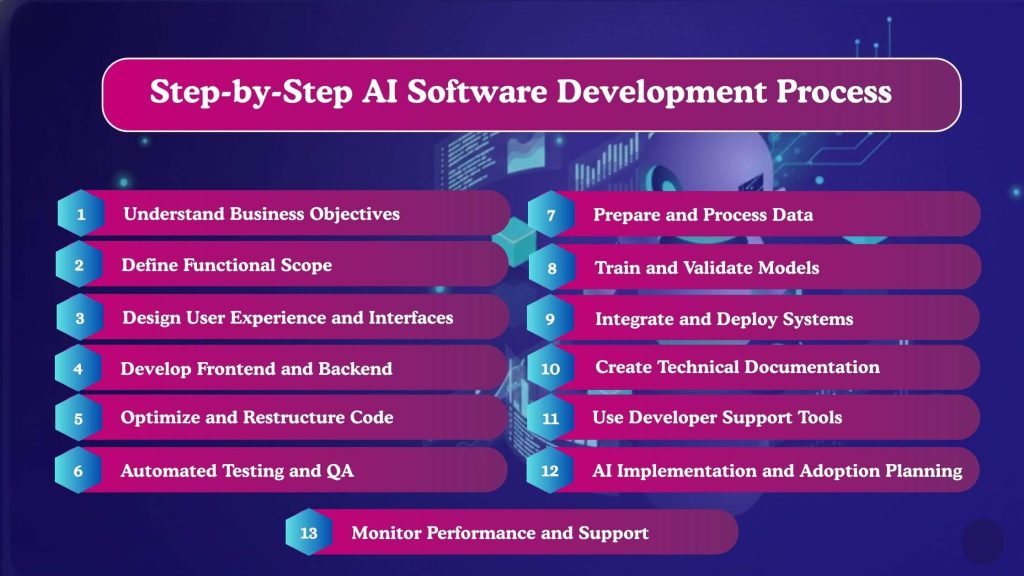
The AI Software Development Process involves several crucial stages, each contributing to the success of the final solution. Following a structured approach helps ensure all objectives are met efficiently, from initial planning through deployment of the AI system.
Let’s explore the key steps involved in building an AI-powered solution.
Understand Business Objectives
The first step in the AI software development process is to understand the business objectives thoroughly. This stage sets the foundation for the entire project by aligning the AI system with the organization’s goals. Whether the aim is to optimize operations, improve customer experience, or enhance decision-making, defining clear business objectives is essential.
It ensures the AI solution is tailored to address specific business pain points or opportunities. Without this understanding, the AI system may not meet user needs or deliver the expected value.
Collaboration between business stakeholders and the development team is critical here to ensure the AI project’s goals are clearly defined and aligned with the strategic vision.
Define Functional Scope
Once business objectives are established, the next step is to define the AI system’s functional scope. This involves outlining what the AI solution will do, its capabilities, and its limitations.
The functional scope clarifies the tasks the AI system is expected to perform, such as automating processes, providing real-time recommendations, or analyzing large datasets. It’s essential to establish boundaries to prevent scope creep, which can lead to delays, increased costs, and a lack of focus.
By defining the core features and functionalities at the outset, developers can ensure the AI solution remains aligned with business objectives and stays within the project’s budget and timeline.
Design User Experience and Interfaces
User experience (UX) plays a pivotal role in AI software development. The design of the user interface (UI) and the overall experience can make or break the success of an AI-powered application.
An intuitive, user-friendly interface enables users to interact with the AI system easily, whether for data entry, real-time feedback, or decision-making. During this phase, both the frontend and backend interfaces are designed to complement each other, providing a seamless experience.
The frontend focuses on the user interface—the part users directly interact with—while the backend ensures the system’s AI models and data infrastructure function smoothly. Designing a cohesive and effective UX/UI requires input from both technical and non-technical stakeholders to ensure the system meets user expectations and is easy to use.
Develop Frontend and Backend
The next step is to develop the AI solution’s frontend and backend. The frontend is what users see and interact with, and it must be designed to support AI functionality in an intuitive, accessible way. This includes the user interface, user input fields, and the visual representation of AI results.
On the other hand, the backend consists of the AI models, data processing pipelines, and infrastructure that support the system. This phase focuses on ensuring that the AI algorithms work seamlessly with the user-facing elements. The backend also manages data storage, security, and performance optimization to ensure the system can scale as needed.
Effective collaboration between frontend and backend developers is crucial during this phase to build a system that functions as a cohesive whole.
Optimize and Restructure Code
After developing the core functionalities, the next step is to optimize and restructure the code. As AI systems handle complex computations and large datasets, ensuring efficient code execution is crucial to performance. Optimization might involve refining algorithms, reducing processing times, or enhancing the system’s scalability.
This phase also focuses on cleaning up the code to improve maintainability and make it easier for future development teams to understand. Code restructuring improves system performance and ensures that the AI solution can adapt to evolving business needs. It also makes troubleshooting and future system expansion easier, enhancing its long-term value.
Automated Testing and QA
Automated testing and quality assurance are critical to ensuring the reliability and accuracy of AI-driven applications. Unlike traditional software, AI systems rely heavily on data behavior and probabilistic outputs, making testing more complex.
This stage focuses on validating system logic, data pipelines, and model responses under different scenarios. Automated test cases help identify performance issues, data inconsistencies, and integration errors early in the development lifecycle.
Regular QA cycles also ensure that updates or retrained models do not break existing functionalities. A robust testing strategy improves system stability and builds confidence before deployment.
Prepare and Process Data
Data preparation is one of the most time-intensive stages in the AI development process. Raw data collected from multiple sources often contains inconsistencies, duplicates, missing values, or irrelevant information.
This step involves cleaning, normalizing, labeling, and transforming data into a usable format. High-quality data directly impacts the accuracy and reliability of AI models. Proper data processing also ensures compliance with security and privacy standards, especially when handling sensitive information.
Without well-prepared data, even the most advanced algorithms fail to deliver meaningful outcomes.
Train and Validate Models
Model training involves feeding prepared datasets into selected algorithms to enable pattern recognition and learning. During this stage, models are iteratively trained to improve prediction accuracy and decision-making capabilities.
Validation is equally important because it assesses how well the trained model performs on unseen data. This helps prevent overfitting and ensures generalization across real-world scenarios.
Performance metrics such as accuracy, precision, recall, and response time are closely monitored. Continuous validation ensures the AI system delivers consistent, reliable results over time.
Integrate and Deploy Systems
Once models are trained and validated, they are integrated into the broader software ecosystem. This step ensures that AI components work seamlessly with existing applications, databases, APIs, and third-party services.
Deployment strategies may vary depending on infrastructure requirements, such as cloud-based environments or on-premise systems. Proper integration ensures smooth data flow, real-time processing, and minimal latency.
Deployment also involves configuring monitoring tools and fail-safe mechanisms to handle unexpected behaviors. A well-executed deployment phase ensures the AI solution is production-ready and scalable.
Create Technical Documentation
Technical documentation is essential for maintaining clarity and continuity throughout the AI Software Development Process. This documentation includes system architecture, data flow diagrams, model behavior explanations, API references, and deployment guidelines.
Clear documentation helps development teams, stakeholders, and future contributors understand how the system functions. It also simplifies troubleshooting, upgrades, and compliance audits. Well-maintained documentation reduces dependency on individual developers and ensures long-term sustainability of the AI solution.
Use Developer Support Tools
Developer support tools enhance productivity and streamline software development ai workflows. These tools include version control systems, model monitoring dashboards, automated pipelines, and debugging utilities.
They help teams manage code changes, track experiments, and collaborate efficiently across different development stages. Support tools also enable faster iteration cycles and better visibility into model performance.
By using the right toolset, development teams can reduce manual effort, improve consistency, and maintain higher development standards throughout the project lifecycle.
AI Implementation and Adoption Planning
Successful AI projects go beyond development and require thoughtful implementation and adoption planning. This stage focuses on preparing teams, processes, and infrastructure to use the AI solution effectively.
It includes training end users, defining operational workflows, and setting expectations for system capabilities. Change management is crucial to ensure smooth adoption across the organization.
Proper planning minimizes resistance and maximizes the practical value delivered by the AI system in real-world operations.
Monitor Performance and Support
Post-deployment monitoring ensures that the AI system continues to perform as expected under real-world conditions. Performance metrics, system health, and data drift are continuously tracked to identify issues early.
AI models may degrade over time due to changing data patterns, making ongoing monitoring essential. Support activities include retraining models, updating data pipelines, and resolving technical issues. Continuous monitoring and support help maintain system accuracy, reliability, and long-term business value.
Want to Create Scalable AI Systems?
Let’s talk about how our AI software development process can help you build intelligent solutions tailored to your business goals.
Cost Breakdown of the AI Software Development
The cost of AI software development varies significantly depending on factors like project complexity, talent requirements, data handling, and infrastructure needs. Below are some rough estimates based on publicly available data:
Key Cost Factors
- Project Scope
- Basic AI (chatbots, automation): $10,000 – $50,000
- Mid-level (predictive analytics, recommendation engines): $50,000 – $250,000+
- Advanced/Custom (enterprise-level solutions): $100,000 – $800,000+
- Talent & Team
- AI developers/consultants charge $27 – $400+ per hour.
- In-house teams incur salaries, benefits, and training costs; outsourcing may lower upfront costs but also incurs agency fees.
- Data
- Costs include data collection, preparation (cleaning, labeling), and acquisition.
- Data preparation can be time-consuming, significantly affecting overall cost.
- Infrastructure & Tools
- Cloud computing (AWS, GCP): $500 – $50,000+ per month for GPU/TPU use.
- On-premises infrastructure incurs $50,000-$150,000+ in upfront costs.
- Maintenance
- Ongoing costs for simpler apps: $5,000 – $20,000+ annually.
- Complex systems may require $200,000+ annually for monitoring, retraining, and updates.
Sample Project Cost Ranges
- Small Automation Tool: $10,000 – $50,000
- Predictive Analytics Platform: $150,000 – $500,000+
- Complex Custom AI System: $120,000 – $800,000+
Cost-Saving Approaches
- Start with a proof of concept (PoC).
- Use cloud infrastructure instead of on-premise hardware.
- Build an MVP and gradually add features.
Why Choose BigDataCentric for AI Software Development?
When it comes to AI Software Development, BigDataCentric stands out for its expertise in delivering customized, scalable, and innovative AI solutions. With a deep understanding of both business needs and the technical intricacies of AI, we ensure that our solutions not only meet but exceed client expectations.
Expertise and Experience
At BigDataCentric, we bring years of AI development experience and have successfully implemented AI-powered solutions across a wide range of industries. Our team of data scientists, AI engineers, and machine learning experts collaborates to deliver solutions aligned with your business objectives.
Tailored Solutions
We understand that each business has unique needs, which is why we develop AI software solutions tailored to your specific requirements. Whether you need predictive analytics, business automation, or a full-scale AI solution, we ensure the result adds value to your organization.
You Might Also Like:
Generative AI vs. Predictive AI: What’s the Difference and Why It Matters?
Scalable and Sustainable Development
Our development approach focuses on building scalable solutions that grow with your business. We incorporate best practices for scalability and performance optimization to ensure that your AI solutions can handle increasing data volumes and complexity over time.
End-to-End AI Development Services
From ideation to deployment and post-launch support, we offer a comprehensive range of services that cover the entire AI development lifecycle. Our experts are with you every step of the way, ensuring smooth integration, testing, and long-term support.
Proven Track Record
BigDataCentric has a proven track record of successful AI projects across various industries. Our focus on quality, innovation, and timely delivery has earned us a reputation as a trusted AI development partner.
Ready to Build Your Custom AI Solution?
Discover how our AI software development process can help you create powerful solutions that drive business growth and innovation.
Final Thoughts
The AI Software Development Process is complex, involving a series of structured steps to ensure the successful creation of intelligent, scalable solutions. From understanding business objectives to deploying models, each phase plays a crucial role in shaping the AI system’s effectiveness.
As AI continues to evolve, businesses must adopt a well-defined process to stay ahead in the competitive landscape. The right approach not only ensures alignment with business goals but also helps manage costs, mitigate risks, and drive continuous improvement.
By partnering with experienced teams like BigDataCentric, businesses can navigate the challenges of AI development with confidence, ensuring their AI systems are both impactful and sustainable over the long term.
FAQs
-
How does automation support the software development process?
Automation streamlines repetitive tasks, reduces human error, and accelerates development by handling code deployment, testing, and integration, thus improving efficiency and consistency.
-
How often should models be updated after deployment?
Models should be updated periodically or when significant changes in data patterns or performance are observed. Typically, updates may occur every few months or in response to new data trends.
-
How is data security managed in AI projects?
Data security in AI projects is managed through encryption, secure data storage, access control, and regular audits to ensure compliance with privacy regulations and protect sensitive information.
-
What are the best strategies for AI software testing?
The best strategies include unit testing, integration testing, model validation, and continuous monitoring. It's also crucial to test AI models for bias, accuracy, and scalability in real-world scenarios.
-
How do businesses measure ROI in AI software development?
ROI in AI software development is measured by evaluating improvements in efficiency, cost savings, revenue growth, and the AI solution's overall impact on business goals and decision-making.

Jayanti Katariya is the CEO of BigDataCentric, a leading provider of AI, machine learning, data science, and business intelligence solutions. With 18+ years of industry experience, he has been at the forefront of helping businesses unlock growth through data-driven insights. Passionate about developing creative technology solutions from a young age, he pursued an engineering degree to further this interest. Under his leadership, BigDataCentric delivers tailored AI and analytics solutions to optimize business processes. His expertise drives innovation in data science, enabling organizations to make smarter, data-backed decisions.


