




Cloud Readiness Assessment: Checklist and Tools for Cloud Success
Blog Summary:
In this blog, we explain what a Cloud Readiness Assessment is and why it is important before cloud migration. It covers key steps, benefits, checklists, and assessment tools to ensure a smooth transition. This helps businesses reduce risks, control costs, and plan cloud adoption effectively.
Cloud adoption has become a major priority for businesses that want to improve scalability, performance, and operational efficiency. Organizations are moving applications, data, and workloads to cloud platforms to reduce infrastructure dependency and support faster digital transformation.
However, cloud migration is not just a technical shift—it impacts business continuity, security, costs, and long-term IT planning.
Many companies start migration without evaluating whether their infrastructure, applications, teams, and processes are actually ready for the cloud. This often leads to challenges like unexpected downtime, security gaps, compliance risks, and budget overruns. That’s why performing a Cloud Readiness Assessment before migration is a practical step to reduce uncertainty and improve decision-making.
A readiness assessment provides a clear understanding of what should be migrated, what needs modernization, and what risks must be addressed early. It helps businesses create a structured migration roadmap and ensure that cloud adoption aligns with business goals.
This becomes even more important for organizations managing complex systems such as analytics platforms and reporting environments, where planning is essential for long-term success.
What is a Cloud Readiness Assessment?
A cloud readiness assessment is a structured evaluation process that helps an organization assess its readiness to migrate its systems, applications, and data to the cloud. It identifies whether your current IT environment can support cloud adoption and what changes are needed before migration begins.
Instead of jumping into cloud migration blindly, this assessment provides a clear understanding of the technical, operational, and business factors that will influence the success of the transition.
This assessment typically reviews your existing infrastructure, application portfolio, security policies, compliance requirements, data architecture, and internal workflows.
It also examines how well your teams are equipped to manage cloud operations, whether additional training is required, and whether your organization has the right governance model for cloud usage.
In many cases, businesses discover that some applications are cloud-ready, while others require re-architecture, modernization, or even replacement.
A cloud readiness assessment is not only about finding gaps—it also helps define the right cloud strategy. For example, it helps determine whether workloads should be moved using a lift-and-shift approach, refactored, or placed in a hybrid environment.
This process becomes especially valuable when migrating systems like analytics dashboards, reporting platforms, or large datasets, where cloud planning must align with data and decision-making goals.
Why Cloud Readiness Assessment is Important Before Cloud Migration?
Cloud migration can bring major benefits such as scalability, flexibility, and improved performance, but it can also create serious challenges if not planned.
Many organizations move to the cloud assuming it will automatically reduce costs and improve efficiency, but without proper evaluation, migration often results in delays, downtime, and unexpected technical issues. That’s why a cloud readiness assessment is a critical step before starting any cloud journey.
One major reason is application compatibility. Not all applications are built for cloud environments, especially legacy systems that depend on outdated infrastructure or tightly connected architectures.
A readiness assessment helps identify which workloads are cloud-ready and which ones need modernization, re-architecture, or replacement to avoid performance problems after migration.
Another key factor is cost and security planning. Cloud expenses can increase quickly if resource usage is not properly estimated, and security risks become higher if governance policies are not in place.
A structured migration readiness assessment helps businesses plan budgets, estimate cloud costs, and ensure compliance with requirements before sensitive data is moved.
Lastly, cloud migration impacts people and operations as much as it impacts technology. Teams need the right skills, processes, and monitoring tools to manage cloud environments effectively.
A readiness assessment ensures the organization is fully prepared—technically and operationally—so migration becomes smooth, controlled, and aligned with business goals.
The Four Steps of a Cloud Readiness Assessment
A cloud migration is smoother when it follows a structured evaluation process rather than relying on guesswork. A cloud readiness assessment is typically conducted in four key phases to help organizations understand their current IT environment, business preparedness, and the steps required to migrate successfully.
These steps ensure migration planning stays realistic, secure, and aligned with long-term business goals.
IT Landscape Overview (Evaluation Phase)
This is the first phase, in which organizations assess their existing IT infrastructure, applications, databases, servers, and network setup. The main goal is to understand the current system architecture and identify what can be migrated easily versus what requires modernization.
It also helps uncover legacy dependencies, performance bottlenecks, and integration challenges. This phase provides a baseline for planning workload prioritization, estimating cloud resource requirements, and ensuring that critical systems, such as analytics and reporting platforms, are migration-ready.
Organizational Overview (Interview Phase)
This phase focuses on understanding how prepared the organization is from an operational and people perspective. It includes stakeholder interviews to evaluate cloud knowledge, internal workflows, decision-making processes, and governance readiness.
It also identifies gaps in skills, training requirements, and team responsibilities after migration. This step ensures cloud adoption is not limited to technology changes but also supported by the right teams and organizational structure.
Comparison with the Market (Analysis Phase)
In this stage, the organization compares its cloud preparedness against industry benchmarks and best practices. This helps businesses understand whether their current infrastructure, security posture, and operational maturity meet modern cloud standards.
The analysis phase also helps validate whether the chosen cloud approach is competitive and scalable. It ensures that the migration plan is not only technically feasible but also aligned with what successful organizations in similar industries are doing.
Initiating Change (Reporting Phase)
This final phase converts assessment findings into a practical cloud migration roadmap. It includes recommendations on workload prioritization, cloud model selection, security improvements, cost estimates, and timelines.
The reporting phase provides a clear action plan that stakeholders can follow confidently. It ensures the business moves forward with structured execution rather than scattered decisions, reducing the chances of delays and migration failure.
Need a Cloud Readiness Check?
We help you perform a cloud application readiness assessment and identify what to migrate, modernize, or optimize. Get expert guidance with a clear migration plan.
Benefits of a Cloud Readiness Assessment
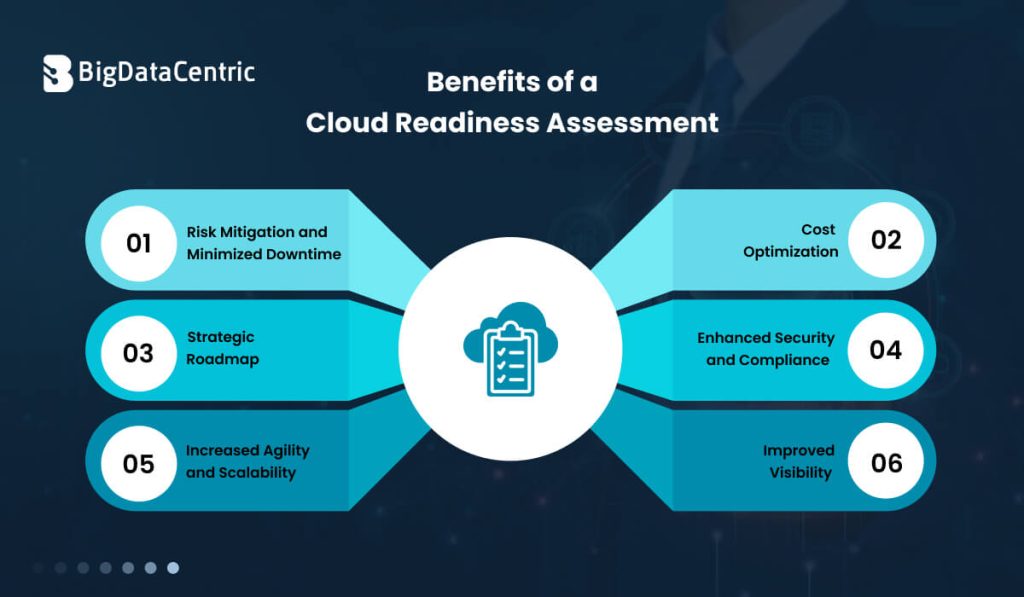
A Cloud Readiness Assessment is not just a technical review—it is a strategic step that helps businesses migrate with clarity and confidence. It highlights gaps in infrastructure, applications, security, and operational readiness before migration begins.
This prevents organizations from making costly decisions based on assumptions and ensures the cloud transition supports long-term business growth.
Below are some key benefits that make this assessment essential to cloud migration planning.
Risk Mitigation and Minimized Downtime
One of the biggest benefits of a readiness assessment is early risk identification. It helps detect issues such as legacy application dependencies, outdated infrastructure, and system vulnerabilities that could cause failures during migration.
By addressing these issues in advance, businesses can reduce downtime and avoid disruptions in business operations. This is especially important for customer-facing applications, data platforms, and business-critical systems where even small outages can impact revenue and productivity.
Cost Optimization
Cloud migration without cost evaluation often leads to overspending. A readiness assessment helps estimate infrastructure needs, storage requirements, compute usage, and licensing impacts, allowing businesses to plan cloud spending more accurately.
It also helps avoid unnecessary cloud services and identifies workloads that should be optimized before migration. This ensures businesses pay only for what they actually need and maintain better control over long-term cloud expenses.
Strategic Roadmap
A readiness assessment provides a structured migration roadmap with clear steps, timelines, and priorities. It helps organizations decide which workloads should move first, which ones need modernization, and which ones should stay on-premise or in a hybrid model.
This roadmap keeps cloud adoption aligned with business goals rather than being treated as a rushed IT initiative. It also improves coordination between teams and ensures migration activities follow a defined plan.
Enhanced Security and Compliance
Security becomes a major concern when systems and sensitive data move to the cloud. A readiness assessment helps evaluate access control, encryption practices, identity management, and compliance requirements.
It also ensures the organization meets regulatory standards such as GDPR, HIPAA, or ISO. This is particularly important for industries handling sensitive customer information, financial data, or confidential business intelligence.
Increased Agility and Scalability
Cloud adoption is meant to make businesses faster and more scalable. A readiness assessment ensures that infrastructure and applications are prepared to take advantage of cloud scalability without performance issues.
It also helps businesses plan for future expansion, workload growth, and sudden traffic spikes. This allows organizations to scale operations without needing heavy hardware upgrades.
Improved Visibility
Many organizations struggle with fragmented systems and unclear IT dependencies. A readiness assessment provides better visibility into applications, infrastructure components, data flows, and operational gaps.
This improved visibility supports smarter migration planning and makes future cloud governance easier. It also helps decision-makers understand the real scope of cloud migration and manage it with better control.
Cloud Readiness Assessment Checklist
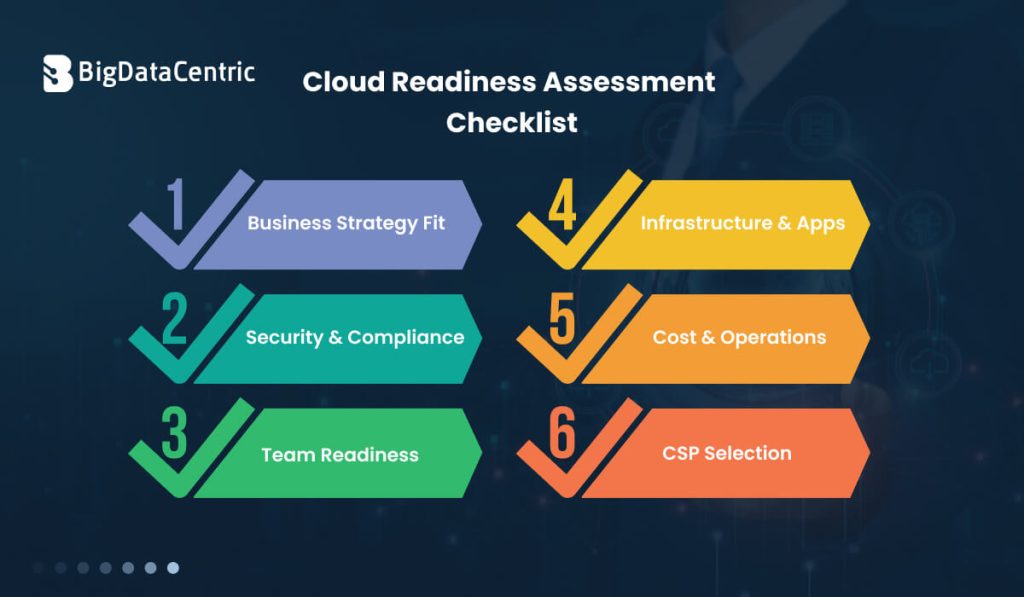
A checklist-driven approach ensures that no important area is overlooked during cloud planning. Instead of focusing only on infrastructure, a readiness review should cover business strategy, applications, security, cost planning, team readiness, and cloud vendor selection. A well-defined checklist helps organizations evaluate cloud adoption realistically and avoid surprises during migration.
Below are the key areas to include in a cloud readiness checklist.
Strategic & Business Alignment
Before migrating, businesses must confirm why they are moving to the cloud and what outcomes they expect. This includes identifying goals such as scalability, faster deployments, improved performance, or reduced operational overhead.
This step also ensures cloud migration aligns with business priorities, customer expectations, and long-term digital strategy. Without clear alignment, migration can turn into a costly technical project with no measurable ROI.
IT Infrastructure & Application Assessment
This part focuses on reviewing servers, networks, storage, databases, and existing architecture. It determines whether the current infrastructure is compatible with cloud migration or requires upgrades before workloads can be moved.
It also evaluates applications to determine whether they are suitable for lift-and-shift, refactoring, or complete replacement. This is often referred to as a cloud application readiness assessment, where dependencies and performance requirements are carefully reviewed.
Security, Compliance, & Risk Management
Security readiness is one of the most critical parts of cloud planning. This includes reviewing identity and access management, encryption standards, authentication methods, and monitoring capabilities.
It also ensures compliance with industry-specific requirements. This step reduces legal and regulatory risks, especially when sensitive customer or business data is involved.
Financial & Operational Analysis
Cloud adoption requires a clear understanding of cost impact. This checklist step includes estimating cloud resource usage, licensing changes, migration expenses, and operational costs.
It also helps calculate expected ROI and evaluate whether cloud adoption will reduce or increase long-term expenses. This is where businesses often evaluate cost-saving opportunities through optimization and workload restructuring.
Organizational & Staff Readiness
Cloud migration requires skilled teams, updated processes, and new operational practices. This step checks whether internal staff have cloud expertise or whether training and hiring are needed.
It also evaluates internal workflows, governance models, and team responsibilities. Without organizational readiness, businesses may migrate successfully but struggle to manage the cloud environment afterward.
Cloud Service Provider (CSP) Selection
Choosing the right cloud provider is a key decision that impacts performance, compliance, cost, and scalability. This checklist step compares providers based on service offerings, security capabilities, support, and pricing models.
It also ensures the selected provider fits the organization’s technical needs and long-term goals. Many businesses also consider multi-cloud or hybrid strategies during this stage to reduce dependency on a single platform.
Key Areas Covered in a Comprehensive Cloud Readiness Assessment
A cloud readiness assessment is effective only when it evaluates every major part of an organization’s IT and operational environment. Instead of focusing only on servers or applications, it also covers security, data handling, cost analysis, skills, and risk planning. This gives businesses a complete picture of what is required for a successful migration.
Below are the key areas typically reviewed during a comprehensive assessment.
Infrastructure Evaluation
This step focuses on reviewing the current IT infrastructure, including servers, storage, networking, virtualization, and system configurations. The goal is to understand whether the existing setup can support cloud migration or if certain components need upgrades or replacement.
Infrastructure evaluation also identifies performance bottlenecks and compatibility issues. It helps determine whether workloads should be moved to a public cloud, a private cloud, or a hybrid model, based on scalability and operational needs.
Application Portfolio Analysis
This section reviews the organization’s applications to identify which ones are cloud-ready and which require modernization. It checks application dependencies, architecture, integrations, performance needs, and criticality to business operations.
This analysis supports decision-making on migration approaches such as rehosting, refactoring, re-platforming, or retiring outdated applications. It plays a major role in a cloud computing readiness assessment, as applications are often the biggest challenge in cloud digital transformation.
Security and Compliance
Security readiness ensures that cloud migration does not expose the organization to threats or regulatory risks. This includes reviewing identity and access management, encryption, security policies, monitoring tools, and vulnerability management.
It also evaluates compliance requirements such as GDPR, ISO, HIPAA, or industry-specific security standards. This is essential for protecting sensitive customer data and ensuring cloud environments remain properly governed.
Data Management
Data is one of the most valuable assets for any organization, so readiness assessments must review how data is stored, processed, and protected. This includes evaluating databases, backup strategies, data pipelines, and disaster recovery plans.
It also helps identify challenges related to data migration, data integrity, latency, and storage costs. For businesses managing analytics platforms, data readiness is even more important to ensure reporting and decision-making systems remain consistent.
Financial Analysis (TCO)
Cloud migration should be evaluated financially before execution. This step focuses on calculating Total Cost of Ownership (TCO), including infrastructure costs, licensing, cloud subscription expenses, and operational maintenance.
It helps businesses understand expected cloud spending and avoid surprises after migration. This financial analysis also highlights areas where optimization can reduce costs and improve ROI.
Skills Gap Analysis (People)
Cloud adoption requires the right talent and expertise. This area checks whether internal teams have enough cloud knowledge to manage cloud platforms, security tools, DevOps processes, and monitoring practices.
If gaps exist, businesses can plan training programs, certifications, or hiring strategies in advance. This ensures cloud migration does not become dependent on external support for long-term operations.
Risk Mitigation & Strategy
This section identifies risks that could affect the success of the migration, including downtime, data loss, security vulnerabilities, and operational disruptions. It also evaluates disaster recovery readiness and business continuity planning.
Based on the findings, businesses can build a structured migration strategy with clear priorities and fallback plans. This ensures migration is executed with minimal disruption and maximum long-term stability.
Best Cloud Readiness Assessment Tools
Using the right tools can make the assessment process faster, more accurate, and easier to manage. These tools help organizations analyze applications, infrastructure dependencies, resource utilization, and modernization needs. They also support reporting and provide insights that help teams build a clear migration strategy.
While some organizations use manual evaluation methods, most prefer using specialized cloud assessment tools to reduce effort and improve decision-making. Below are some widely used tools for readiness assessment.
vFunction
vFunction is a popular tool for analyzing and modernizing enterprise applications, especially complex monolithic systems. It helps identify application dependencies and provides recommendations for refactoring applications into cloud-friendly architectures.
It is especially useful for organizations planning modernization before migration. vFunction supports cloud adoption by helping teams reduce technical debt and prepare applications for scalable cloud environments.
You Might Also Like:
CloudCheckr
CloudCheckr is mainly used for cloud governance, cost management, and security monitoring. It helps organizations evaluate cloud usage, optimize spending, and ensure compliance with requirements across cloud environments.
During readiness planning, CloudCheckr can provide valuable visibility into resource utilization and potential cost risks. It is a strong tool for businesses seeking greater control over budgeting and governance before migration.
Cloudamize
Cloudamize is a cloud migration planning and analytics tool that helps assess workloads and recommend the best migration approach. It evaluates infrastructure performance and maps workloads to cloud environments based on usage patterns.
This tool is useful for businesses that want accurate cost forecasting and migration planning. It helps identify which workloads should move first and supports better decision-making during a migration readiness assessment process.
Not Sure Which Workloads Should Move to the Cloud?
Our cloud assessment services help you evaluate applications, dependencies, and performance needs so you can migrate the right workloads at the right time.
A Final Word
Cloud migration is not just about moving workloads—it is about building a scalable, secure, and future-ready IT foundation. A well-executed cloud readiness assessment helps organizations avoid costly surprises, improve migration planning, and ensure that cloud adoption aligns with business goals.
From evaluating infrastructure and applications to reviewing security, compliance, and cost impact, readiness assessments create the clarity needed for a smooth transition.
If your organization is planning a cloud transformation, working with experts can make the process faster and more reliable. At BigDataCentric, we help businesses evaluate their cloud environment, analyze application readiness, and build structured migration strategies that reduce risk and improve ROI.
With strong expertise in data-driven systems, analytics, and enterprise modernization, our team ensures your migration is planned with the right technical and business perspective.
Whether you need guidance on cloud planning, workload optimization, or long-term scalability, BigDataCentric can support your cloud journey with the right mix of strategy and execution.
FAQs
-
What are the 9 stages of readiness?
The 9 stages of readiness typically include evaluating business strategy, governance, people/skills, security, compliance, infrastructure, applications, data, and operations. These areas together determine how prepared an organization is for cloud migration.
-
How do I prepare for a cloud assessment?
To prepare, gather details about your applications, infrastructure, security policies, compliance needs, and costs, and identify key stakeholders. Also document current workloads and define clear migration goals.
-
What is the difference between CAF and WAF?
CAF (Cloud Adoption Framework) is a structured guide to plan and manage cloud migration and operations. WAF (Well-Architected Framework) focuses on reviewing and improving cloud architecture for security, performance, cost, and reliability.
-
What are the four types of assessment?
The four common types include infrastructure assessment, application assessment, security/compliance assessment, and financial/cost assessment. These help evaluate overall readiness before cloud migration.

Jayanti Katariya is the CEO of BigDataCentric, a leading provider of AI, machine learning, data science, and business intelligence solutions. With 18+ years of industry experience, he has been at the forefront of helping businesses unlock growth through data-driven insights. Passionate about developing creative technology solutions from a young age, he pursued an engineering degree to further this interest. Under his leadership, BigDataCentric delivers tailored AI and analytics solutions to optimize business processes. His expertise drives innovation in data science, enabling organizations to make smarter, data-backed decisions.


