




Customer 360 Data Model: A Simple Guide for Growing Businesses
Blog Summary:
This blog explains how a Customer 360 Data Model helps businesses unify customer data from multiple sources into a single, accurate view. It covers how the model works, its core components, key benefits, and real-world use cases across industries. The guide also outlines practical steps to build a unified customer view and highlights how a structured approach turns customer data into actionable insights.
Customer data today is scattered across websites, mobile apps, sales tools, support systems, marketing platforms, and analytics dashboards. Each system captures a fragment of customer behavior, but very few organizations truly see the full picture.
This fragmentation leads to inconsistent experiences, misaligned campaigns, and decisions based on partial insights rather than reality.
That’s where a Customer 360 Data Model becomes essential. Instead of treating customer data as isolated records, it brings everything together into a single, unified structure that reflects how customers actually interact with a business across channels and touchpoints.
The goal is not just consolidation, but clarity—understanding who the customer is, what they’ve done, and how they’re likely to behave next.
As digital interactions increase and customer expectations continue to rise, businesses can no longer rely on siloed data or channel-specific views.
Marketing teams need accurate segmentation, sales teams need contextual insights, and support teams need complete histories to respond effectively. A unified customer view becomes the foundation for delivering relevance, consistency, and trust at scale.
This blog breaks down the concept step by step—starting from the basics and moving through benefits, core components, industry use cases, and implementation steps.
Whether you’re exploring what a customer 360 is for the first time or planning to build a scalable data foundation, this guide will help you understand how a structured approach to customer data can transform both strategy and execution.
What is Customer 360 Data Model?
A Customer 360 Data Model is a structured approach to organizing customer data from multiple sources into a single, unified view. Instead of keeping customer information scattered across systems, it connects data such as profiles, interactions, transactions, and engagement history into one consistent structure.
This model helps businesses understand what a customer 360 is by linking data from platforms like CRM systems, marketing tools, websites, support channels, and analytics solutions.
Through standardization and identity matching, it eliminates duplicates and inconsistencies, ensuring every team works with the same accurate customer information.
Rather than being a standalone tool, the model acts as a foundation for customer 360 integration. It supports a true 360-degree view of customer behavior, enabling organizations to analyze interactions across channels and make more informed, experience-driven decisions.
Why Customer 360 Data Model Matters?
Modern customers interact with businesses across multiple touchpoints, often switching channels mid-journey. When data from these interactions lives in silos, teams see only fragments of the customer story.
This disconnect leads to inconsistent messaging, missed opportunities, and decisions based on incomplete information rather than real behavior.
A unified approach helps organizations build a reliable 360-degree view of customer interactions. Marketing teams can target audiences more accurately, sales teams gain context before conversations, and support teams resolve issues faster because they understand the full customer history, not just the latest interaction.
The importance also lies in trust and accuracy. Clean, connected customer data reduces duplication, conflicting records, and manual reconciliation. This improves reporting, strengthens compliance efforts, and ensures that strategic decisions are backed by consistent, high-quality data.
Ultimately, the model matters because it shifts businesses from reactive, channel-based actions to proactive, customer-centric strategies—where every interaction feels relevant, timely, and informed.
How Customer 360 Data Model work?
A Customer 360 Data Model works by systematically collecting, refining, and unifying customer data from multiple systems to form a single, trusted customer view.
Instead of relying on isolated records, it follows a step-by-step data flow that ensures accuracy, consistency, and usability across the organization.
Data Aggregation
Customer data is gathered from various sources such as CRM platforms, websites, mobile applications, marketing tools, support systems, and transaction databases. This step focuses on pulling raw data from all relevant touchpoints without altering its original structure.
Data Standardization
Once aggregated, the data is transformed into a common format. Differences in naming conventions, data types, and field structures are aligned so that information from different systems can be compared and combined correctly.
Identity Resolution
This step matches records for the same individual across systems. Using identifiers such as email addresses, phone numbers, device IDs, or customer IDs, the model links related data points to avoid fragmented or duplicate profiles.
Data Cleansing and Validation
Inaccurate, incomplete, or outdated records are corrected or removed. This ensures the customer data remains reliable and reduces errors that could impact analytics or downstream activation.
Centralized Repository
Finally, the refined data is stored in a centralized location, such as a data warehouse or customer data platform. This repository becomes the single source of truth, enabling teams to access a consistent, up-to-date view of customers for analytics, reporting, and engagement.
What are the Benefits of Customer 360?
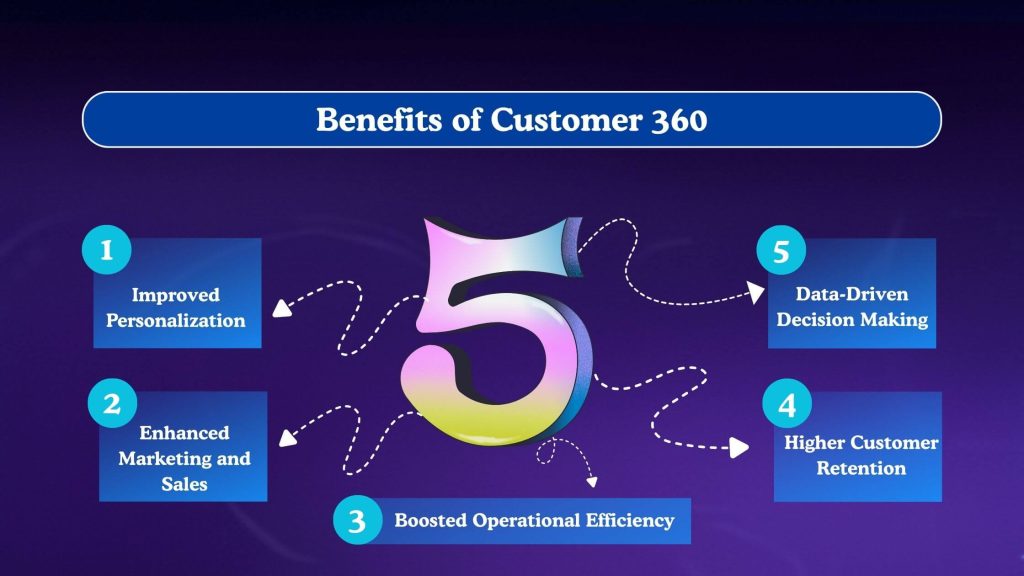
A unified customer view helps organizations move from assumptions to clarity. When data from multiple touchpoints is connected and reliable, teams can work with confidence, reduce friction, and deliver more consistent outcomes across the customer journey.
Improved Personalization and Customer Experience
With a complete 360 view of the customer, businesses can tailor interactions based on real behavior, preferences, and history. This leads to more relevant messaging, timely recommendations, and experiences that feel consistent across channels rather than repetitive or disconnected.
Enhanced Marketing and Sales
Marketing teams gain better segmentation and targeting, while sales teams enter conversations with full context. Campaigns become more precise, lead qualification improves, and conversion rates increase because outreach is aligned with actual customer intent and engagement patterns.
Boosted Operational Efficiency
When customer data is centralized and standardized, teams spend less time fixing errors, reconciling records, or switching between systems. This reduces manual effort, accelerates processes, and allows teams to focus on higher-value tasks rather than on data cleanup.
Higher Customer Retention
Understanding customer behavior and engagement trends makes it easier to identify churn risks early. Businesses can proactively address issues, personalize retention strategies, and build stronger, long-term relationships based on informed interactions.
Data-Driven Decision Making
Reliable customer data supports accurate reporting and meaningful insights. Leaders can make strategic decisions based on complete information rather than partial views, improving forecasting, planning, and overall business performance.
Unify Customer Data Across All Channels
Bring CRM, marketing, sales, and support data into one centralized view to improve engagement and customer experience.
Core Components of a Customer 360 Data Model
A strong customer data foundation is built on multiple components that work together to collect, unify, manage, and activate customer information.
Each component ensures that customer data remains accurate, secure, and usable across teams and systems.
Data Ingestion & Integration
This component handles the continuous flow of customer data from multiple internal and external sources. It ensures seamless customer 360 integration by connecting systems such as CRM, marketing platforms, transactional databases, and digital touchpoints into a unified data pipeline.
Identity Resolution & Management
Identity resolution links multiple records that belong to the same individual across systems. Managing identifiers over time helps maintain a consistent 360-degree view of the customer, even as data changes or new touchpoints are introduced.
Unified Customer Profiles
All resolved data is consolidated into a single customer profile. These profiles provide a comprehensive view of attributes, interactions, and historical activity, enabling teams to work from a single trusted source of customer truth.
Customer Data Categories
Customer data is structured into defined categories such as demographic, behavioral, transactional, and engagement data. This organization improves clarity, simplifies analysis, and supports better segmentation and personalization efforts.
Data Quality Management
Data quality processes ensure customer information remains accurate, complete, and consistent. Regular validation, deduplication, and monitoring help prevent errors that could impact analytics or customer-facing initiatives.
Data Governance & Privacy
This component defines policies for data access, usage, and protection. It ensures compliance with privacy regulations while maintaining transparency and control over sensitive customer information.
You Might Also Like:
Analytics & Activation Layer
The analytics layer transforms unified data into actionable insights through reporting and modeling. The activation layer then enables these insights to be applied across business systems to drive informed, real-time actions.
Customer 360 Use Cases Across Industries
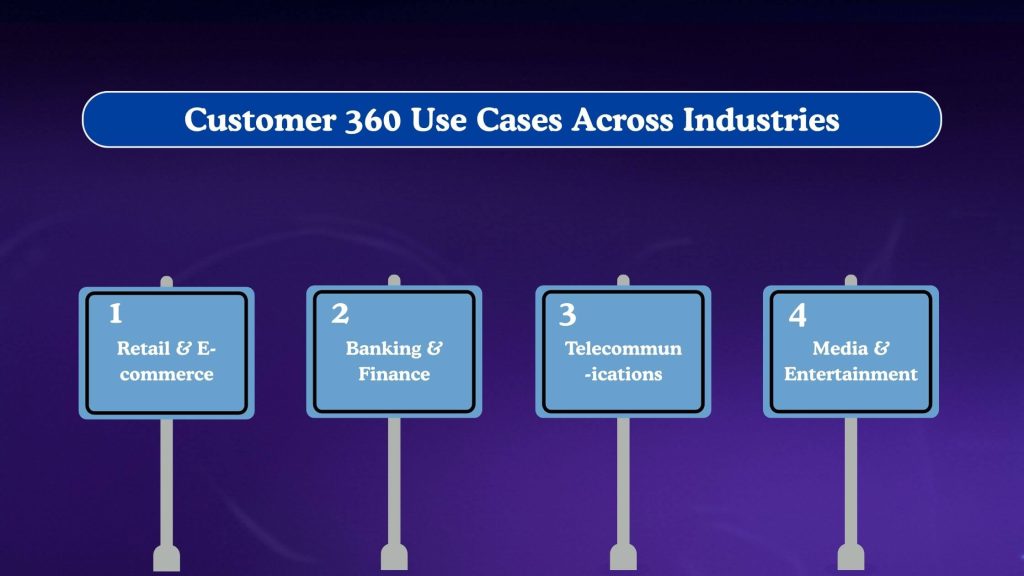
A unified customer view enables businesses across industries to better understand behavior, preferences, and engagement patterns. While the core model remains the same, its application varies based on industry-specific needs and customer touchpoints.
Retail & E-commerce
Retailers use a 360-degree view of customer interactions to connect online and offline behavior. This helps personalize product recommendations, optimize promotions, and deliver consistent experiences across websites, mobile apps, and physical stores.
Banking & Finance
In banking, a unified customer view supports personalized financial offerings, risk assessment, and compliance. By combining transaction data, service interactions, and digital engagement, institutions can improve customer trust and deliver more relevant financial solutions.
Telecommunications
Data analytics for telecom providers relies on a complete customer view to manage subscriptions, usage patterns, and service history. This enables proactive issue resolution, targeted upselling, and improved retention through more informed customer engagement.
Media & Entertainment
Media companies use customer insights to understand content preferences and engagement trends. A unified view helps drive personalized content recommendations, optimize subscriptions, and enhance audience loyalty across digital platforms.
Key Steps to Create a Unified Customer View
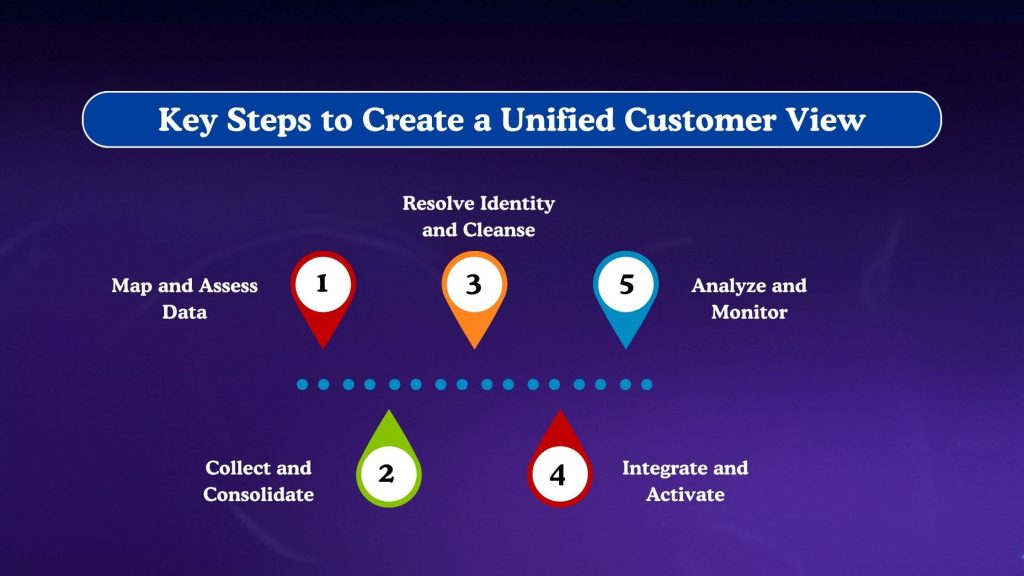
Creating a single, reliable customer view requires a structured and methodical approach. Each step ensures that customer data is accurate, connected, and ready to support analytics and activation across business functions.
Map and Assess Data
The first step is to identify all customer data sources and understand what information each system holds. This assessment helps uncover gaps, redundancies, and data quality issues that need to be addressed early.
Collect and Consolidate
Customer data is then gathered from the identified sources and brought into a centralized environment. Consolidation ensures that data from different channels is available in one place for further processing.
Resolve Identity and Cleanse
This step focuses on matching records that belong to the same customer and removing duplicates or inconsistencies. Cleansing ensures the data is accurate, complete, and suitable for building a reliable customer view.
Integrate and Activate
Once unified, customer data is integrated with analytics, marketing, sales, and service platforms. This allows teams to use insights in real time and deliver consistent experiences across touchpoints.
Analyze and Monitor
The final step involves analyzing customer data to generate insights and continuously monitoring data quality. Ongoing evaluation ensures the customer view remains accurate as data sources and business needs evolve.
How BigDataCentric Helps Design and Implement Customer 360 Data Models?
Designing a unified customer view requires more than data collection—it demands the right architecture, governance, and execution strategy. BigDataCentric helps organizations approach customer data unification with a clear, scalable, and business-focused mindset.
The team begins by assessing existing data ecosystems to identify gaps, silos, and integration challenges. By aligning data engineering, analytics, and business objectives, BigDataCentric designs a customer data foundation that supports long-term growth rather than short-term fixes.
This includes selecting the right data pipelines, storage layers, and identity resolution approaches based on real-world use cases.
With strong expertise across data science, business intelligence, integration and deployment, and analytics, BigDataCentric enables organizations to transform unified customer data into actionable insights.
From supporting personalization initiatives to improving reporting accuracy and operational visibility, the focus remains on turning customer data into measurable business value—without adding unnecessary complexity.
Need Help with Customer 360 Integration?
Let’s connect your customer data sources and build a reliable data model that supports analytics, reporting, and activation.
Conclusion
A well-structured Customer 360 Data Model enables organizations to move beyond fragmented customer data and build a single, reliable view that supports informed decision-making.
By unifying data across systems, resolving identities, and maintaining data quality, businesses gain clarity into customer behavior and engagement.
More importantly, this unified approach helps teams work with consistent information, improve personalization, and deliver seamless experiences across touchpoints.
When implemented thoughtfully, it becomes a long-term foundation for analytics, activation, and customer-centric growth rather than just a one-time data initiative.
By focusing on the right components, use cases, and implementation steps, organizations can turn customer data into a strategic asset that drives measurable business outcomes.
FAQs
-
What does 360 stand for?
360 stands for a complete, all-around view of the customer. It means capturing customer interactions, preferences, and behavior across every channel in one unified profile.
-
What is the difference between customer 360 and customer 720?
Customer 360 focuses on understanding customer data across channels and touchpoints. Customer 720 goes a step further by adding real-time context, predictive insights, and two-way engagement for deeper personalization.
-
What is the customer 360 strategy?
A customer 360 strategy is a plan to unify customer data from multiple systems into one trusted view. It helps improve personalization, customer experience, marketing, and decision-making.
-
What is a 360 view of the customer?
A 360 view of the customer is a single, consolidated profile showing customer history, interactions, purchases, and preferences. It helps businesses understand customers better and deliver consistent experiences.
-
Is customer 360 a CDP?
Customer 360 is not a CDP, but a CDP can be used to build it. Customer 360 is the concept of a unified customer view, while a CDP is a platform that helps collect and manage customer data.

Jayanti Katariya is the CEO of BigDataCentric, a leading provider of AI, machine learning, data science, and business intelligence solutions. With 18+ years of industry experience, he has been at the forefront of helping businesses unlock growth through data-driven insights. Passionate about developing creative technology solutions from a young age, he pursued an engineering degree to further this interest. Under his leadership, BigDataCentric delivers tailored AI and analytics solutions to optimize business processes. His expertise drives innovation in data science, enabling organizations to make smarter, data-backed decisions.


