




How is Data Science in Agriculture Shaping Smart Farming?

Blog Summary:
Data-driven technologies are transforming modern agriculture by enabling smarter planning and more efficient resource use. This blog explains how data science supports better crop management, yield prediction, and supply chain optimization. It also explores key data sources, techniques, applications, and future trends shaping agriculture. By adopting data-driven approaches, agricultural stakeholders can improve productivity, sustainability, and long-term decision-making.
Agriculture is no longer driven only by experience and seasonal intuition. With increasing pressure to improve productivity, manage limited resources, and respond to climate uncertainty, farming today is becoming more data-driven than ever.
This shift has opened the door to Data Science in Agriculture, where data-driven insights help farmers, agribusinesses, and policymakers make smarter, faster decisions across the entire agricultural value chain.
Modern farms generate vast amounts of data every day—from soil sensors and weather stations to satellite imagery and market trends. When this data is properly collected, processed, and analyzed, it becomes a powerful asset.
Patterns hidden within historical and real-time datasets can reveal how crops respond to environmental changes, how resources can be used more efficiently, and how risks such as pest outbreaks or yield loss can be minimized.
The growing connection between data science and agriculture is enabling more precise planning, better forecasting, and improved sustainability. Instead of reacting to problems after they occur, agricultural stakeholders can now anticipate challenges and take preventive action.
This data-driven approach supports not only higher yields but also long-term soil health, reduced input costs, and improved supply chain coordination.
As agricultural operations continue to scale and diversify, data science is becoming a strategic necessity rather than an optional upgrade. In the sections ahead, we’ll explore how this transformation works, the technologies behind it, and the real-world applications that are reshaping modern agriculture.
Understanding Data Science in Agriculture
Data science in agriculture focuses on analyzing agricultural data to support better decision-making across farming operations. It uses analytical methods to process data collected from sources such as soil sensors, weather systems, satellite imagery, and farm records, turning raw data into useful insights.
The connection between data science and agriculture helps farmers move beyond traditional guesswork. By identifying patterns in soil conditions, crop health, and weather, farmers can plan activities such as planting, irrigation, and fertilization with greater accuracy.
Overall, data-driven insights allow agricultural stakeholders to manage resources more efficiently, reduce risks, and improve productivity. This approach lays the groundwork for modern, technology-driven farming practices.
How Data Science is Transforming Modern Agriculture?
Modern agriculture is undergoing a major shift as data-driven insights replace traditional trial-and-error methods. By analyzing real-time and historical data, farmers can better understand how factors such as weather patterns, soil conditions, and crop behavior affect overall productivity. This allows agricultural decisions to be based on evidence rather than assumptions.
With the support of data science services in agriculture, farming operations are becoming more predictive and responsive. Advanced analytics help identify potential risks early, such as yield fluctuations or pest infestations, enabling timely intervention. Farmers can also optimize input use by applying water, fertilizers, and pesticides only where and when needed.
This transformation is also improving scalability and sustainability across the agricultural sector. Large datasets help agribusinesses streamline operations, reduce waste, and align production with market demand. As a result, modern agriculture is becoming more efficient, resilient, and environmentally responsible.
Key Benefits of Data Science in Agriculture
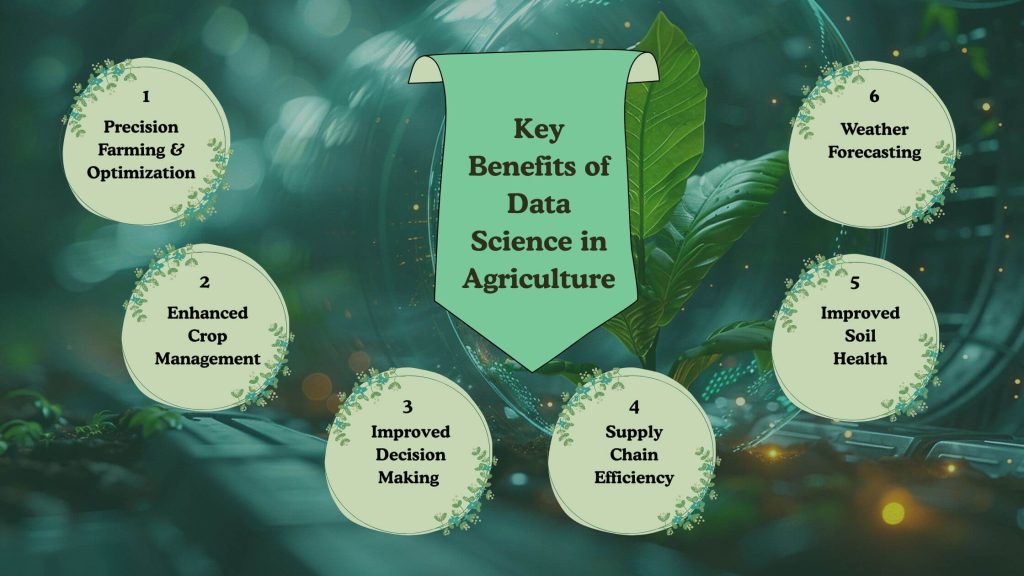
Data-driven technologies are helping agriculture become more efficient, predictable, and sustainable. By analyzing real-time and historical farm data, agricultural stakeholders can gain deeper visibility into field conditions, crop performance, and external factors such as weather and market demand. This enables smarter planning, reduces risk, and improves the use of available resources.
Here are the key benefits of using data science in agriculture –
Precision Farming & Resource Optimization
Data analytics enables farmers to identify field-level variations and apply inputs accordingly. Instead of uniform treatment, resources such as water, fertilizers, and pesticides are used only where needed. This reduces wastage, lowers input costs, and improves overall crop efficiency. Precision-driven decisions also support sustainable farming by minimizing environmental impact.
Enhanced Crop Management
Continuous monitoring of crop health using data helps identify stress factors early. Issues related to pests, diseases, or nutrient deficiencies can be addressed before they spread. This leads to healthier crops, higher-quality yields, and more consistent output across seasons.
Improved Decision Making & Planning
Accurate insights derived from agricultural data support better planning throughout the farming cycle. Farmers can make informed decisions related to planting schedules, irrigation timing, and harvesting periods. This reduces uncertainty and improves operational efficiency by relying on factual insights rather than assumptions.
Supply Chain Efficiency
Data-driven forecasting improves coordination across storage, logistics, and distribution networks. Better visibility into demand and supply patterns helps reduce post-harvest losses and ensures timely delivery to markets. This improves profitability for farmers and reliability for buyers.
Improved Soil Health
Soil data analysis helps track moisture levels, nutrient balance, and soil composition over time. With these insights, farmers can adopt balanced soil management practices that maintain fertility and prevent long-term degradation. Healthy soil directly contributes to sustainable productivity.
Weather Forecasting
Advanced data models analyze weather patterns to provide accurate forecasts and early warnings. Farmers can prepare for adverse conditions, such as drought or heavy rainfall, in advance. This enables timely interventions and minimizes crop losses from unpredictable climate conditions.
Struggling with Agricultural Decision-Making?
Our data science solutions help agricultural businesses make informed, reliable decisions across farming operations.
Core Data Sources Used in Agricultural Data Science
Agricultural data science relies on diverse data sources that capture real-time field conditions, machine performance, and external environmental factors. These data streams provide the foundation for analysis, modeling, and forecasting across farming operations. By combining multiple sources, stakeholders gain a holistic view of farm performance and risks.
Here are the core data sources commonly used in agricultural data science –
Sensors and IoT Devices
Field sensors collect real-time data on soil moisture, temperature, humidity, and nutrient levels. These continuous inputs help monitor field conditions accurately and support timely interventions.
IoT-enabled devices reduce manual monitoring efforts and improve data reliability. The collected data plays a critical role in optimizing irrigation, fertilization, and crop care strategies.
GPS and Machinery Telematics
GPS-enabled equipment generates data on field coverage, equipment usage, fuel consumption, and operational efficiency. This data helps track farming activities with precision and avoid overlaps or missed areas.
Machinery telematics also supports preventive maintenance by identifying performance issues early. As a result, farm operations become more efficient and cost-effective.
Cameras and Computer Vision
Cameras installed on drones, machinery, or fixed locations capture visual data related to crop growth and field conditions. Computer vision techniques analyze this imagery to detect plant stress, weed growth, or disease symptoms.
Early identification enables targeted action rather than blanket treatments. This improves yield quality while reducing unnecessary input usage.
Remote Sensing Data
Satellite and aerial imagery provide large-scale insights into crop health, vegetation indices, and land conditions. Remote sensing helps monitor fields that are difficult to inspect manually on a regular basis.
It supports yield estimation, drought detection, and crop classification across vast agricultural areas. These insights are especially valuable for large farms and agribusinesses.
Administrative, Market, and Historical Data
Historical yield records, weather data, pricing trends, and administrative records add valuable context to real-time field data. This information supports long-term planning, demand forecasting, and risk assessment.
When combined with field-level data, it enables more accurate predictions and strategic decision-making across the agricultural value chain.
Key Data Science Techniques Used in Agriculture
Modern agriculture uses advanced analytics to convert raw data into actionable insights. These techniques help process large datasets collected from farms, equipment, and external sources, enabling accurate predictions and smarter decision-making. By combining multiple methods, agricultural stakeholders can address complex challenges more effectively.
Here are the key data science techniques used in agriculture –
Internet of Things (IoT) & Sensors
IoT devices and sensors continuously collect data from fields, livestock, and equipment. This real-time data enables monitoring of environmental conditions, crop health, and resource usage without manual intervention.
Consistent data flow improves visibility across farming operations. It also enables timely responses to changing field conditions.
Remote Sensing & Drones
Drones and satellite-based sensing capture high-resolution images of farmland. These images are analyzed to detect crop stress, irrigation issues, and growth variations across fields. Remote sensing reduces the need for physical field inspections. It also supports large-scale monitoring with higher accuracy.
Big Data & Analytics
Agricultural systems generate massive volumes of data from multiple sources. Big data platforms help store, process, and analyze this information efficiently. Advanced analytics uncover trends, correlations, and anomalies that support strategic planning. This approach improves scalability and performance across agricultural operations.
Machine Learning (ML) & Predictive Analytics
Machine learning models analyze historical and real-time data to predict outcomes such as crop yields, disease outbreaks, and weather impact. Predictive analytics helps farmers take proactive measures rather than reacting to problems.
Over time, models improve accuracy as more data becomes available. This leads to continuous optimization of farming decisions.
Applications of Data Science in Agriculture

Data-driven technologies are being applied across various agricultural activities to improve productivity, reduce risks, and support sustainable practices.
By analyzing patterns from multiple data sources, farmers and agribusinesses can make informed decisions at every stage of the farming lifecycle. These applications help translate insights into real-world outcomes.
Here are some of the major applications of data science in agriculture –
Crop Yield Prediction and Optimization
Predictive models analyze historical yield data, soil conditions, and weather patterns to estimate crop output. These insights help farmers plan planting strategies and allocate resources effectively.
Accurate yield prediction also supports better financial planning and risk management. Over time, optimization techniques improve overall farm performance.
Smart Irrigation
Data collected from soil sensors and weather forecasts helps determine the exact water requirements of crops. Smart irrigation systems ensure water is applied only when necessary and in the right quantity. This reduces water waste and prevents crop stress from over- or under-irrigation. It also supports sustainable water management.
Nutrient Prediction
Soil and crop data are analyzed to understand nutrient deficiencies and requirements. This enables precise fertilizer application based on actual crop needs. Nutrient prediction reduces fertilizer overuse and improves soil health. As a result, crop quality and yield consistency improve.
Pest & Disease Management
Data models help identify early signs of pest infestations or disease outbreaks. By analyzing environmental conditions and crop behavior, farmers can take preventive measures before damage spreads.
This targeted approach reduces crop loss and minimizes chemical usage. It also supports safer and more sustainable farming practices.
Supply Chain Optimization
Agricultural data supports better coordination across storage, transportation, and distribution. Demand forecasting helps reduce post-harvest losses and improves inventory management.
Efficient supply chains ensure timely delivery to markets. This increases profitability and reduces operational inefficiencies.
Market & Price Prediction
Historical pricing data and market trends are analyzed to forecast future price movements. This helps farmers decide when and where to sell their produce.
Better price prediction reduces dependency on middlemen and improves revenue planning. It also supports more transparent agricultural markets.
Planning to Adopt Data-Driven Agriculture?
From data strategy to implementation, we help agricultural businesses unlock value through reliable analytics and insights.
Key Considerations Before Adopting Data Science in Agriculture
Before implementing data-driven solutions, agricultural stakeholders must evaluate several practical and strategic factors. Successful adoption depends not only on technology but also on readiness, infrastructure, and long-term value.
Addressing these considerations early helps avoid implementation challenges and ensures sustainable outcomes.Here are the key considerations before adopting data science in agriculture –
Data Availability and Quality
Reliable insights depend on accurate and consistent data. Incomplete, outdated, or inconsistent datasets can lead to misleading outcomes. Farmers and agribusinesses must ensure proper data collection processes and validation mechanisms. High-quality data improves the effectiveness of analytical models.
Cost and Return on Investment (ROI)
Implementing data-driven solutions requires investment in tools, infrastructure, and expertise. It is important to evaluate whether the expected benefits justify the costs. Clear ROI metrics help measure long-term value. Gradual adoption can help manage expenses effectively.
Interoperability
Agricultural systems often use multiple tools and platforms. Incompatibility between systems can limit data sharing and insights. Ensuring interoperability allows seamless integration of data from various sources. This improves scalability and long-term usability.
Infrastructure and Connectivity
Data science solutions depend on reliable connectivity and computing infrastructure. Limited internet access in rural areas can affect real-time data transmission. Adequate infrastructure ensures consistent data flow and system performance. This is critical for real-time monitoring and analytics.
Data Ownership and Privacy
Clear policies are needed to define who owns the data and how it can be used. Protecting sensitive farm and business data is essential to maintain trust. Strong security measures help prevent unauthorized access. Transparent data governance supports ethical and compliant usage.
Cost of Implementing Data Science Solutions in Agriculture
The cost of adopting data-driven solutions in agriculture varies with farm size, technology requirements, and implementation scope. Expenses typically include data collection tools, software platforms, infrastructure, and skilled expertise.
Understanding these cost components helps set realistic expectations and plan investments effectively.
Initial costs may involve installing sensors, IoT devices, or upgrading connectivity and storage systems. Ongoing expenses can include data processing, model maintenance, and system support. However, many solutions are scalable, allowing gradual adoption based on budget and priorities.
While the upfront investment may seem significant, long-term benefits often outweigh the costs. Improved efficiency, reduced input wastage, better yield forecasting, and optimized operations contribute to measurable savings over time.
Evaluating costs alongside expected returns ensures a balanced and sustainable implementation strategy.
Future Trends in Data Science in Agriculture
Future of data science and in agriculture continues to evolve as new technologies and digital ecosystems mature. Emerging trends are focused on increasing automation, improving real-time decision-making, and strengthening transparency across the agricultural value chain.
These advancements aim to make farming more resilient, efficient, and scalable.
Here are some key future trends shaping data-driven agriculture.
Hyper-Automation & Robotics
Automation powered by advanced analytics is enabling robotic systems to perform tasks such as planting, harvesting, and field monitoring. These systems reduce labor dependency and improve operational precision. Robotics combined with data insights supports consistent performance across large-scale farms. Over time, this trend will drive higher productivity with lower manual effort.
Generative AI & Virtual Assistants
Virtual assistants are being introduced to support farmers with real-time recommendations and insights. These systems analyze complex datasets and present information in a simple, actionable format. Generative tools help simulate scenarios and optimize planning decisions. This trend improves accessibility to data-driven insights for non-technical users.
Data Interoperability & Ecosystems
Future agricultural systems will focus on seamless data exchange across platforms and stakeholders. Interoperable ecosystems enable better collaboration between farmers, suppliers, and distributors. Unified data environments improve visibility and reduce fragmentation. This leads to more connected and efficient agricultural operations.
5G & Edge Computing
High-speed connectivity and edge computing enable faster data processing closer to the source. This reduces latency and supports real-time analytics in the field. Improved connectivity enhances the performance of sensors, drones, and automated equipment. These technologies are critical for time-sensitive agricultural decisions.
Blockchain for Traceability
Blockchain technology enhances transparency and trust across agricultural supply chains. It enables secure tracking of produce from farm to market. Immutable records help verify quality, origin, and compliance. This trend supports food safety, accountability, and consumer confidence.
BigDataCentric’s Expertise in Agricultural Data Science Solutions
BigDataCentric supports agricultural businesses in turning complex data into actionable insights that improve efficiency and sustainability. With strong experience in analytics, predictive modeling, and data-driven systems, the team helps organizations make informed decisions across farming, supply chain, and agribusiness operations.
Our expertise spans data engineering, advanced analytics, and intelligent system development tailored to agricultural use cases. By combining domain understanding with scalable data platforms, BigDataCentric enables accurate forecasting, operational optimization, and risk mitigation. Solutions are designed to integrate smoothly with existing systems while remaining flexible for future growth.
Through customized data science and analytics services, BigDataCentric helps agricultural stakeholders gain deeper visibility into operations and performance. This approach empowers businesses to improve productivity, manage resources efficiently, and adapt to changing market and environmental conditions.
Still Looking to Improve Agricultural Decisions?
Leverage data-driven solutions to optimize crop planning, resource usage, and operational efficiency across your farm or agribusiness.
Conclusion
Data-driven approaches are reshaping how agricultural challenges are addressed, from field-level operations to supply chain planning. By analyzing data from multiple sources, farmers and agribusinesses can improve productivity, reduce uncertainty, and make better use of limited resources. This shift supports more sustainable and resilient farming practices.
As adoption continues to grow, Data Science in Agriculture is becoming a practical tool rather than a futuristic concept. With the right data, technology, and strategy in place, agricultural stakeholders can achieve long-term efficiency, profitability, and environmental balance.
FAQs
-
Can data science help predict crop yield accurately?
Yes, data science analyzes historical yield data, soil conditions, and weather patterns to generate reliable yield forecasts. Accuracy improves over time as more data is collected and models are refined.
-
How secure is agricultural data in data science solutions?
Agricultural data is protected using encryption, access controls, and secure storage systems. Proper governance policies ensure data is accessed only by authorized users.
-
Is data science useful for small and medium-sized farms?
Yes, scalable data solutions allow smaller farms to adopt data-driven insights gradually. Even limited data can help improve planning, reduce costs, and increase productivity.
-
How do agricultural businesses measure ROI from data science?
ROI is measured by comparing improvements in yield, cost savings, and reduced resource waste against implementation costs. Long-term efficiency gains also contribute to value assessment.
-
Can data science help optimize harvest timing?
Yes, data models analyze crop maturity, weather forecasts, and field conditions to recommend optimal harvest windows. This helps maximize yield quality and minimize losses.

Jayanti Katariya is the CEO of BigDataCentric, a leading provider of AI, machine learning, data science, and business intelligence solutions. With 18+ years of industry experience, he has been at the forefront of helping businesses unlock growth through data-driven insights. Passionate about developing creative technology solutions from a young age, he pursued an engineering degree to further this interest. Under his leadership, BigDataCentric delivers tailored AI and analytics solutions to optimize business processes. His expertise drives innovation in data science, enabling organizations to make smarter, data-backed decisions.


