




Enterprise Digital Transformation – Strategy, Challenges & Roadmap

Blog Summary:
Enterprise Digital Transformation reshapes how large organizations operate, innovate, and compete in a fast-evolving digital economy. From strategy alignment and technology modernization to workforce enablement and performance measurement, every stage drives successful execution. With the right roadmap and best practices, enterprises achieve greater agility, smarter decision-making, and long-term scalability.
Enterprises today operate in an environment defined by speed, scale, and constantly shifting customer expectations. Traditional business models, static systems, and rigid processes are no longer enough to stay competitive. Organizations are now expected to make faster decisions, operate more intelligently, and be more connected with their customers than ever before.
This is where Enterprise Digital Transformation becomes a strategic necessity rather than a technology upgrade. It represents a shift in how businesses think, operate, and deliver value. From modernizing legacy infrastructure to adopting data-driven operations and enabling a flexible workforce, transformation touches every layer of the enterprise.
However, this journey is not about adopting isolated tools. It requires a well-defined enterprise transformation strategy, strong leadership alignment, and a clear focus on long-term business outcomes. Enterprises that approach transformation with clarity and purpose build resilience, scalability, and sustained growth in a digital-first economy.
What is Enterprise Digital Transformation?
Enterprise digital transformation is the systematic adoption of digital technologies, modern operating models, and data-driven processes across all levels of a large organization to improve performance, customer value, and business agility fundamentally. Unlike surface-level digitization, this transformation reshapes how enterprises think, work, and compete.
It extends beyond updating software or migrating systems to the cloud. It involves reimagining business workflows, redefining customer engagement, building intelligent automation into operations, and creating a culture that continuously adapts to change.
The focus is not only on efficiency but also on long-term competitiveness through enterprise digital solutions and services.
At its core, the digital transformation of business aligns technology with business strategy. Marketing, operations, finance, human resources, supply chain, and customer service are increasingly interconnected through data and automation.
This integration allows enterprises to break down silos, improve collaboration, and respond to market changes with speed and accuracy.
More importantly, enterprise digital transformation is not a one-time initiative. It is an evolving journey that grows alongside business goals, customer demands, and technological innovation.
Organizations that treat it as a continuous strategy—rather than a fixed project—are the ones that build real competitive advantage.
Why Does Enterprise Digital Transformation Matter Today?
Markets today move faster than ever, and customer expectations continue to rise across every digital touchpoint. Enterprises are under constant pressure to deliver seamless experiences, faster services, and personalized interactions.
This growing demand is prompting organizations to rethink traditional operating models and adopt connected-enterprise digital solutions that enhance responsiveness and visibility across the organization.
Operational challenges are another major reason transformation has become essential. Many enterprises still struggle with disconnected systems, manual workflows, and delayed reporting, all of which slow decision-making and limit scalability.
Modern enterprise digital services streamline operations, unify data, and automate core business processes, thereby reducing inefficiencies and enabling organizations to respond more quickly to change.
The shift toward hybrid work, data-driven planning, and continuous innovation has also made transformation unavoidable. Enterprises that treat digital initiatives as long-term business strategies rather than short-term projects are better positioned for sustainable growth.
In this environment, Enterprise Digital Transformation is no longer about adopting new tools—it is about building a future-ready organization that can adapt, scale, and compete with confidence.
Key Components of Enterprise Digital Transformation
A successful transformation initiative is built on multiple interconnected components that work together to modernize the enterprise ecosystem. These components ensure that digital change is not limited to technology alone but extends to strategy, operations, and people.
When aligned properly, they create a strong foundation for sustainable enterprise-wide growth.
Digital Strategy Alignment
Every successful transformation begins with a clearly defined enterprise transformation strategy that aligns digital goals with overall business objectives. This alignment ensures that technology investments directly support revenue growth, customer experience, and operational efficiency.
Without strategic direction, digital initiatives often remain fragmented and fail to deliver measurable business value.
Technology and Data Foundation
A strong digital backbone is essential for enabling enterprise-scale transformation. Cloud platforms, data pipelines, analytics systems, and integration layers form the core infrastructure that supports modern operations.
Enterprises that invest in reliable enterprise digital solutions gain better data visibility, improved security, and the flexibility needed to scale operations without disruption.
Process Modernization
Modern enterprises must move away from rigid, manual workflows and adopt automated, intelligent processes. Process modernization removes bottlenecks, improves turnaround time, and enhances service consistency across departments.
By digitizing core functions such as finance, operations, and customer support, organizations create faster, more transparent business environments.
People and Skill Transformation
Technology alone cannot drive meaningful change without a digitally capable workforce. Enterprises must upskill employees, encourage cross-functional collaboration, and build a culture that supports continuous learning.
A digitally aligned workforce accelerates adoption, improves innovation, and ensures enterprise digital services are used to their full potential across the organization.
Start Your Digital Transformation Journey
Share your enterprise transformation goals with us and let our experts help you build scalable, future-ready digital solutions with measurable business impact.
Benefits of Enterprise Digital Transformation
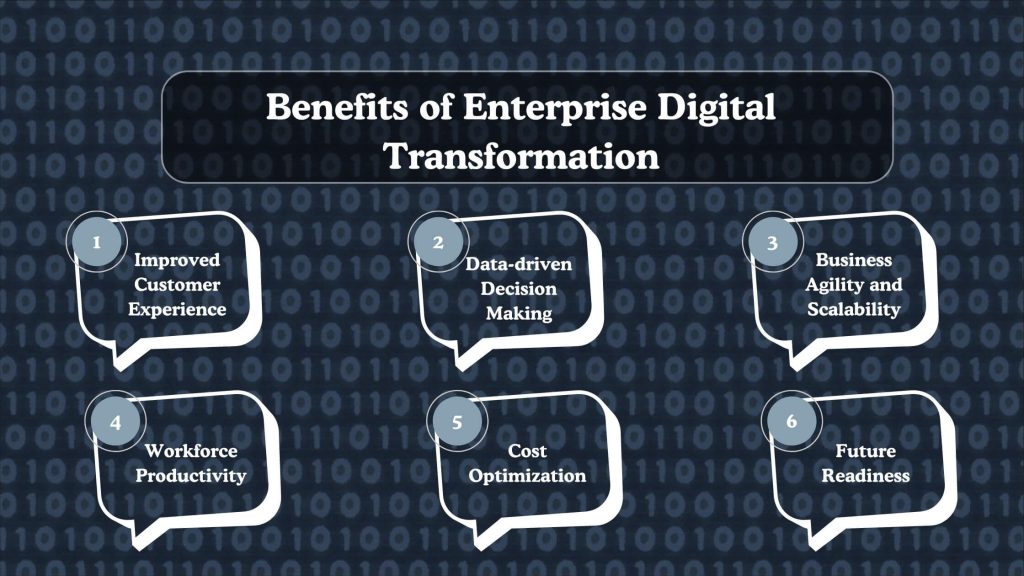
When executed with a clear enterprise transformation strategy, Enterprise Digital Transformation delivers measurable improvements across customer experience, operations, workforce efficiency, and long-term scalability.
These benefits extend beyond technology upgrades and directly affect how enterprises compete, grow, and sustain performance in a continually evolving market.
Improved Customer Experience
Digital platforms enable enterprises to deliver consistent, personalized, and responsive experiences across all customer touchpoints. From faster service delivery to unified communication channels and real-time support, enterprise digital solutions help businesses meet rising customer expectations while strengthening brand trust and engagement.
Data-driven Decision Making
With modern analytics and integrated data systems, enterprises gain real-time visibility into performance, customer behavior, and operational trends.
This enables leadership teams to move away from instinct-based decisions and rely on accurate insights to forecast, plan, and optimize across departments.
Business Agility and Scalability
Digitally modern enterprises can adapt quickly to market shifts, new customer demands, and sudden operational changes.
Cloud infrastructure, automation, and flexible architectures enable businesses to scale operations up or down without significant dependencies on infrastructure or lengthy deployment cycles.
Workforce Productivity
Automation of repetitive tasks, smarter collaboration tools, and centralized data access significantly improve employee efficiency. Teams spend less time on manual processing and more time on strategic, high-impact work, resulting in better output and reduced operational fatigue.
Cost Optimization
Digital transformation helps reduce long-term operational costs by improving resource utilization, minimizing redundant systems, and optimizing process efficiency.
Enterprises benefit from lower maintenance costs, improved asset performance, and greater control over operational expenditures.
Future Readiness
The most important benefit is long-term sustainability. Digitally mature enterprises are better prepared to adopt emerging technologies, respond to regulatory changes, and innovate continuously.
This ensures the digital transformation of business remains a growth enabler rather than a reactive necessity.
Enterprise Digital Transformation Readiness Indicators
Before launching large-scale transformation initiatives, enterprises must assess whether their organization is prepared across the technology, workforce, and customer-experience dimensions.
Readiness indicators help leadership evaluate existing capabilities, gaps, and priorities to ensure digital initiatives deliver real business outcomes rather than fragmented improvements.
Cloud Adoption Preparedness
Enterprises ready for transformation typically favor cloud-based infrastructure and platforms. This includes a willingness to migrate legacy systems, adopt scalable architectures, and ensure secure data access.
Cloud readiness enables flexibility, faster deployment cycles, and stronger disaster recovery capabilities, all of which are critical for enterprise-scale modernization.
Hybrid Workforce Demand
A growing need for remote accessibility, digital collaboration tools, and flexible work models signals readiness for transformation. Enterprises that actively support distributed teams through secure networks, cloud platforms, and integrated communication ecosystems demonstrate a forward-looking approach to workforce enablement and operational continuity.
Customer Journey Expectations
When customer expectations outpace existing service capabilities, it is a strong indicator of transformation.
Rising demands for faster responses, personalized interactions, self-service options, and real-time support show that enterprises must rethink engagement models using modern enterprise digital services.
Outdated Enterprise Tools
A heavy reliance on legacy software, manual workflows, and disconnected systems is one of the clearest signals that transformation is overdue.
Outdated tools restrict data visibility, slow down operations, and increase operational risk. Enterprises facing these challenges urgently require modernization to enhance agility, security, and scalability.
Enterprise Digital Transformation Roadmap
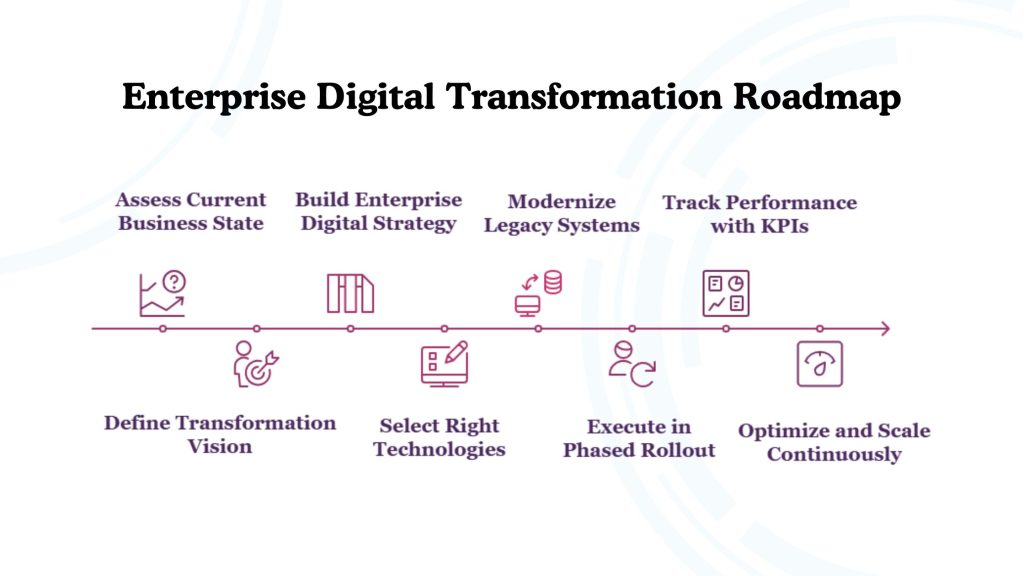
A structured roadmap helps enterprises move from strategy to execution with clarity and control. It ensures that transformation efforts remain aligned with business goals, minimize risk, and deliver measurable outcomes at every stage of the journey.
Assess Current Business State
The first step is to evaluate existing processes, technology systems, workforce capabilities, and data maturity. This assessment helps identify inefficiencies, digital gaps, and departmental readiness levels.
A clear understanding of the current state allows enterprises to define realistic transformation priorities.
Define Transformation Vision
Once the baseline is established, leadership must articulate a clear vision of the transformed enterprise. This includes defining business outcomes, customer experience goals, and operational improvements.
A well-defined vision ensures alignment across teams and prevents fragmented digital initiatives.
Build Enterprise Digital Strategy
An enterprise digital strategy connects business objectives with digital execution. It outlines technology priorities, investment areas, governance models, and performance benchmarks.
This strategy acts as the foundation for selecting platforms, designing processes, and driving long-term value creation.
Select Right Technologies
Business needs, not trends, should always drive technology selection. Enterprises must evaluate scalability, security, integration capabilities, and long-term support before choosing platforms for cloud computing, analytics, automation, and enterprise systems.
You Might Also Like
Modernize Legacy Systems
Outdated applications and infrastructure often create bottlenecks during transformation. Modernizing or refactoring legacy systems improves system performance, reduces operational risk, and enables seamless data flow across the organization without disrupting business continuity.
Execute in Phased Rollout
A phased execution approach minimizes risk and allows enterprises to test, refine, and scale digital initiatives gradually. Implementing transformation in manageable stages ensures business operations remain stable while teams adapt to new tools and processes.
Track Performance with KPIs
Measuring progress through defined key performance indicators helps enterprises monitor efficiency, adoption, and business impact. Performance tracking ensures that transformation efforts remain data-driven and aligned with strategic outcomes.
Optimize and Scale Continuously
Transformation does not end with implementation. Continuous optimization through feedback, analytics, and process refinement ensures sustained performance improvements.
Once stability is achieved, enterprises can scale digital initiatives across new markets, departments, and service lines.
Plan Your Digital Strategy
Connect with our transformation experts to design a secure, scalable, and results-driven digital strategy for your enterprise.
Best Practices for Successful Enterprise Digital Transformation
Even the most advanced technologies fail to deliver value if transformation efforts lack clarity, alignment, and disciplined execution.
Following proven best practices helps enterprises reduce risk, improve adoption, and ensure long-term success across digital initiatives.
Strong Leadership Sponsorship
Transformation requires active involvement from executive leadership. When senior leaders visibly sponsor digital initiatives, it builds trust, secures resources, and accelerates decision-making.
Leadership alignment also ensures that transformation remains tied to strategic business goals rather than becoming an isolated IT project.
Cross-functional Alignment
Successful transformation depends on interdepartmental collaboration. IT, operations, marketing, finance, and HR must collaborate on shared goals through unified workflows and data access.
Cross-functional alignment removes silos, streamlines execution, and ensures that enterprise digital services create value across the entire organization.
Continuous Innovation Mindset
Enterprises must treat transformation as an ongoing journey rather than a one-time initiative. A culture of continuous innovation encourages teams to experiment, learn, and refine processes as technologies and market conditions evolve. This mindset keeps organizations competitive and adaptable.
User Adoption Focus
Digital initiatives only succeed when employees and end users actively adopt them. Enterprises must prioritize intuitive design, proper training, and role-specific enablement.
Focusing on user adoption minimizes resistance, improves productivity, and maximizes return on transformation investments.
Performance-driven Execution
Clear KPIs, milestone tracking, and outcome-based evaluation ensure that transformation efforts remain measurable and accountable. Performance-driven execution enables enterprises to identify gaps early, continuously optimize strategies, and demonstrate tangible business impact.
Enterprise Digital Transformation Use Cases

Real-world use cases demonstrate how transformation initiatives translate into measurable business value across different industries.
From enhancing customer engagement to optimizing complex operations, enterprises are leveraging digital capabilities to drive efficiency, resilience, and innovation at scale.
Retail Industry Transformation
Retail enterprises are using digital solutions to unify online and offline customer experiences, improve inventory visibility, and enable personalized engagement. Advanced analytics helps retailers forecast demand more accurately, while automation streamlines order fulfillment and supply chain coordination.
These capabilities enable retail organizations to respond more quickly to evolving consumer behavior and seasonal demand patterns.
Healthcare Enterprise Systems
Healthcare enterprises are modernizing clinical, administrative, and patient engagement systems to improve service quality and operational efficiency.
The integration of healthcare chatbot solutions further enhances patient communication by enabling instant appointment scheduling, symptom checks, and round-the-clock support.
Digital platforms support remote consultations, unified patient records, and real-time data sharing across departments. This results in faster diagnosis, improved care coordination, and stronger compliance with regulatory requirements.
Logistics and Supply Chain
Logistics enterprises rely on transformation to enhance visibility, tracking, and coordination across complex supply networks. Real-time analytics, automated routing, and predictive maintenance reduce delivery delays and optimize asset utilization.
Digital platforms also enhance collaboration among suppliers, distributors, and partners, thereby creating more resilient supply chain ecosystems.
Financial Services Modernization
Financial institutions are modernizing core banking systems, payment platforms, and customer engagement channels to deliver faster, more secure services. Digital transformation supports real-time transactions, automated compliance reporting, and personalized financial offerings.
These capabilities help financial enterprises improve customer trust while maintaining operational transparency and agility.
Measuring Enterprise Digital Transformation Success
Measuring success is essential to ensure that transformation efforts deliver real business value rather than merely technological upgrades.
The right performance indicators help enterprises track efficiency, adoption, customer impact, and long-term financial outcomes with clarity and consistency.
Operational Performance Metrics
Operational metrics focus on efficiency, speed, and reliability across business processes. These include turnaround time, process automation rates, system uptime, error reduction, and cost per transaction.
Improvements in these areas indicate stronger process optimization and system maturity across departments.
Customer Experience KPIs
Customer-focused indicators reflect how transformation impacts engagement, satisfaction, and loyalty. Metrics such as customer satisfaction scores, response times, retention rates, and omnichannel consistency help enterprises assess whether digital initiatives are enhancing the customer journey.
Digital Adoption Indicators
Digital adoption measures the extent to which employees and users adopt new platforms and workflows. Login frequency, feature usage, training completion, and automation acceptance rates indicate whether systems are being used to their full potential or are encountering resistance.
ROI and Business Impact
Return-on-investment and business-impact metrics focus on revenue growth, cost savings, productivity improvements, and market expansion. These indicators help leadership justify digital investments and demonstrate how transformation initiatives contribute to long-term profitability and competitive positioning.
How BigDataCentric Supports Enterprise Digital Transformation?
BigDataCentric enables organizations to turn complex digital goals into clear, scalable, and outcome-driven execution. By combining deep expertise across data science, business intelligence, ML solutions, and enterprise platforms, the team helps businesses design and implement enterprise digital solutions that align directly with long-term growth objectives.
From strategy to execution, BigDataCentric supports every phase of the transformation journey. This includes digital readiness assessment, enterprise transformation strategy creation, technology consulting, system integration, and process automation.
Businesses benefit from data-driven architectures, optimized workflows, and secure, scalable infrastructure that supports continuous innovation without disrupting ongoing operations.
What differentiates BigDataCentric is its ability to bridge business challenges with practical digital execution. Whether it is modernizing analytics systems, strengthening intelligent automation, or enabling smarter decision-making through advanced data platforms, the focus remains on measurable business outcomes.
This approach ensures that Enterprise Digital Transformation is not treated as a one-time initiative, but as a continuously evolving capability that drives sustainable performance and competitive advantage.
Ready to modernize your enterprise operations?
Our experts help you design scalable digital solutions that streamline workflows, improve agility, and drive measurable business growth.
Conclusion
Enterprise transformation is no longer a future goal—it is a present-day business imperative shaped by changing customer expectations, evolving technologies, and increasing operational complexity. Organizations that delay modernization risk falling behind in agility, efficiency, and competitive positioning.
A successful Enterprise Digital Transformation journey requires more than the adoption of new tools. It requires a clear strategy, a modern technological foundation, process optimization, and continuous workforce enablement.
When these elements work together, enterprises gain the ability to scale smarter, innovate faster, and deliver consistent value across every business function.
With the right roadmap, performance tracking, and execution partners in place, transformation becomes a long-term growth engine rather than a disruptive challenge. Enterprises that treat digital change as a continuous capability—rather than a one-time initiative—are the ones that remain resilient, adaptive, and future-ready.
FAQs
-
What are the 5 pillars of digital transformation?
The five pillars are strategy, technology, data, processes, and people. Together, they ensure digital initiatives align with business goals, run on the right tech, and are successfully adopted by teams.
-
What are the 4 C's of digital transformation?
The 4 C’s are Customer, Culture, Change, and Cloud. They focus on improving customer experience, building a digital culture, managing change, and enabling scalability through cloud platforms.
-
What is the best example of digital transformation?
A strong example is Netflix, which transformed from a DVD rental service into a global digital streaming platform using cloud computing, data analytics, and automation.
-
What are the four types of digital transformation?
The four types are process transformation, business model transformation, domain transformation, and cultural transformation. Each focuses on a different aspect of modernization and growth.
-
What are digital enterprise systems?
Digital enterprise systems are integrated software platforms like ERP, CRM, cloud systems, and analytics tools that help organizations manage operations, data, and customer interactions digitally.

Jayanti Katariya is the CEO of BigDataCentric, a leading provider of AI, machine learning, data science, and business intelligence solutions. With 18+ years of industry experience, he has been at the forefront of helping businesses unlock growth through data-driven insights. Passionate about developing creative technology solutions from a young age, he pursued an engineering degree to further this interest. Under his leadership, BigDataCentric delivers tailored AI and analytics solutions to optimize business processes. His expertise drives innovation in data science, enabling organizations to make smarter, data-backed decisions.


