




Foundation Model vs LLM: Which Model Fits Your Use Case?
Blog Summary:
This blog explains the key differences between Foundation Models and LLMs, helping you understand how each model type works and where they best fit. Foundation models offer broad, multimodal versatility, while LLMs specialize in deep language understanding and generation. The comparison covers scope, training methods, applications, adaptability, and overlapping capabilities. Real-world examples of both model types highlight how they’re used in modern systems. With the right evaluation approach, organizations can choose a model that aligns with their goals and supports scalable, future-ready solutions.
The rapid growth of modern language and multimodal systems has sparked ongoing discussions about how these models differ, where they overlap, and which models businesses should rely on.
As organizations explore the possibilities of advanced model architectures, the comparison between Foundation Models and LLMs has become an essential starting point for understanding how today’s intelligent systems work at scale.
Foundation models are broad, versatile systems trained on massive, diverse datasets, enabling them to support a wide range of downstream tasks. Large Language Models (LLMs), on the other hand, are typically built on top of foundation model capabilities but specialize in language-specific activities such as summarization, conversation, classification, and generation.
With companies increasingly integrating intelligent solutions across workflows — from customer service and automation to analytics and content generation — choosing the right model type is crucial.
Understanding how each model learns, adapts, and performs allows teams to build systems that align with real-world goals, data readiness, and scalability needs.
Whenever possible, connecting these insights with practical guidance helps businesses evaluate which model aligns with their operational requirements and strategic roadmap.
Understanding Foundation Models
Foundation models are large-scale neural networks trained on massive, diverse datasets spanning text, images, audio, code, and other modalities. Their core strength lies in learning broad, generalized representations that can be applied to many different tasks rather than being limited to a single purpose.
These models rely on extensive pretraining, where they learn patterns, relationships, and context across billions of data points. This enables them to handle functions such as classification, translation, generation, reasoning, and retrieval without needing complete retraining for each new task.
One of their key advantages is adaptability. Foundation models can be fine-tuned or instruction-aligned for domain-specific needs, allowing teams to build specialized applications quickly. Their versatility and scalability make them a foundational layer for modern intelligent systems.
Understanding Large Language Models (LLMs)
Large Language Models (LLMs) are specialized models designed to understand, generate, and work with human language. They are typically built on transformer-based architectures and trained on massive text corpora, allowing them to recognize linguistic patterns, context, semantics, and structure across a wide range of topics and writing styles.
Unlike broader foundation models, LLMs are optimized primarily for tasks involving text. This includes conversation, summarization, translation, question-answering, sentiment analysis, content generation, and reasoning over written information.
Their focused training enables them to deliver highly fluent, contextually relevant outputs that align closely with human-like communication.
LLMs can be fine-tuned, instruction-tuned, or adapted with additional data to suit specific domains such as llm in finance, healthcare, legal, or education. Their precision in handling language-based tasks makes them among the most widely adopted components in modern intelligent systems, especially when understanding or generating text is central.
Foundation Model vs LLM: A Side-by-Side Snapshot
| Aspect | Foundation Models | Large Language Models (LLMs) |
|---|---|---|
| Scope & Functionality | Broad, supports multimodal and multi-domain tasks | Focused, designed specifically for language-based tasks |
| Training Data & Objectives | Trained on diverse datasets (text, images, audio, code) to learn general representations | Trained mainly on large text datasets to understand and generate human language |
| Application Areas | Vision, analytics, predictions, classification, multimodal generation, cross-domain tasks | Chatbots, summarization, translation, content creation, Q&A, language reasoning |
| Specialization | Acts as a base model that can be adapted for many different downstream tasks | Specialized in linguistic tasks and optimized for text generation and understanding |
| Adaptability and Fine-Tuning | Highly adaptable for multimodal and domain-specific applications | Fine-tuned for specific language use cases and improved domain knowledge |
How Do Foundation Models and LLMs Differ?
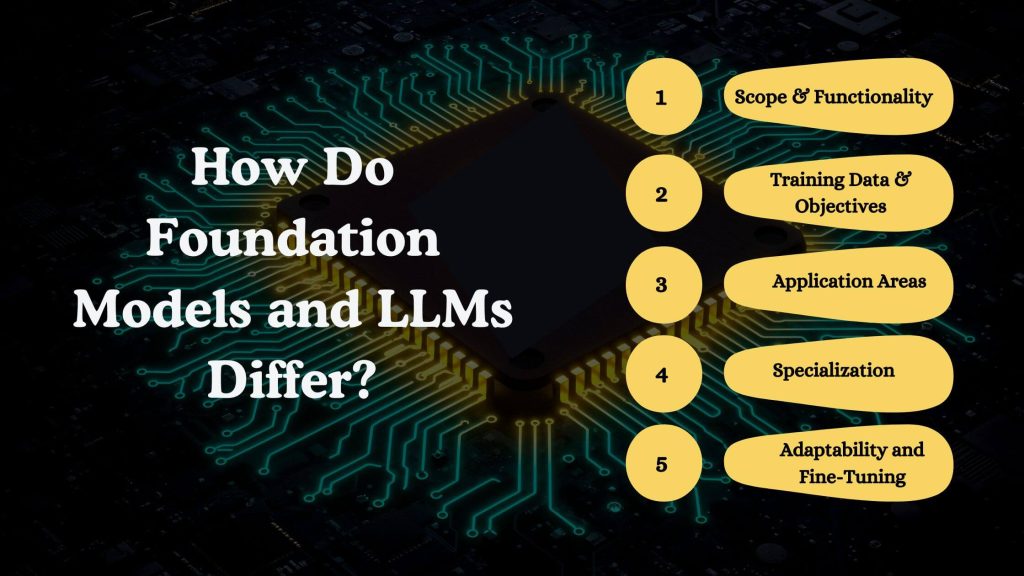
Here are some reasons about how they are different –
Scope & Functionality
Foundation models are built to be general-purpose backbones. Their scope spans multiple data modalities — text, images, audio, and sometimes code or structured signals — which lets them provide representations and capabilities useful across many downstream tasks.
Functionally, they act as the “base layer”: provide embeddings, multimodal understanding, and generative primitives that different applications can reuse.
LLMs, by contrast, have a narrower functional remit focused on language. Their scope is centered on understanding and generating human-readable text, performing tasks such as dialogue, summarization, translation, and complex language reasoning. Functionally, LLMs excel when the primary requirement is linguistic competence rather than cross-modal abilities.
Training Data and Objectives
The training data for foundation models is intentionally diverse. These models are exposed to huge, mixed-type datasets so they learn broad statistical structure across modalities.
Their training objectives emphasize learning transferable representations — often via self-supervised tasks — so that a single pretrained model can be adapted to many downstream goals.
LLMs are trained predominantly on text-based corpora. Their objectives typically focus on language modeling (predicting the next token), masked token prediction, or instruction-following fine-tuning, thereby sharpening their ability to produce coherent, context-aware language. Because their data and objectives are language-centric, they develop fine-grained knowledge of syntax, semantics, and discourse.
Application Areas
Foundation models power scenarios that demand multimodal reasoning or a unified representation across tasks.
For example, image captioning combined with retrieval, multimodal search, cross-domain transfer learning, or vision-and-language assistants. They’re useful wherever a single backbone can reduce the engineering overhead for many distinct applications.
LLMs dominate applications where the core task is text: customer support agents, document summarization, code generation from natural language, knowledge extraction, and conversational interfaces.
Their strong linguistic fluency and context handling make them the default choice when textual quality and coherence are priorities.
Specialization
Specialization for foundation models typically occurs through targeted fine-tuning or adapter layers that guide the broad model toward specific domains (e.g., medical imaging and radiology reports).
They can be specialized while still retaining multimodal capabilities, which is valuable when an LLM use case requires more than just language proficiency.
LLMs specialize by further narrowing their training or fine-tuning on domain-specific text. This yields models that are highly accurate at domain language, terminology, and conventions.
For instance, legal drafting, clinical note generation, or financial analysis — but still primarily operate in the text modality.
Adaptability and Fine-Tuning
Foundation models are designed for adaptability: techniques such as parameter-efficient fine-tuning, adapters, and prompt-based learning enable practitioners to reuse the same base across many tasks without full retraining.
This reduces cost and speeds deployment when multiple, related applications are needed from the same model.
LLMs are also highly adaptable, but adaptation typically focuses on improving language behavior. Instruction tuning, few-shot prompting, and domain-specific fine-tuning sharpen performance for particular language tasks.
The practical difference is that LLM adaptation optimizes for linguistic output quality, whereas foundation-model adaptation can shift capabilities across modalities and languages.
Select the Model That Drives Growth
From understanding differences to choosing the right model, we help you turn your foundation model vs LLM evaluation into a future-ready business solution.
Where Do Foundation Models and LLMs Overlap?
Although foundation models and LLMs serve different purposes, they share several underlying principles that connect their development and behavior.
Their similarities become clearer when we look at how they are built, trained, and scaled.
Underlying Model Architectures
Both foundation models and LLMs frequently share the same architectural foundations — most commonly transformer-based designs that use attention mechanisms to model relationships across tokens or input elements.
These architectures enable large-scale sequence modeling, contextual embeddings, and parallel training. In practice, the same core components—self-attention, feed-forward layers, and layer normalization—are reused and scaled based on the model’s purpose.
Because of this shared design, improvements such as enhanced attention mechanisms and normalization techniques often benefit both model families.
Training Techniques & Approaches
The dominant training paradigm for both model types is large-scale pretraining using self-supervised objectives (e.g., masked token prediction, next-token prediction, contrastive learning), followed by task-specific adaptation.
Techniques such as instruction tuning, supervised fine-tuning, few-shot learning, and parameter-efficient tuning (adapters, LoRA, prompt tuning) are applied across both families to specialize behavior.
As a result, innovations in training strategies — curriculum learning, data curation, or mixed-modality pretraining — are often transferable between foundation models and LLMs.
Computational Requirements & Scaling
Scaling laws affect both foundation models and LLMs: larger parameter counts, bigger datasets, and more compute typically improve capabilities, up to practical limits. Both require substantial infrastructure for pretraining (multi-GPU/TPU clusters, efficient sharding, memory optimization) and careful engineering for inference (quantization, batching, caching).
Because of these shared scaling challenges, many organizations reuse or adapt the same tooling and deployment patterns, whether they are running a multimodal foundation model or a language-focused LLM.
Contribution to Generative Technologies
Foundation models and LLMs both power modern generative systems. LLMs drive fluent text generation, code synthesis, and conversational agents, while foundation models extend generative capability across modalities (image synthesis, audio generation, multimodal storytelling).
In practice, generative applications often combine the two: an LLM might handle the narrative and instruction-following. At the same time, a multimodal foundation model produces images or audio from that narrative, creating richer, multi-sensory outputs.
Ability to Understand Context & Meaning
Both model types are designed to capture context and semantic relationships, though with different emphases. LLMs specialize in deep, nuanced language understanding — discourse, pragmatics, and subtle inference — because their pretraining is language-dense.
Foundation models capture broader contextual signals across modalities, which can improve cross-modal reasoning (for example, grounding a caption in image features). Together, these strengths enable systems that better understand meaning within and across data types.
Popular Foundation Model Examples
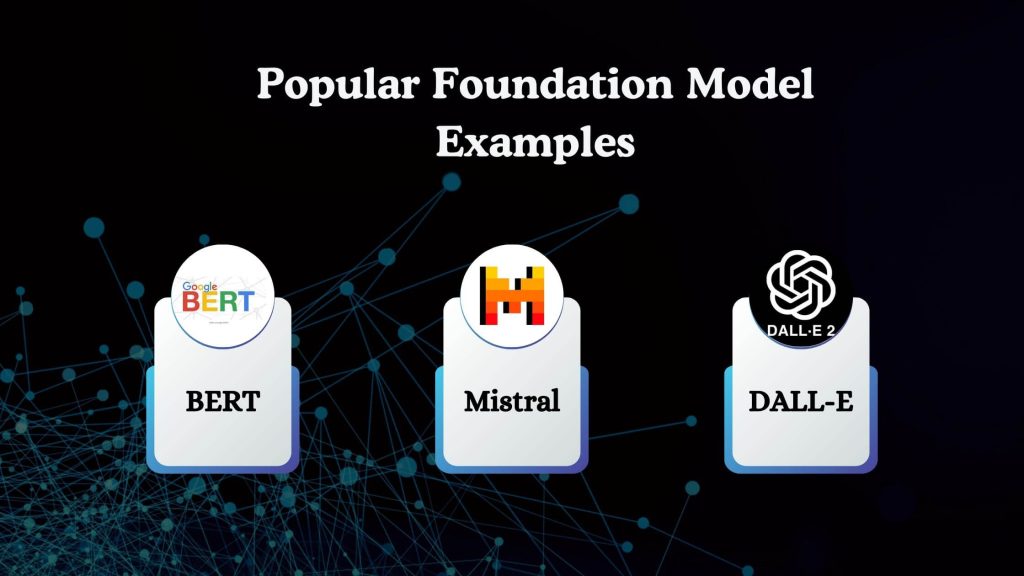
Foundation models come in various forms, each designed to handle different modalities and tasks. Below are some of the most widely recognized models that highlight the versatility of foundation model architecture.
BERT
BERT is a transformer-based foundation model trained using masked language modeling, enabling it to understand bidirectional context in text. It supports tasks such as classification, sentiment analysis, and question answering, and remains a core model in natural language understanding.
Mistral
Mistral models are lightweight yet powerful foundation models engineered for strong reasoning and language performance. Their efficient architecture makes them ideal for high-speed processing, scalability, and flexible adaptation across different domains.
DALL-E
DALL-E is a multimodal foundation model that generates highly detailed images from text prompts. It learns connections between language and visual elements, enabling creative image synthesis, artistic styles, and concept-driven visual outputs.
Popular LLM Examples
Large Language Models have become central to modern language understanding and generation. Below are some notable LLMs known for their performance, scale, and real-world applications –
OpenAI’s GPT-4
GPT-4 is a highly advanced LLM known for strong reasoning, context handling, and human-like text generation. It supports tasks such as conversation, summarization, coding, analysis, and more. Its training on diverse text sources helps it deliver coherent, accurate, and context-aware outputs.
Google’s PaLM
PaLM is Google’s large language model built for powerful reasoning and multilingual understanding. It excels at tasks such as question answering, translation, code generation, and complex problem-solving. Its architecture focuses on efficient scaling and improved training stability.
Llama
Llama is a family of open, efficient LLMs that deliver strong performance with reduced computational requirements. It supports tasks like content creation, classification, chat-based interactions, and fine-tuning for domain-specific use cases, making it widely adopted in research and enterprise environments.
Foundation Model vs LLM: Deciding What Works for You?
Choosing between a foundation model and an LLM depends on the type of data you work with, the complexity of your tasks, and the level of specialization or versatility your system needs.
When Should You Opt for a Foundation Model?
A foundation model is ideal when your tasks span multiple data types, such as text, images, audio, or structured data. It works well for multimodal workflows, cross-domain applications, and scenarios where you want a single model to support multiple downstream tasks. If scalability and broad adaptability matter, a foundation model is usually the better fit.
When Should You Pick a Large Language Model?
Choose an LLM when your primary focus is language-based tasks—conversation, summarization, content creation, classification, translation, or analysis. LLMs excel when you need strong linguistic accuracy and contextual understanding. If your workflow revolves around text, an LLM offers more precision and efficiency.
Which Model Will Deliver the Best Results for You?
Let our experts evaluate your data and use-cases to help you choose the most effective model for your business.
How BigDataCentric Supports Your Model Selection & Deployment?
BigDataCentric helps organizations choose between a foundation model and an LLM by assessing their data types, operational needs, and long-term scalability goals. The team evaluates whether a broad multimodal backbone or a language-focused model will deliver higher efficiency, accuracy, and overall value.
This ensures that your model strategy aligns directly with your use-case requirements and business objectives.
Beyond selection, BigDataCentric supports the entire deployment lifecycle—including data preparation, fine-tuning, integration, infrastructure setup, and performance optimization.
The team also provides continuous monitoring and refinement to maintain reliability as workloads grow. With this end-to-end support, businesses can confidently implement models that scale smoothly and deliver consistent results.
Conclusion
Understanding the difference between foundation models and LLMs helps organizations choose the right approach for their goals, whether they need broad multimodal capabilities or highly specialized language performance.
Each model type brings unique strengths, and the decision ultimately depends on the data involved and the level of adaptability or specialization required.
As the ecosystem continues to evolve, both foundation models and large language models will play central roles in powering advanced applications. With the right strategy, businesses can leverage these technologies to build scalable, efficient, and high-performing solutions that support long-term digital growth.
FAQs
-
Why are GPT-4 and LLaMA called foundational models?
They are called foundational models because they are trained on massive, diverse datasets and provide general-purpose capabilities that can support many downstream tasks. Their broad pretraining allows them to be adapted for multiple applications.
-
Do foundation models cost more than LLMs?
Yes, foundation models usually cost more because they require larger datasets, multimodal training, and more compute resources. LLMs are generally cheaper since they focus only on language data.
-
Can LLMs perform more than text tasks?
LLMs are primarily designed for text, but with additional tools or extensions, they can interact with images, code, or structured data. However, their core capability remains language understanding and generation.
-
Is Google Gemini a foundational model?
Yes, Google Gemini is considered a foundational model because it is trained across multiple modalities—text, images, audio, and more—and supports a wide range of downstream applications.
-
Does an LLM fall into the foundation model category?
Yes, an LLM can be a type of foundation model if it serves as a general-purpose, pretrained base for multiple language-related tasks. However, not all foundation models are LLMs, as some are multimodal.

Jayanti Katariya is the CEO of BigDataCentric, a leading provider of AI, machine learning, data science, and business intelligence solutions. With 18+ years of industry experience, he has been at the forefront of helping businesses unlock growth through data-driven insights. Passionate about developing creative technology solutions from a young age, he pursued an engineering degree to further this interest. Under his leadership, BigDataCentric delivers tailored AI and analytics solutions to optimize business processes. His expertise drives innovation in data science, enabling organizations to make smarter, data-backed decisions.


