




Mistral vs Llama: Which Open-Source AI Model is Better?
Blog Summary:
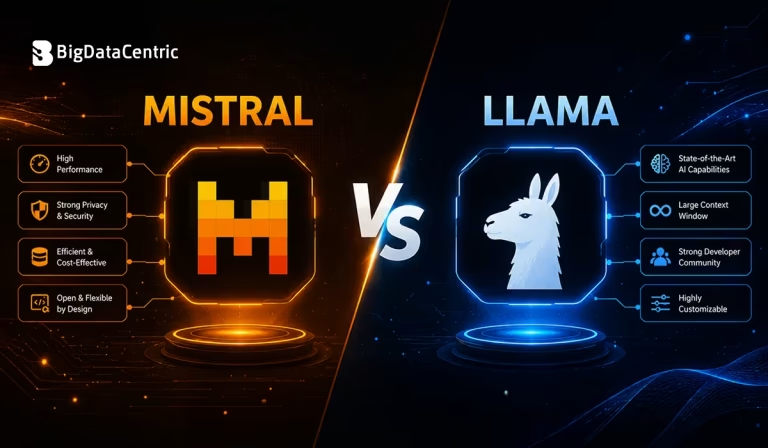
Mistral and Llama are leading open-source large language models, each designed to meet different AI and business needs. Mistral excels in efficient deployment, self-hosting, and cost optimization, while Llama offers advanced reasoning, customization, and a strong developer ecosystem. This comparison highlights their features, use cases, and key differences to help you choose the right model. By understanding their strengths, businesses can make informed decisions for successful AI adoption.
Open-source large language models (LLMs) have transformed the way organizations build AI-powered applications, from intelligent chatbots and coding assistants to document automation and enterprise search. Among the leading options available today, Mistral vs Llama has become one of the most common comparisons for businesses and developers evaluating which model best aligns with their technical requirements, deployment preferences, and long-term AI strategy.
Both model families deliver strong language understanding and generation capabilities, but they are designed with different priorities. Mistral focuses on efficient performance, lightweight deployment, and flexible self-hosting, making it well-suited for organizations that value speed, privacy, and cost optimization. Llama, developed by Meta, offers a broader ecosystem, advanced reasoning capabilities, and extensive community support, making it a popular choice for enterprise-grade AI applications and research.
The right choice depends on factors such as model performance, hardware availability, licensing requirements, scalability, and the type of AI solutions you plan to build. Whether you’re developing a secure enterprise assistant, automating document processing, or deploying AI at scale, understanding the strengths and trade-offs of each model is essential.
In this blog, we’ll compare Mistral and Llama across architecture, performance, customization, deployment, use cases, and licensing to help you determine which open-source AI model is the better fit for your business needs.
A Small Introduction to Mistral
Mistral is a family of open-weight large language models (LLMs) developed by Mistral AI, a European company focused on building efficient, high-performance AI models for enterprise and developer use. Known for delivering strong reasoning and language capabilities with lower computational requirements, Mistral has quickly become a popular choice for organizations seeking open, flexible alternatives to proprietary AI models.
One of Mistral’s biggest strengths is its deployment flexibility. Businesses can self-host supported models on their own infrastructure or deploy them across cloud environments, giving them greater control over data security, compliance, and operational costs. This makes Mistral particularly suitable for industries where privacy, regulatory requirements, and infrastructure ownership are top priorities.
The Mistral model family supports a wide range of AI applications, including intelligent chatbots, document processing, coding assistance, workflow automation, and multimodal tasks involving both text and images. Its combination of performance, scalability, and cost efficiency enables organizations to build enterprise-grade AI solutions without requiring extensive computing resources.
Advantages of Using Mistral
Mistral has become a preferred choice for many organizations because it combines strong language capabilities with efficient deployment and flexible licensing.
Its open-weight approach, resource-efficient architecture, and enterprise-focused design make it suitable for businesses looking to build scalable AI solutions while maintaining greater control over infrastructure and costs.
Below are some of the key advantages that make Mistral stand out.
Open-Weight Flexibility & Self-Hosting
One of Mistral’s biggest advantages is its open-weight availability, allowing organizations to deploy supported models on their own infrastructure instead of relying solely on third-party APIs.
Self-hosting provides greater control over sensitive business data, enables customization for specific use cases, and reduces dependence on external service providers. This flexibility is particularly beneficial for enterprises with strict security, compliance, or deployment requirements.
EU Data Sovereignty
As a European AI company, Mistral places a strong emphasis on data sovereignty and regulatory compliance. Organizations operating under regulations such as GDPR can deploy models within their preferred cloud or on-premises environments, helping ensure that sensitive information remains under their control.
This makes Mistral an attractive option for industries such as healthcare, finance, and government, where data privacy is a critical consideration.
Cost Efficiency
Mistral is designed to deliver high-quality AI performance while requiring fewer computational resources than many larger language models. Lower hardware requirements translate into reduced infrastructure costs, making it easier for startups and enterprises to deploy AI applications at scale. Businesses can achieve reliable performance without making significant investments in expensive computing resources.
Agentic Workflows & Tool Integration
Mistral supports modern AI workflows that extend beyond text generation. It can integrate with external tools, APIs, databases, and business applications to perform multi-step tasks, automate processes, and retrieve real-time information. These capabilities make it well suited for building AI agents that can assist with research, workflow automation, software development, customer support, and other enterprise operations.
Top Applications of Mistral
Mistral’s efficient architecture, flexible deployment options, and multimodal capabilities make it suitable for a wide range of enterprise AI applications. From automating repetitive tasks to improving decision-making, businesses can leverage Mistral to build secure, scalable, and high-performing AI solutions across different industries.
Document Processing & Data Extraction
Organizations use Mistral to automate the extraction of information from invoices, contracts, reports, forms, and other business documents.
By accurately identifying and structuring key data, it reduces manual effort, speeds up document processing, and improves operational efficiency. These capabilities are especially valuable for finance, legal, healthcare, and insurance workflows.
Autonomous Software Engineering & DevOps
Mistral can assist development teams by generating code, explaining complex logic, debugging applications, creating documentation, and automating routine development tasks. When integrated into DevOps pipelines, it can also support log analysis, incident summaries, and workflow automation, helping teams improve productivity and reduce development time.
Enterprise Chatbots & Assistants
Many businesses deploy Mistral to build AI-powered virtual assistants that provide instant responses to customer and employee queries. These assistants can retrieve information from internal knowledge bases, automate support requests, and deliver personalized interactions, making them useful for customer service, HR, IT support, and internal collaboration.
Secure, Self-Hosted AI
For organizations handling confidential information, Mistral’s self-hosting capabilities offer greater control over data privacy and security. Enterprises can run AI models within their own infrastructure or private cloud environments, ensuring sensitive business information remains protected while meeting regulatory and compliance requirements.
Multimodal & Image Comprehension
Beyond text processing, Mistral also supports multimodal AI applications by understanding both text and visual inputs. This enables businesses to analyze images, interpret scanned documents, extract insights from visual content, and build AI solutions that integrate multiple data formats to enable more accurate, context-aware decision-making.
Power Your Business with Custom AI Solutions
Develop AI-powered applications tailored to your industry with expert guidance on model selection, fine-tuning, integration, and deployment.
A Small Introduction to Llama
Llama is a family of open-source large language models developed by Meta to support research, commercial applications, and enterprise AI development.
Designed to deliver strong reasoning, coding, and language understanding capabilities, Llama has become one of the most widely adopted open-source model families, backed by an extensive developer community and a rapidly growing ecosystem of tools and integrations.
The Llama model family offers multiple model sizes to meet different performance and deployment requirements, enabling organizations to build everything from lightweight AI assistants to advanced enterprise applications.
Its compatibility with popular AI frameworks, cloud platforms, and inference tools makes deployment more accessible for developers while supporting customization through fine-tuning and domain-specific training.
With support for multilingual tasks, code generation, document analysis, and multimodal capabilities in newer versions, Llama is well suited for a wide range of business use cases.
Its balance of performance, scalability, and community support makes it a reliable choice for organizations looking to develop production-ready AI solutions across cloud, on-premises, and hybrid environments.
You Might Also Like:
Open Source vs Closed Source Security: A Complete Comparison
Key Advantages of Llama
Llama has gained widespread adoption because it combines strong performance with the flexibility of an open-source ecosystem.
Its extensive community support, customizable architecture, and ability to scale across different deployment environments make it a practical choice for startups, enterprises, and research teams building AI-powered applications.
Open-Source Freedom & Customization
Llama provides developers with the flexibility to customize models for domain-specific tasks through fine-tuning and additional training. Its compatibility with popular machine learning frameworks and deployment tools allows organizations to adapt the model to unique business requirements while maintaining greater control over AI development.
State-of-the-Art Performance
Llama delivers strong performance across a variety of natural language processing tasks, including reasoning, content generation, summarization, coding, and question answering. Continuous improvements across newer model versions have enhanced accuracy and instruction-following capabilities, making it suitable for both enterprise and research applications.
Multimodal and Extended Context Support
Recent Llama models support multimodal inputs, enabling them to process text alongside images for more comprehensive AI interactions. They also offer extended context windows, allowing the models to understand and retain larger amounts of information within a single prompt. This is particularly useful for analyzing lengthy documents, maintaining multi-turn conversations, and handling complex business workflows.
Cost-Efficient Scalability
Llama can be deployed across cloud platforms, private infrastructure, or hybrid environments, giving organizations the flexibility to scale AI workloads based on their operational needs.
With multiple model sizes available, businesses can select the right balance between performance, resource consumption, and deployment cost without overprovisioning their infrastructure.
Top Applications of Llama
Llama’s versatility and strong ecosystem make it suitable for a broad range of AI-driven business applications.
Its ability to process complex language tasks, support multimodal inputs, and integrate with enterprise systems enables organizations to develop scalable solutions for automation, customer engagement, and knowledge management.
Enterprise Document Parsing & Analysis
Organizations use Llama to analyze contracts, invoices, reports, policies, and other business documents by extracting key information and generating concise summaries. It can also classify documents, identify important entities, and support intelligent search, helping teams reduce manual processing and improve decision-making.
On-Device AI Assistants
Llama can power AI assistants that run on local devices, allowing users to access intelligent features without relying entirely on cloud connectivity. This is especially valuable for applications where low latency, offline functionality, and enhanced data privacy are essential, such as enterprise productivity tools and mobile applications.
Multimodal Analysis
With multimodal capabilities available in newer Llama models, businesses can analyze both text and images within a single workflow. This supports use cases such as visual document interpretation, image-based question answering, product image analysis, and content moderation, enabling richer AI-powered experiences.
Advanced Coding Assistants
Development teams leverage Llama to generate code, explain programming concepts, review code quality, and assist with debugging. By integrating with development environments and repositories, it helps accelerate software development while improving productivity across coding and testing workflows.
Secure Customer Service & RAG Chatbots
Llama is widely used to build Retrieval-Augmented Generation (RAG) chatbots that retrieve accurate information from internal knowledge bases before generating responses.
This approach enables organizations to create secure customer support systems, internal help desks, and enterprise knowledge assistants that deliver more reliable, context-aware answers while protecting proprietary data.
Mistral vs Llama: Side-by-Side Comparison
Both Mistral and Llama are among the leading open-source large language model (LLM) families, but they are built with different priorities. Mistral emphasizes lightweight performance, efficient deployment, and self-hosting, whereas Llama focuses on advanced reasoning, scalability, and a mature developer ecosystem.
Understanding how they differ across key aspects can help organizations select the right model for their AI initiatives.
Model Design and Architecture
Mistral:
Mistral is designed with efficiency at its core, using optimized transformer architectures that deliver high performance while consuming fewer computational resources. Its models are well suited for organizations looking to deploy AI on limited hardware or private infrastructure without sacrificing accuracy. This efficient design also enables faster inference, making Mistral a strong option for real-time AI applications and enterprise workloads.
Llama:
Llama follows a scalable architecture with multiple model sizes that cater to a wide range of AI applications, from lightweight assistants to advanced enterprise solutions. Newer Llama models introduce improved reasoning, larger context windows, and multimodal capabilities, allowing developers to handle increasingly complex tasks. Its architecture is optimized for flexibility, making it easier to integrate into diverse development environments.
Model Performance and Accuracy
Mistral:
Mistral delivers strong performance across tasks such as text generation, summarization, coding, and document understanding while maintaining lower computational overhead. Its optimized architecture allows it to achieve competitive benchmark results, making it a reliable choice for businesses that require fast and efficient AI inference without investing heavily in high-end hardware.
Llama:
Llama is recognized for its excellent reasoning, instruction following, and coding capabilities. Recent model versions have significantly improved performance on complex language tasks, multilingual understanding, and enterprise AI workloads. These advancements make Llama particularly effective for applications requiring deeper contextual understanding and higher response accuracy.
Speed, Efficiency, and Resource Consumption
Mistral:
One of Mistral’s biggest advantages is its resource efficiency. It requires less memory and computing power than many comparable models, resulting in faster inference speeds and lower infrastructure costs. This makes it ideal for startups, edge deployments, and businesses aiming to maximize performance while minimizing operational expenses.
Llama:
Llama also offers efficient performance, but larger variants generally require more GPU memory and computational resources. While this increases infrastructure requirements, it enables the model to tackle more complex reasoning and large-scale enterprise applications. Organizations with robust AI infrastructure can benefit from its additional capabilities.
Ecosystem, Community, and Developer Support
Mistral:
Although relatively new, Mistral has rapidly gained traction among developers and enterprises. Its growing ecosystem includes integrations with major cloud providers, AI frameworks, and deployment platforms. Continuous model updates and increasing community contributions are making it an increasingly attractive option for production AI systems.
Llama:
Llama benefits from one of the largest open-source AI communities available today. Developers have access to extensive documentation, fine-tuned model variants, open-source tools, and active community support. This mature ecosystem simplifies development, experimentation, and enterprise deployment while accelerating innovation.
Fine-tuning and Customization Capabilities
Mistral:
Mistral supports efficient fine-tuning for domain-specific applications, allowing organizations to adapt models for specialized tasks such as document intelligence, healthcare, finance, and customer support. Its open-weight availability also provides greater flexibility when deploying customized AI solutions within private environments.
Llama:
Llama offers extensive fine-tuning capabilities supported by a mature ecosystem of training frameworks and optimization techniques. Developers can efficiently customize the model using parameter-efficient methods, making it suitable for enterprise applications that require industry-specific knowledge and highly personalized AI experiences.
Licensing, Accessibility, and Commercial Usage
Mistral:
Mistral offers several open-weight models with flexible deployment options, enabling organizations to self-host AI applications while maintaining greater control over infrastructure and sensitive data. Its licensing approach makes it a practical choice for enterprises prioritizing privacy, compliance, and operational flexibility.
Llama:
Llama is available for commercial use under Meta’s licensing terms, with access varying across different model versions. Its broad availability and extensive adoption make it suitable for many enterprise AI projects, but organizations should review the applicable license before deployment to ensure it aligns with their commercial and compliance requirements.
When Should You Choose Mistral?
Mistral is an excellent choice for organizations that prioritize efficient AI deployment, lower infrastructure costs, and greater control over their data.
Its lightweight architecture and open-source availability make it particularly suitable for businesses looking to build scalable AI applications without relying heavily on proprietary cloud services. Below are some scenarios where Mistral is the better fit.
For Cost-Sensitive Tasks & Multimodal Needs
If your organization wants to deploy AI while keeping infrastructure and operational costs under control, Mistral offers an efficient solution. Its optimized models deliver strong performance with lower hardware requirements, making them ideal for startups and enterprises managing high-volume AI workloads. Newer multimodal models also enable applications that combine text and image understanding, such as document analysis, visual content interpretation, and intelligent automation.
For Coding & Development
Mistral is well suited for software development teams that need AI assistance for code generation, debugging, documentation, and workflow automation. Its fast inference speeds help developers receive quick responses, improving productivity throughout the software development lifecycle. It also integrates well with development tools and enterprise workflows.
For Edge Computing
Organizations deploying AI on local servers, edge devices, or private cloud environments can benefit from Mistral’s resource-efficient design. Its lower computational requirements allow businesses to run AI applications closer to where data is generated, reducing latency while maintaining consistent performance in environments with limited computing resources.
For Strict Data Privacy
Businesses operating in highly regulated industries such as healthcare, finance, legal services, and government often require complete control over sensitive information. Mistral’s self-hosting capabilities allow organizations to keep AI workloads within their own infrastructure, helping them meet security, compliance, and data privacy requirements without exposing confidential data to external AI platforms.
When Should You Choose Llama?
Llama is a strong choice for organizations that require advanced reasoning, extensive customization, and a well-established open-source ecosystem.
With multiple model sizes, robust developer support, and compatibility with popular AI frameworks, it is well suited for businesses building scalable, enterprise-grade AI applications.
Offline Capabilities
Llama can be deployed on local infrastructure, private servers, or edge devices, allowing organizations to run AI applications without relying entirely on cloud-based services. This makes it ideal for environments with limited internet connectivity or strict security requirements, where keeping data within the organization’s infrastructure is a priority.
Custom Fine-Tuning
If your AI application requires domain-specific knowledge or specialized responses, Llama offers extensive fine-tuning capabilities. Developers can customize the model using enterprise datasets to improve performance for use cases such as customer support, legal document analysis, healthcare assistance, financial services, and internal knowledge management.
Cost Efficiency
Llama provides multiple model variants, allowing businesses to choose the right balance between performance and infrastructure costs. Smaller models are suitable for lightweight applications, while larger models can handle more complex enterprise workloads. This flexibility enables organizations to optimize deployment costs based on their specific requirements without compromising scalability.
Ready to Build with the Right AI Model?
Whether you’re considering Mistral, Llama, or another open-source LLM, our AI specialists can help you select, customize, and deploy the ideal solution for your business goals.
Final Thoughts
Choosing between Mistral vs Llama ultimately depends on your business goals, infrastructure, and AI use case. Mistral is well suited for organizations that prioritize efficient deployment, lower infrastructure costs, self-hosting, and data privacy, while Llama excels in advanced reasoning, extensive customization, and enterprise-scale AI applications backed by a mature open-source ecosystem.
Evaluating factors such as performance, scalability, licensing, and deployment requirements will help you select the model that best supports your long-term AI strategy.
At BigDataCentric, we help businesses turn these AI capabilities into practical, scalable solutions. Whether you’re looking to implement AI-powered chatbots, intelligent document processing, coding assistants, or custom enterprise AI applications, our experts can help you choose the right LLM, fine-tune it for your specific needs, and seamlessly integrate it into your existing workflows to accelerate innovation and drive measurable business outcomes.
FAQs
Is llama better than Mistral?
There isn't a single winner—it depends on your use case. Llama is often preferred for advanced reasoning, customization, and enterprise-scale applications, while Mistral stands out for efficient performance, lower resource requirements, and flexible self-hosting.
Is llama AI better than ChatGPT?
Llama and ChatGPT serve different purposes. ChatGPT provides a polished, managed AI experience with powerful reasoning and broad capabilities, whereas Llama is an open-source model family that gives developers greater control for customization, fine-tuning, and self-hosted deployments.
Is Mistral AI better than Claude?
Neither model is universally better. Mistral is a strong choice for organizations seeking open-weight models, deployment flexibility, and cost-efficient AI, while Claude is known for its strong reasoning, long-context understanding, and high-quality conversational responses.
Which is the best mistral model?
The best Mistral model depends on your requirements. For enterprise-grade performance and multimodal capabilities, Mistral Medium 3 is a strong option, while Mistral Small is well suited for cost-effective deployments and lightweight AI applications.


Jayanti Katariya is the CEO of BigDataCentric, a leading provider of AI, machine learning, data science, and business intelligence solutions. With 18+ years of industry experience, he has been at the forefront of helping businesses unlock growth through data-driven insights. Passionate about developing creative technology solutions from a young age, he pursued an engineering degree to further this interest. Under his leadership, BigDataCentric delivers tailored AI and analytics solutions to optimize business processes. His expertise drives innovation in data science, enabling organizations to make smarter, data-backed decisions.


