




ServiceNow Alternative: Top Tools & Key Comparisons
Blog Summary:
Finding the right ServiceNow Alternative comes down to flexibility, usability, and cost alignment. Many organizations prefer tools that are easier to implement and better suited to specific service needs. This blog covered leading alternatives across IT service management, customer support, and internal operations. It also highlighted key features to evaluate when selecting the right platform.
Organizations today rely heavily on digital service management platforms to streamline internal operations, manage customer requests, and maintain service continuity across teams.
For many years, ServiceNow has been a widely adopted solution in this space, particularly among large enterprises with complex workflows. However, as business needs evolve, not every organization finds it a good long-term fit.
Companies are increasingly reassessing their service management tools due to factors such as high licensing costs, complex implementation, steep learning curves, or limited flexibility for growing teams. This has led to increased interest in exploring a ServiceNow Alternative that delivers similar capabilities with better usability, faster deployment, or more cost-effective pricing models.
From customer support platforms and IT service desks to employee experience tools and knowledge management systems, the market now offers a wide range of solutions designed to meet diverse operational needs. Some focus on simplicity and quick setup, while others emphasize automation, integrations, or scalability for distributed teams.
In this blog, we’ll explore why businesses consider moving away from ServiceNow, what features truly matter when evaluating other platforms, and a curated list of tools that stand out as strong options in today’s service management landscape.
What is ServiceNow?
ServiceNow is a cloud-based platform used by organizations to manage digital workflows across IT services, employee operations, and customer support. It was originally developed as an IT service management solution to help teams handle incidents, service requests, change management, and asset tracking within a centralized system. By bringing these processes together, organizations can maintain service consistency and improve operational efficiency.
Over time, ServiceNow expanded beyond ITSM into a broader enterprise service management platform. It now supports multiple business functions, including HR service delivery, customer service management, IT operations, and low-code application development.
This allows large enterprises to standardize workflows across departments and gain better visibility into service performance and operational data.
Despite its extensive capabilities, ServiceNow is often seen as complex to implement and maintain. High licensing costs, reliance on specialized developers, and longer deployment timelines can make it less practical for small to mid-sized organizations or teams seeking faster agility.
These limitations are a key reason why many businesses begin evaluating other platforms that can meet their service management needs with greater simplicity and flexibility.
Popular ServiceNow Alternatives to Consider
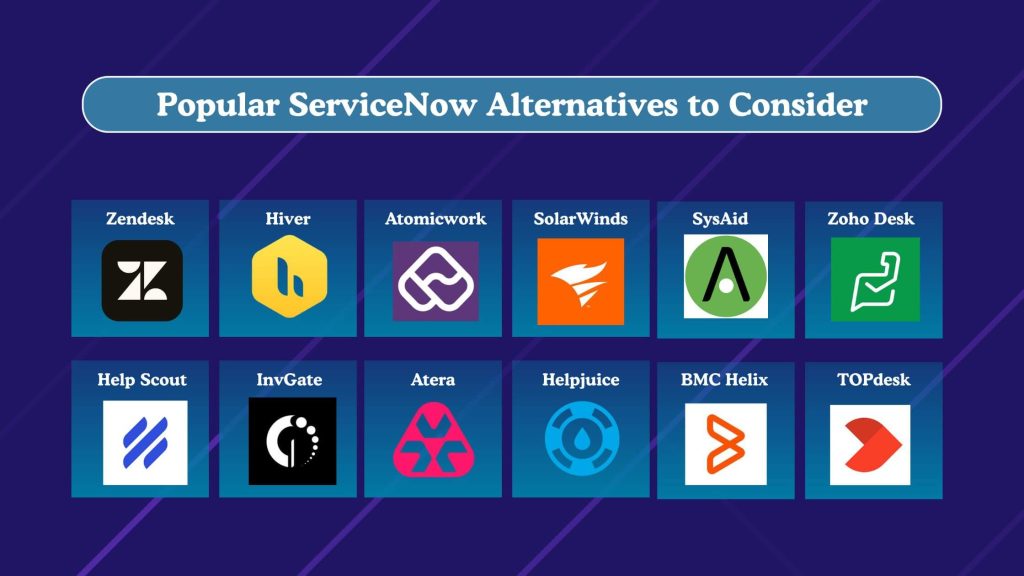
When searching for a strong ServiceNow Alternative, it’s important to look beyond just IT service management. Many tools excel in specific domains, such as customer support, employee communication, remote monitoring, or knowledge base management, while still delivering robust workflow automation and service delivery capabilities.
Below, we explore a curated set of alternatives — ranging from help desk and omnichannel platforms to ITSM and enterprise-grade service management solutions — each suitable for different business needs.
Zendesk — Omnichannel Customer Support Platform
Description:
Zendesk is a widely used customer service and support platform that enables businesses to manage support tickets and interactions across multiple channels like email, live chat, phone, and social media.
With a focus on delivering seamless support experiences at scale, it’s a flexible solution for teams that want intuitive ticketing and omnichannel engagement without the complexity of enterprise ITSM tools.
Why I Picked:
Zendesk stands out as a service-first platform that blends help desk functionality with excellent customer experience capabilities, making it ideal for teams that care deeply about user satisfaction and interaction quality.
Key Features:
- Unified omnichannel ticketing (email, chat, social media)
- AI-powered automation and workflows
- Self-service and help center portals
- App marketplace for integrations
- Scalable reporting and analytics
Pros and Cons:
| Pros | Cons |
|---|---|
| Easy to deploy and use | Can become expensive with advanced features |
| Strong omnichannel support | Less focused on deep ITSM workflows |
| Excellent integrations | Customization complexity at enterprise scale |
Hiver — Shared Inbox for Multichannel Teams
Description:
Hiver is a collaborative inbox solution built on top of Gmail that helps teams manage shared email channels, like support@ or help@ inboxes, without switching platforms. It’s designed to streamline communication for small- to medium-sized support and operations teams. (General industry context)
Why I Picked:
Hiver appeals to teams that primarily use email for support and internal coordination but need better collaboration, automation, and tracking — making it a practical alternative to ServiceNow for light-weight service workflows.
Key Features:
- Shared inbox with collision detection
- Assignment and status tracking
- Automation rules
- Email templates and canned responses
- Integration with Slack, Sheets, and CRM tools
Pros and Cons:
| Pros | Cons |
|---|---|
| Extremely easy setup | Not a full ITSM platform |
| Affordable pricing | Lacks advanced workflow automation |
| Great for email-heavy teams | Limited reporting |
Atomicwork — Employee Communication and Service Hub
Description:
Atomicwork positions itself as a central hub for employee communication and automated service delivery, helping internal teams manage requests, share knowledge, and keep workflows synchronized. Its emphasis is on empowering employees with self-service tools and simplified support interactions.
Why I Picked:
This tool bridges the gap between collaboration platforms and service management, making it ideal for organizations seeking internal service delivery without the overhead of traditional ITSM solutions.
Key Features:
- Employee request portal
- Internal knowledge base
- Workflow automation
- Interactive forms and approvals
- Custom service catalog
Pros and Cons:
| Pros | Cons |
|---|---|
| Focus on employee experience | Smaller ecosystem vs larger ITSM players |
| Intuitive interface | Limited external support channels |
| Good self-service tools | Fewer integrations |
SolarWinds — IT Asset and Service Management
Description:
SolarWinds Service Desk is an ITSM platform that combines ticketing, asset management, and automation in a single system. It’s well-suited for organizations that need IT-focused service delivery with strong infrastructure visibility.
Why I Picked:
SolarWinds’ strength lies in integrated asset and service management, making it a compelling alternative to ServiceNow for technical teams that want asset tracking and service workflows together.
Key Features:
- Incident and problem management
- IT asset management
- Reporting and dashboards
- Automation workflows
- Change and release management
Pros and Cons:
| Pros | Cons |
|---|---|
| Comprehensive ITSM + asset tracking | Can be complex for non-IT teams |
| Strong automation | Pricing scaled by tech seats |
| Good analytics | Setup can require expertise |
SysAid — Automated and Intelligent Service Desk
Description:
SysAid is a robust IT service management solution with automation at its core, helping teams manage incidents and service requests with minimal manual effort.
Why I Picked:
It’s a balanced alternative when you want enterprise-grade ITSM functionality without the heavy licensing and complexity of some larger platforms.
Key Features:
- Automated ticketing and workflows
- AI-driven recommendations
- Asset and configuration management
- Self-service portals
Pros and Cons:
| Pros | Cons |
|---|---|
| Strong automation | Not as well-known as competitors |
| Good value for mid-sized teams | Interface can feel dated |
| Scales with growth | Customization may need support |
Zoho Desk — Privacy-Focused Customer Support Solution
Description:
Zoho Desk is a help desk platform that prioritizes privacy and user-centric support, offering tools for ticket management, customer interactions, and automation across multiple channels. (Industry list source)
Why I Picked:
Zoho Desk is excellent for businesses that want cost-effective customer service workflows, strong privacy, and a modular ecosystem.
Key Features:
- Omnichannel ticketing
- Context-aware help center
- AI suggestions and routing
- Custom dashboards and reporting
Pros and Cons:
| Pros | Cons |
|---|---|
| Affordable pricing | Not designed for internal ITSM |
| Strong privacy focus | Advanced Automation Limited |
| Easy to use | Fewer enterprise integrations |
Help Scout — Personalized Customer Support Platform
Description:
Help Scout focuses on personalized customer support, with shared inboxes, collaboration tools, and built-in knowledge base functionality. It’s ideal for teams that want human-centered support rather than heavy ITSM workflows.
Why I Picked:
For teams prioritizing customer satisfaction and team collaboration, Help Scout offers a streamlined, less technical approach than traditional ServiceNow competitors.
Key Features:
- Shared inbox and conversation management
- Customer profiles and notes
- Docs knowledge base
- Workflow automation
Pros and Cons:
| Pros | Cons |
|---|---|
| Highly intuitive | Lacks deep ITSM features |
| Excellent customer focus | Limited advanced analytics |
| Great collaboration | Not suitable for large enterprise IT |
InvGate — Automated IT Ticket Management
Description:
InvGate Service Management is an IT support solution with automation, help desk dashboards, and incident workflows designed to scale with organizational needs.
Why I Picked:
InvGate appeals to teams seeking quick deployment, robust ticket automation, intuitive dashboards, and ITIL-aligned practices.
Key Features:
- Visual workflow automation
- Self-service portals
- Knowledge management
- Custom reports and dashboards
Pros and Cons:
| Pros | Cons |
|---|---|
| ITIL-certified practices | Pricing can scale quickly |
| Fast implementation | Smaller integration ecosystem |
| Good reporting | Limited external channel support |
Atera — Remote Monitoring and IT Management
Description:
Atera is a unified platform that combines remote monitoring and IT management with help desk automation — a strong fit for managed service providers (MSPs) and IT teams managing remote environments.
Why I Picked:
It merges IT support and infrastructure monitoring, making it useful for tech teams focused on remote support and maintenance.
Key Features:
- Remote monitoring and management
- Ticketing and automation
- Patch and endpoint management
- Reporting
Pros and Cons:
| Pros | Cons |
|---|---|
| Unified IT/remote support | Can be complex for new users |
| Strong monitoring | Feature set overlaps other tools |
| MSP-friendly | Not focused on general customer support |
Helpjuice — Knowledge Base Management Software
Description:
Helpjuice is a powerful knowledge base platform that helps teams create, organize, and manage internal or external knowledge repositories.
Why I Picked:
For teams that rely heavily on self-service and knowledge sharing, Helpjuice is a focused alternative to ServiceNow’s knowledge module, with deeper content control and customization.
Key Features:
- Robust article editor
- AI-powered suggestions
- Advanced permissions
- Analytics and reporting
Pros and Cons:
| Pros | Cons |
|---|---|
| Excellent content control | Not a ticketing tool |
| Strong analytics | Requires separate support tools |
| Scales with organization | No built-in ITSM workflows |
BMC Helix — Enterprise-Grade Service Management
Description:
BMC Helix is an enterprise-class ITSM suite often compared closely with ServiceNow, offering comprehensive service and operations management with AI and automation at scale.
Why I Picked:
It’s one of the closest functional alternatives to ServiceNow, especially for large IT environments demanding complex workflows and automation.
Key Features:
- AI-driven automation
- Multi-cloud support
- Integrated ITSM + ITOM
- Service catalog & CMDB
Pros and Cons:
| Pros | Cons |
|---|---|
| Deep ITSM capabilities | Expensive for small teams |
| Enterprise scalability | Longer implementation cycles |
| Strong automation | High learning curve |
TOPdesk — Easy-to-Configure Service Management
Description:
TOPdesk is an accessible service management platform that simplifies workflows and task tracking across IT and business functions, ideal for small- to mid-sized organizations.
Why I Picked:
It’s a great alternative to ServiceNow for teams that want quick setup, an intuitive design, and flexible service workflows without the complexity of heavy customization.
Key Features:
- Incident and request management
- Self-service portals
- Asset catalog
- Knowledge base
Pros and Cons:
| Pros | Cons |
|---|---|
| Easy to configure | Not as scalable as enterprise ITSM |
| Focus on usability | Feature set less deep |
| Affordable plans | Smaller ecosystem |
Why Look for a ServiceNow Alternative?
While ServiceNow is a powerful platform, it isn’t always the most practical choice for every organization. One of the most common reasons businesses start evaluating other options is cost.
Licensing fees, add-on modules, and long-term contracts can quickly become expensive, especially for small to mid-sized companies or teams that only need a subset of its capabilities.
Another major factor is implementation complexity. Deploying ServiceNow often requires dedicated specialists, extended setup timelines, and ongoing customization efforts.
For organizations that prioritize speed, flexibility, or lean operations, this level of complexity can slow down service delivery rather than improve it. Teams may also find the learning curve steep, which impacts adoption across non-technical departments.
Additionally, many businesses don’t need an all-encompassing enterprise platform. They may prefer tools that focus on specific use cases, such as customer support, internal service requests, asset management, or employee communication. This is where exploring a ServiceNow Alternative makes sense—allowing organizations to choose solutions that better align with their workflows, scale at their pace, and deliver clearer value without unnecessary overhead.
Features to Look For In ServiceNow Alternatives
Choosing the right platform goes beyond matching feature lists. The best alternatives align with how your teams actually work, integrate smoothly into your existing systems, and scale without adding operational friction.
Below are the core capabilities to consider when evaluating market options-
Ticketing & Workflow Automation
A reliable ticketing system is the foundation of any service management platform. Look for tools that let you create, assign, prioritize, and resolve requests via customizable workflows.
Automation features such as rule-based routing, SLA tracking, and auto-escalation help reduce manual effort and maintain consistent response times. For many organizations, this is where a well-designed ServiceNow Alternative can offer faster setup and easier customization.
Integration Capabilities
Service platforms rarely operate in isolation. Strong integration support ensures the tool can connect with communication apps, CRM systems, monitoring tools, and productivity software already in use.
Native integrations, APIs, and marketplace add-ons make it easier to maintain seamless data flow across systems without heavy engineering effort.
Knowledge Management
An effective knowledge base reduces ticket volume and empowers users to solve common issues independently. Look for features like searchable articles, version control, access permissions, and analytics to track content usage.
Platforms that tightly integrate knowledge management with ticketing workflows can significantly improve resolution times and user satisfaction.
Reporting and Analytics
Visibility into performance is essential for continuous improvement. Reporting tools should provide insights into ticket volume, response times, resolution trends, and team workloads.
Custom dashboards and exportable reports help stakeholders measure service efficiency and identify bottlenecks without relying on external reporting tools.
Scalability & Flexibility
As teams grow or processes evolve, the platform should adapt without major reconfiguration. Scalable pricing models, modular features, and flexible workflow design enable businesses to gradually expand usage.
This is especially important for organizations moving away from rigid enterprise platforms toward more adaptable solutions.
Asset and Configuration Management
For IT-focused teams, asset tracking and configuration management are critical. Features like hardware and software inventories, dependency mapping, and lifecycle tracking help maintain system reliability and support informed decision-making.
Not all tools offer deep asset management, so this capability should be assessed based on operational needs.
Searching for a Better Service Management Solution?
We help you identify and implement platforms that align with your service and operational needs.
Conclusion
Selecting the right platform ultimately depends on how well it aligns with your operational goals, team structure, and long-term growth plans. While ServiceNow remains a strong enterprise solution, many organizations find greater value in tools that are easier to adopt, more cost-efficient, and tailored to specific service management needs.
Exploring the right ServiceNow Alternative allows businesses to focus on flexibility, faster implementation, and measurable outcomes without unnecessary complexity.
With a growing ecosystem of service management platforms, the key is not to replace ServiceNow feature by feature, but to choose a solution that fits your workflows and scales at your pace.
Whether your priority is customer support, IT service delivery, asset management, or employee experience, today’s market offers capable options that deliver strong results.
For organizations evaluating or implementing service management solutions, having the right technical and strategic guidance is just as important as choosing the platform itself.
BigDataCentric works with businesses to design, integrate, and optimize digital service workflows using data-driven approaches, ensuring that service platforms align with broader operational and analytics strategies. This helps teams move beyond tool adoption and toward sustained service excellence.
FAQs
-
Which is better, SAP or ServiceNow?
SAP and ServiceNow serve different purposes. SAP focuses on ERP and core business processes, while ServiceNow specializes in IT and service workflow automation. The better choice depends on whether your priority is business operations or service management.
-
Is ServiceNow still in demand?
Yes, ServiceNow remains in demand, especially among large enterprises managing complex IT and service workflows. However, growing cost and complexity are pushing many organizations to explore more flexible and scalable alternatives.
-
Is ServiceNow a CRM or ERP system?
ServiceNow is neither a traditional CRM nor an ERP system. It is primarily a service management and workflow automation platform, though it can integrate with CRM and ERP tools to support broader business processes.
-
Can Jira replace ServiceNow?
Jira can replace ServiceNow for basic ticketing and agile IT workflows, but it lacks advanced ITSM, asset management, and enterprise service features. Jira works best for development-focused teams rather than full-scale service management.
-
Is Snowflake a competitor to ServiceNow?
Snowflake is not a competitor to ServiceNow. Snowflake is a cloud data platform for analytics and data warehousing, while ServiceNow focuses on service management and workflow automation.

Jayanti Katariya is the CEO of BigDataCentric, a leading provider of AI, machine learning, data science, and business intelligence solutions. With 18+ years of industry experience, he has been at the forefront of helping businesses unlock growth through data-driven insights. Passionate about developing creative technology solutions from a young age, he pursued an engineering degree to further this interest. Under his leadership, BigDataCentric delivers tailored AI and analytics solutions to optimize business processes. His expertise drives innovation in data science, enabling organizations to make smarter, data-backed decisions.


