Business Analytics as a Service Explained for Enterprise Growth

 Total View: 202
Submitting the form below will ensure a prompt response from us.
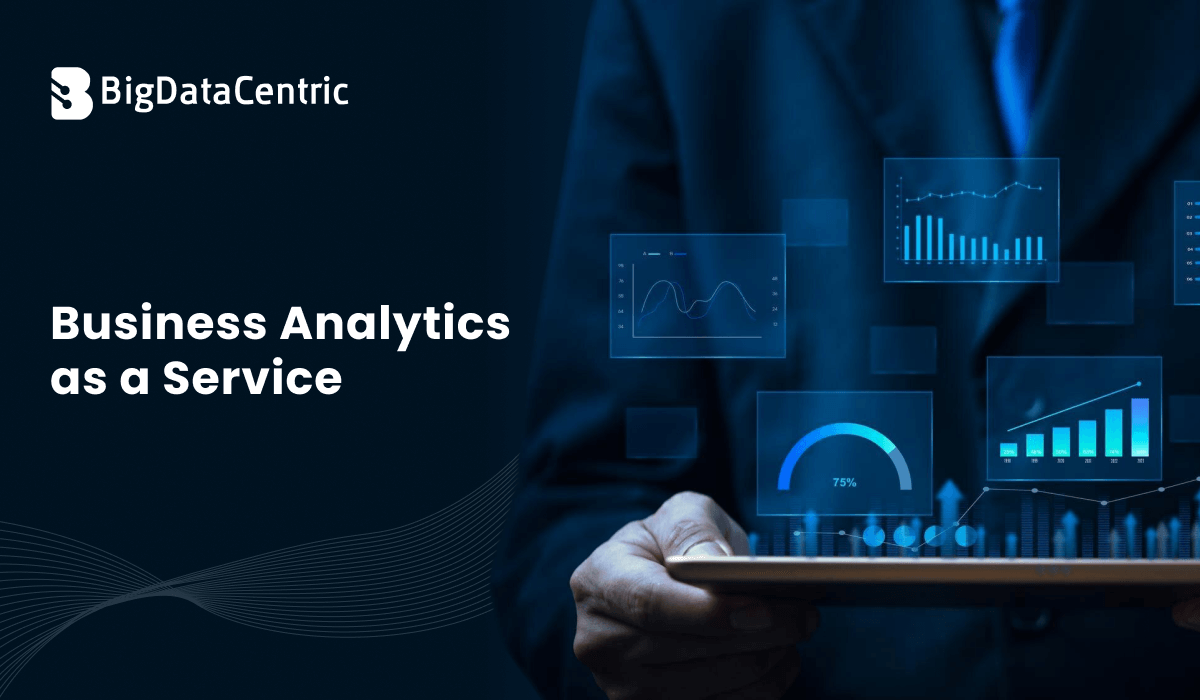
In today’s data-driven economy, organizations must quickly turn vast amounts of data into meaningful insights. However, building and maintaining an in-house analytics infrastructure can be costly and complex. This is where Business Analytics as a Service (BAaaS) comes into play.
Business Analytics as a Service delivers analytics capabilities—such as data processing, visualization, and advanced analytics—through cloud-based platforms on a subscription or pay-as-you-go basis. It enables organizations to focus on insights rather than infrastructure.
What is Business Analytics as a Service?
Business Analytics as a Service is a cloud-delivered model where analytics tools, platforms, and expertise are provided as a managed service. Instead of investing in hardware, software licenses, and specialized teams, businesses access analytics capabilities over the internet.
Key components typically include:
- Data ingestion and integration
- Data warehousing or lakes
- Dashboards and reporting
- Advanced analytics and ML models
- Ongoing maintenance and support
How Business Analytics as a Service Works?
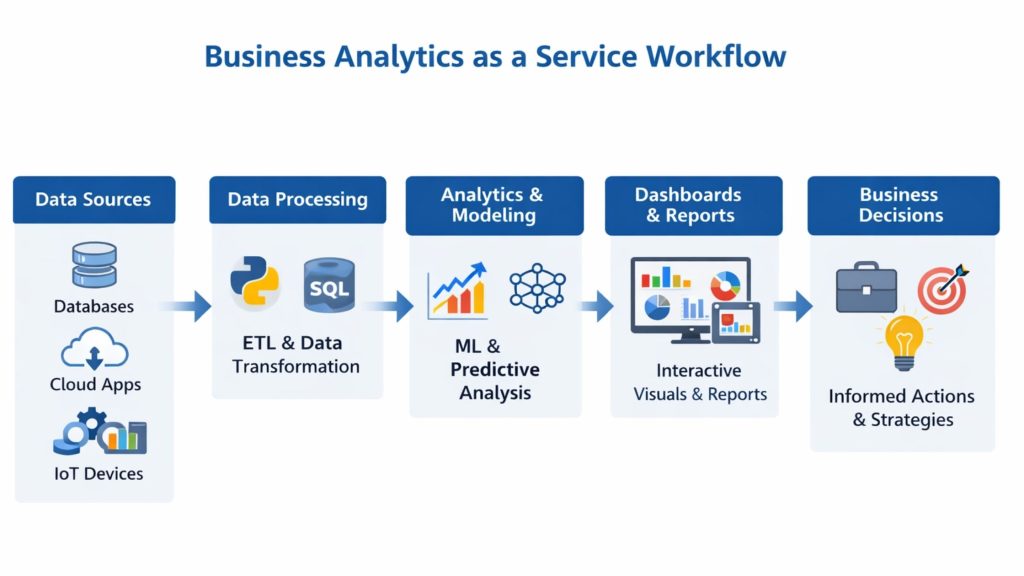
The BAaaS workflow usually follows these steps:
- Data Collection – Data is ingested from multiple sources (CRM, ERP, web apps, IoT).
- Data Processing – Raw data is cleaned, transformed, and stored.
- Analytics & Modeling – KPIs, trends, and predictive models are applied.
- Visualization & Reporting – Insights are delivered through dashboards and reports.
- Continuous Optimization – Models and dashboards evolve as business needs change.
Key Benefits of Business Analytics as a Service
Here are the key benefits of Business Analytics as a Service that help organizations simplify analytics, reduce operational effort, and make better data-driven decisions.
Faster Time to Insight
Prebuilt analytics pipelines significantly reduce setup time.
Lower Costs
No upfront infrastructure or large analytics teams required.
Scalability
Easily scale analytics as data volumes grow.
Access to Expertise
Gain access to experienced data engineers and analysts.
Focus on Core Business
Teams spend time acting on insights, not managing tools.
Common Use Cases
- Executive dashboards and KPI tracking
- Customer behavior and churn analysis
- Sales and revenue forecasting
- Marketing performance analytics
- Operational efficiency analysis
Python Example: Data Processing for Analytics
Below is a simple Python example showing how raw data might be prepared in a BAaaS pipeline.
import pandas as pd

# Load raw business data
data = pd.read_csv("sales_data.csv")

# Clean and transform
data["order_date"] = pd.to_datetime(data["order_date"])
data["revenue"] = data["quantity"] * data["price"]

# Aggregate KPIs
monthly_revenue = data.groupby(data["order_date"].dt.to_period("M"))["revenue"].sum()

print(monthly_revenue)
This type of processing typically runs automatically in the background as part of an analytics service.
Advanced Analytics in BAaaS
Business Analytics as a Service often includes predictive and prescriptive analytics.
Example: Simple Predictive Model in Python
from sklearn.linear_model import LinearRegression
import numpy as np

# Example dataset
X = np.array([[1], [2], [3], [4]])
y = np.array([1000, 1500, 2000, 2500])

model = LinearRegression()
model.fit(X, y)

forecast = model.predict([[5]])
print("Forecasted Revenue:", forecast[0])
Such models can be embedded into dashboards to support decision-making.
Tools Commonly Used in Business Analytics as a Service
| Tool | Purpose | Best Practices |
|---|---|---|
| Power BI / Tableau | Visualization & reporting | Design KPI-focused dashboards and enable role-based access |
| Snowflake / BigQuery | Cloud data warehousing | Maintain clean data models and optimize queries for performance |
| Python / SQL | Data processing & modeling | Standardize data transformations and validate data quality |
| Airflow | Workflow orchestration | Automate pipelines with proper monitoring and failure alerts |
| ML libraries | Predictive analytics | Continuously retrain models and track model performance |
Security and Governance Considerations
BAaaS providers typically handle:
- Role-based access control
- Data encryption at rest and in transit
- Compliance with GDPR, HIPAA, and related regulations.
- Audit logging and monitoring
This ensures enterprise-grade security without internal overhead.
Is Business Analytics as a Service Right for Your Business?
Business Analytics as a Service is a good fit for organizations that want quick access to insights without investing heavily in analytics infrastructure or specialized teams. It works especially well for businesses dealing with growing data volumes, multiple data sources, or rapidly changing reporting needs.
If your goal is to make faster, data-driven decisions while keeping costs predictable and operations flexible, BAaaS can be a practical, scalable option.
Modernize Your Data & Analytics Stack
From dashboards to predictive models, we deliver end-to-end analytics as a managed service.
Conclusion
Business Analytics as a Service empowers organizations to become data-driven without the burden of building and maintaining complex analytics infrastructure. By leveraging cloud platforms, automation, and expert support, businesses gain faster insights, reduced costs, and scalable analytics capabilities.
For companies looking to modernize analytics and make smarter decisions, BAaaS is a practical and future-ready solution.

Jayanti Katariya is the CEO of BigDataCentric, a leading provider of AI, machine learning, data science, and business intelligence solutions. With 18+ years of industry experience, he has been at the forefront of helping businesses unlock growth through data-driven insights. Passionate about developing creative technology solutions from a young age, he pursued an engineering degree to further this interest. Under his leadership, BigDataCentric delivers tailored AI and analytics solutions to optimize business processes. His expertise drives innovation in data science, enabling organizations to make smarter, data-backed decisions.