How Does AI Voice Work? Quick Guide with Examples

 Total View: 62
Submitting the form below will ensure a prompt response from us.
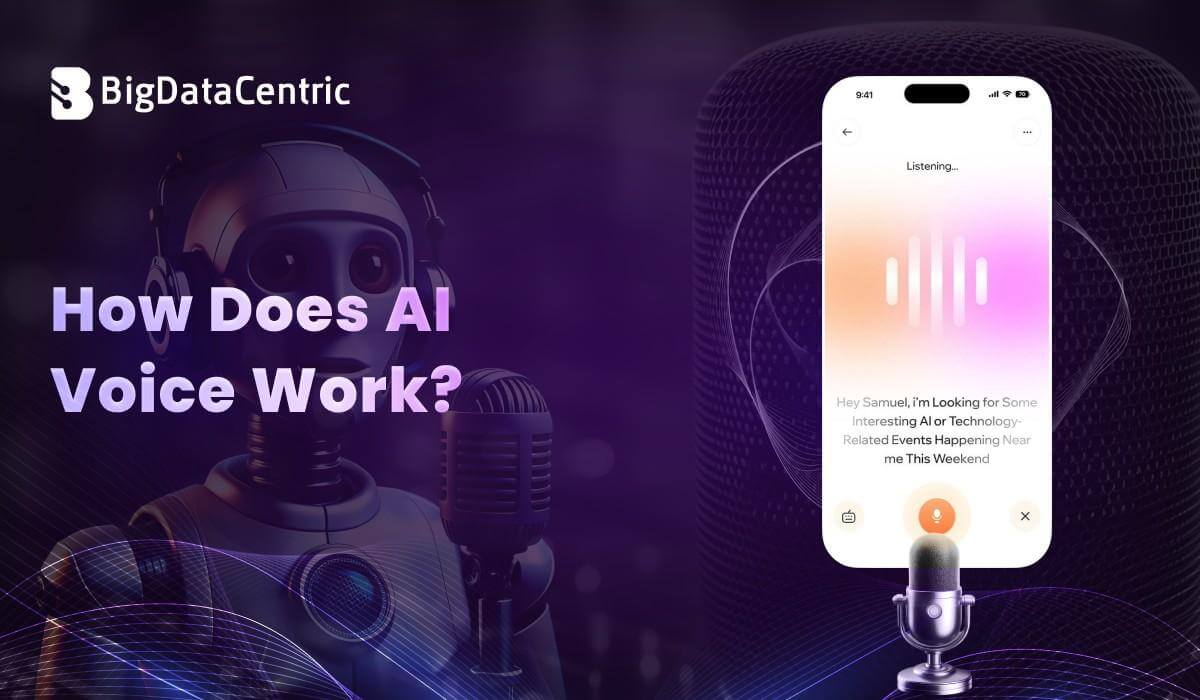
AI voice technology powers virtual assistants, smart speakers, and voice-enabled apps. From asking questions to controlling devices, AI voice systems allow humans to interact with machines naturally using speech.
But how does AI voice work behind the scenes?
What is AI Voice Technology?
AI voice refers to systems that can:
- Understand spoken language (Speech Recognition)
- Interpret meaning (Natural Language Processing)
- Generate spoken responses (Text-to-Speech)
It combines multiple AI technologies to enable seamless voice interaction.
Types of AI Voice Systems
Voice Assistants
Used in smartphones and smart devices.
Voice Bots
Customer support automation.
Voice Search
Search engines responding to voice queries.
Voice Biometrics
Authentication using voice patterns.
How Does AI Voice Work? (Step-by-Step)
AI voice systems follow a pipeline of processes:
Speech-to-Text (STT)
The first step is converting spoken audio into text.
- A microphone captures sound waves
- Audio is processed into digital signals
- AI models transcribe speech into text
Python Example: Speech Recognition
import speech_recognition as sr

recognizer = sr.Recognizer()

with sr.Microphone() as source:
   print("Speak something...")
   audio = recognizer.listen(source)

try:
   text = recognizer.recognize_google(audio)
   print("You said:", text)
except Exception as e:
   print("Error:", e)
Natural Language Processing (NLP)
Once speech is converted to text, NLP analyzes the meaning.
Key tasks include:
- Intent detection
- Entity recognition
- Context understanding
Example:
 User says → “Book a flight to Delhi”
 System detects → Intent: Booking, Location: Delhi
Decision Making / AI Processing
The system decides what action to take.
This may involve:
- Querying databases
- Running algorithms
- Calling APIs
Text-to-Speech (TTS)
Finally, the system converts text response into speech.
Python Example: Text-to-Speech
import pyttsx3

engine = pyttsx3.init()
engine.say("Hello, how can I help you?")
engine.runAndWait()
Complete AI Voice Flow
User Speech → Speech-to-Text → NLP → Decision → Text-to-Speech → Voice Output
Key Technologies Behind AI Voice
Automatic Speech Recognition (ASR)
Converts speech into text.
Natural Language Processing (NLP)
Understands meaning and intent.
Machine Learning Models
Improve accuracy over time.
Deep Learning
Handles complex speech patterns and accents.
Real-World Applications
AI voice technology is widely used in:
- Customer support (call centers)
- Smart homes (IoT devices)
- Healthcare (voice documentation)
- Automotive systems (hands-free control)
- Accessibility tools (for visually impaired users)
Security Considerations
AI voice systems must handle:
- Voice spoofing attacks
- Data privacy
- Secure authentication
Voice biometrics is increasingly used to enhance security.
Future of AI Voice
Emerging trends include:
- Emotion-aware voice AI
- Multilingual voice assistants
- Real-time translation
- Personalized voice experiences
- Integration with generative AI
AI voice is becoming more human-like and context-aware.
Build AI Voice Solutions
Create intelligent voice assistants and speech-enabled applications.
Conclusion
So, how does AI voice work?
AI voice systems combine:
- Speech-to-text
- Natural language processing
- Decision-making algorithms
- Text-to-speech
to create seamless human-machine communication.
As AI continues to evolve, voice interfaces will become a primary way we interact with technology, making systems more intuitive, accessible, and intelligent.

Jayanti Katariya is the CEO of BigDataCentric, a leading provider of AI, machine learning, data science, and business intelligence solutions. With 18+ years of industry experience, he has been at the forefront of helping businesses unlock growth through data-driven insights. Passionate about developing creative technology solutions from a young age, he pursued an engineering degree to further this interest. Under his leadership, BigDataCentric delivers tailored AI and analytics solutions to optimize business processes. His expertise drives innovation in data science, enabling organizations to make smarter, data-backed decisions.