




AI in SaaS for Healthcare – A Complete Guide to Smarter Digital Care

Blog Summary:
AI in SaaS for Healthcare is reshaping digital healthcare by enabling intelligent automation, predictive insights, and remote care delivery. From personalized treatment to billing automation and virtual care models, intelligent SaaS platforms are driving operational efficiency and better patient outcomes. As adoption grows, healthcare organizations are moving toward smarter, scalable, and more connected care ecosystems.
The healthcare industry is rapidly shifting toward cloud-based platforms that improve efficiency, accessibility, and patient care. In this transformation, AI in SaaS for Healthcare plays a key role by helping healthcare providers transition from basic digital tools to intelligent, data-driven systems that support faster decision-making and improved outcomes.
Modern SaaS healthcare software can manage patient data, automate routine operations, and enable virtual care at scale. When combined with AI healthcare solutions, these platforms help healthcare organizations improve diagnostics, personalize treatments, and streamline workflows without requiring heavy infrastructure investments.
As hospitals and digital health providers continue to adopt SaaS in healthcare, demand for intelligent platforms is growing rapidly. From remote patient monitoring to predictive analytics, AI technology in healthcare is becoming an essential part of how connected, efficient, and patient-focused care is delivered today.
Global Healthcare SaaS Market Landscape
The global healthcare software-as-a-service market has grown strongly in recent years. According to Grandview Research, the market size was USD 25.13 billion in 2024 and is projected to reach USD 70.3 billion by 2030, with a 20.0% compound annual growth rate from 2025 to 2030.
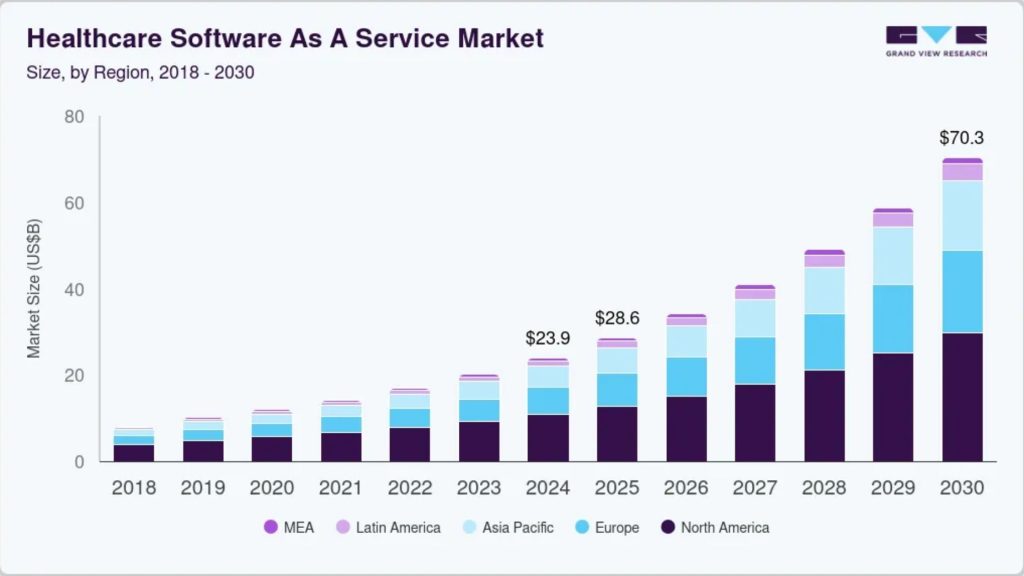
This rapid expansion is driven primarily by the increasing adoption of cloud computing, demand for cost-efficient healthcare systems, the growing adoption of remote healthcare services, and the need to meet strict regulatory compliance standards.
From a regional perspective, North America dominated the healthcare SaaS market in 2024, accounting for the largest revenue share at 45.39%. The U.S. healthcare SaaS sector continues to expand as cloud-based platforms are widely adopted across hospitals, clinics, and insurance providers.
In terms of applications, the telemedicine segment accounted for 16.42% of the market in 2024, reflecting rising demand for virtual healthcare services. By deployment model, the hybrid segment generated the highest revenue, while by end use, the provider segment held the largest share in the same year.
The market’s growth is further supported by the broader shift toward digital transformation in healthcare, encouraged by government programs and rapid technological progress.
Additionally, increasing focus on patient engagement, rising data security requirements, and the need for more efficient healthcare management systems continue to strengthen the adoption of saas healthcare software and advanced ai technology in healthcare across global healthcare ecosystems.
Understanding AI-Powered SaaS in the Healthcare Sector
AI-powered SaaS in healthcare refers to cloud-based software platforms that combine scalable infrastructure with intelligent data processing capabilities. These platforms are designed to collect, analyze, and interpret massive volumes of medical, operational, and behavioral data in real time.
Unlike traditional healthcare systems that primarily store data, intelligent SaaS platforms actively support decision-making, automation, and predictive analytics across clinical and administrative workflows.
Modern AI healthcare solutions embedded into SaaS platforms help providers move beyond reactive care. These systems can detect disease patterns, identify potential risks, automate repetitive tasks, and assist medical staff by providing faster, more accurate recommendations.
Whether it is validating clinical data, remotely monitoring patient vitals, or optimizing appointment scheduling, the intelligence layer operates continuously in the background to improve both care quality and operational efficiency.
Another defining aspect of intelligent SaaS platforms is accessibility. A robust AI platform for healthcare allows hospitals, clinics, startups, and even solo practitioners to access enterprise-grade tools without the burden of heavy infrastructure investments.
As a result, AI services in healthcare are no longer limited to large institutions. These platforms also integrate smoothly with electronic health records, billing tools, and patient engagement systems, enabling unified digital care ecosystems.
The same ecosystem approach is also evident in connected patient communication systems, including healthcare chat platforms already deployed across many clinical environments.
Major Benefits of AI in SaaS for Healthcare
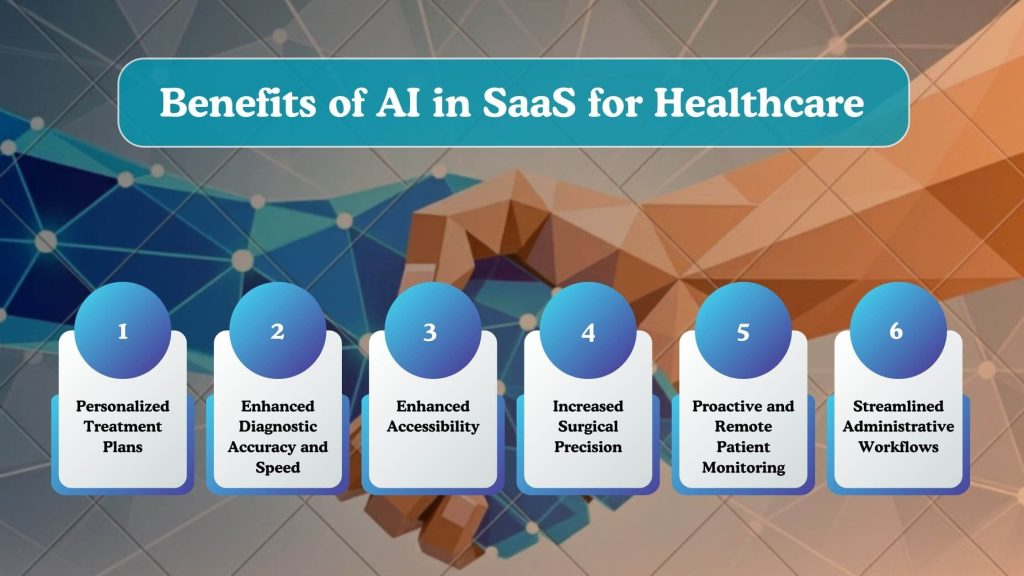
The integration of intelligence-driven systems into cloud-based healthcare platforms is improving how medical organizations operate, diagnose, and deliver care. AI in SaaS for Healthcare is helping hospitals and digital health providers overcome traditional challenges, including delayed diagnosis and limited patient engagement.
Below are the key benefits shaping this transformation-
Personalized Treatment Plans
Intelligent SaaS platforms analyze patient history, genetic data, lifestyle factors, and real-time health metrics to design customized treatment strategies. Instead of relying on generalized protocols, doctors can offer more precise therapies aligned with individual patient needs.
This level of personalization improves patient outcomes and reduces unnecessary treatments, making care more targeted and cost-efficient.
Enhanced Diagnostic Accuracy and Speed
Advanced data processing enables modern systems to detect diseases more quickly and with higher precision. These platforms analyze medical images, lab results, and clinical records to identify early-stage conditions that may be missed by manual analysis.
As a result, clinicians receive faster diagnostic support, leading to quicker treatment decisions and improved recovery rates.
Enhanced Accessibility
Cloud-based platforms powered by intelligent technologies are expanding access to healthcare in remote and underserved regions. Patients can now consult doctors virtually, receive continuous monitoring, and access health information without geographical limitations.
This increased accessibility also helps reduce hospital overcrowding and enables timely medical intervention.
Increased Surgical Precision
Surgical procedures have become more accurate with the support of intelligent systems that assist with planning and execution. These platforms help surgeons visualize complex anatomy, simulate procedures, and make data-backed decisions during operations.
The result is reduced surgical risk, fewer complications, and shorter recovery periods for patients.
Proactive and Remote Patient Monitoring
Remote patient monitoring has become more effective with continuous data collection through connected devices. Intelligent platforms track vital signs, detect abnormal patterns, and alert healthcare providers before conditions worsen.
This enables timely interventions, especially for patients with chronic diseases, and supports preventive care rather than reactive treatment.
Streamlined Administrative Workflows
Administrative inefficiencies remain a major burden for healthcare organizations. Intelligent SaaS platforms automate appointment scheduling, document management systems, claims processing, and resource allocation.
This reduces manual workload, minimizes human error, and enables healthcare professionals to focus more on patient care rather than on paperwork. The operational improvements here directly reflect the growing benefits of AI in healthcare across both clinical and non-clinical departments.
Core Use Cases of AI-Powered Healthcare SaaS
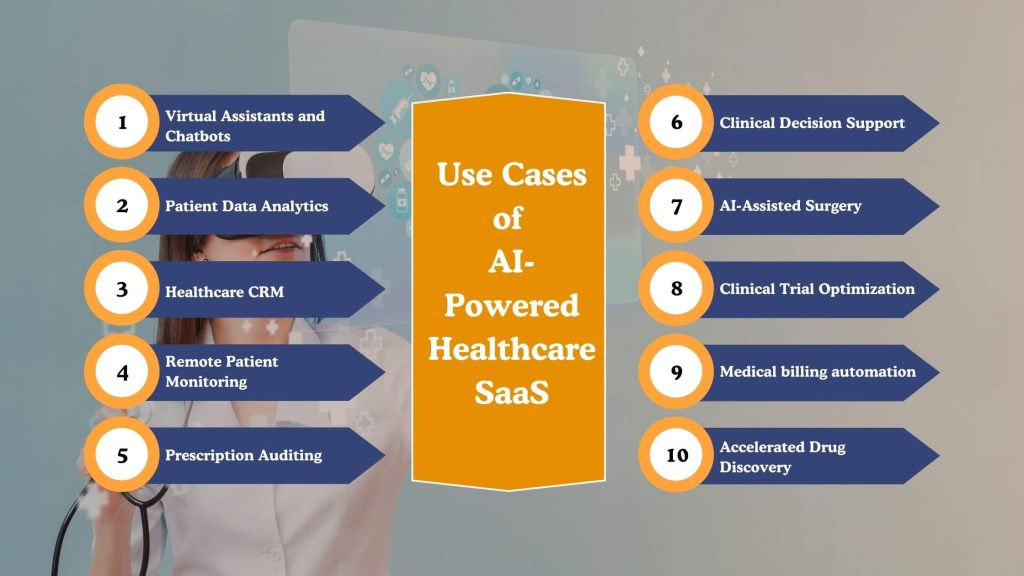
AI-powered SaaS platforms are now deeply embedded across clinical, operational, and research environments.
These real-world applications show how intelligent cloud systems are improving accuracy, efficiency, and patient outcomes across the healthcare ecosystem.
Virtual Assistants and Chatbots
Virtual assistants help patients schedule appointments, check symptoms, receive medication reminders, and get instant answers to common medical queries. These tools operate 24/7 and reduce the workload on hospital staff.
They also improve patient engagement by providing faster communication. This makes digital interactions more accessible and reliable.
Patient Data Analytics
Patient data analytics platforms process large volumes of clinical and behavioral data to identify health patterns and risk factors. These systems help doctors detect diseases early and track patient progress more accurately.
They also support population health management by identifying high-risk patient groups. This leads to more informed and timely treatment decisions.
Healthcare CRM
Healthcare CRM platforms manage patient communication, appointment history, treatment follow-ups, and engagement across a single system. They help providers maintain consistent interactions across digital and physical touchpoints.
These systems also support personalized care journeys. As a result, patient satisfaction and retention improve significantly.
Remote Patient Monitoring
Remote patient monitoring systems track vital signs, such as heart rate, blood glucose levels, and blood pressure, using connected devices. Physicians receive real-time alerts when abnormal readings are detected.
This enables early intervention and reduces unnecessary hospital visits. It is especially effective for managing chronic conditions.
Prescription Auditing
Prescription auditing systems automatically review medication orders to detect dosage errors, drug interactions, and duplicate prescriptions. These platforms improve patient safety while supporting regulatory compliance.
They also reduce the risk of adverse drug reactions. This ensures more accurate and secure medication management.
Clinical Decision Support
Clinical decision support systems assist clinicians with diagnosis and treatment planning using real-time patient data and clinical guidelines. These tools reduce diagnostic errors and provide evidence-based recommendations.
They support faster clinical decisions across departments. This leads to improved care quality and consistency.
AI-Assisted Surgery
AI-assisted surgical systems support surgeons with detailed imaging, real-time guidance, and procedure planning. These platforms enhance surgical precision and reduce the risk of complications.
They also help shorten patient recovery times. Complex procedures become safer and more predictable with data-backed support.
Clinical Trial Optimization
Clinical trial platforms streamline patient recruitment, monitor trial progress, and ensure compliance with research protocols. They help detect anomalies in trial data early and improve reporting accuracy.
These systems also speed up data analysis. This results in shorter trial timelines and higher success rates.
Medical Billing Automation
Medical billing automation platforms handle coding, claim submission, fraud detection, and reimbursement tracking. They reduce manual errors and speed up payment cycles.
These systems also ensure compliance with healthcare billing regulations. As a result, revenue cycle management becomes more efficient.
Accelerated Drug Discovery
Drug discovery platforms analyze chemical structures, biological data, and past research using advanced modeling techniques. These systems help researchers identify promising compounds faster.
They significantly reduce research timelines and development costs. This accelerates the delivery of new therapies to the market.
Upgrade Your Healthcare Platform with Smart SaaS
Modernize your digital healthcare ecosystem using AI in SaaS for Healthcare for automation, analytics, and connected care.
Key Technologies Powering AI-Based Healthcare SaaS
AI-powered healthcare SaaS platforms rely on a strong technology foundation to deliver accurate, scalable, and secure digital healthcare services.
These core technologies work together to support real-time data processing, automation, and intelligent decision-making across healthcare systems.
Machine Learning (ML) and Deep Learning (DL)
Machine learning and deep learning enable healthcare platforms to analyze large volumes of clinical data, medical images, and patient records with high accuracy. These models continuously improve their performance through training on new data.
They support disease detection, risk prediction, and personalized treatment planning. This makes AI healthcare solutions more precise and reliable over time.
Cloud Computing and Edge Computing
Cloud computing provides the scalable infrastructure needed to store and process massive healthcare datasets securely. Edge computing complements this by enabling real-time data processing at the edge, closer to medical devices and patients.
Together, they ensure low latency, high performance, and high availability for SaaS healthcare software. This combination is essential for remote monitoring and critical care applications.
Natural Language Processing (NLP) and Generative AI (GenAI)
NLP helps healthcare systems understand and process unstructured clinical data such as doctors’ notes, discharge summaries, and patient queries. Generative models assist in clinical documentation, medical report creation, and virtual assistant responses.
These technologies improve communication accuracy and documentation efficiency. They also enhance patient engagement across digital health platforms.
Robotic Process Automation (RPA) & Robotics
RPA automates repetitive administrative tasks, including appointment scheduling, claims processing, billing, and data entry. This reduces operational workload and minimizes human errors across healthcare workflows.
Robotics, on the other hand, supports surgical assistance, rehabilitation, and precision-based medical procedures. Together, these technologies improve both clinical and non-clinical efficiency.
The Future of AI in SaaS for Healthcare
The future of AI in SaaS for Healthcare is centered on smarter platforms, connected ecosystems, and predictive care models.
As healthcare continues to shift toward digital-first services, intelligent SaaS solutions will play a critical role in transforming how care is delivered, managed, and scaled.
Next-generation Intelligent Healthcare Platforms
Next-generation platforms will combine real-time data processing, automation, and predictive intelligence into unified healthcare systems. These platforms will support personalized care, faster diagnostics, and automated workflows across departments.
They will also adapt continuously in response to patient behavior and clinical outcomes. This will improve both treatment accuracy and operational efficiency.
Interoperable Cloud Ecosystems
Interoperable cloud ecosystems will enable seamless data exchange between hospitals, labs, pharmacies, insurers, and digital health providers. These systems will eliminate data silos and ensure a continuous flow of patient information across platforms.
Strong interoperability will also improve care coordination and reduce treatment delays. This creates a truly connected SaaS environment in a healthcare setting.
Predictive Population Health Platforms
Predictive population health platforms will analyze large-scale health data to identify disease trends, outbreak risks, and high-risk populations. These systems will support early interventions and large-scale preventive care strategies.
Governments and healthcare organizations will use these insights for better healthcare planning. This marks a shift from reactive to predictive healthcare delivery.
AI-first Virtual Hospitals and Digital Care Models
AI-first virtual hospitals will deliver remote consultations, continuous monitoring, automated diagnosis support, and digital treatment pathways. These models will reduce dependency on physical infrastructure and expand access to quality healthcare.
Patients will receive care from anywhere through intelligent digital platforms. This will significantly strengthen the role of AI platforms in healthcare for global care delivery.
How BigDataCentric Helps Healthcare Businesses with AI SaaS Adoption?
BigDataCentric supports healthcare organizations at every stage of their SaaS adoption journey by delivering scalable, secure, and intelligent digital healthcare solutions. From strategy to deployment, the focus remains on building platforms that improve patient outcomes while simplifying operational complexity.
The team helps healthcare providers implement AI healthcare solutions tailored to real-world clinical and business needs. This includes integrating intelligent systems with existing hospital infrastructure, electronic health records, and patient engagement platforms to ensure seamless data flow and system interoperability.
BigDataCentric also enables healthcare businesses to adopt advanced saas healthcare software for automation, remote monitoring, analytics, and digital care delivery. Strong expertise in data science and healthcare platforms ensures compliance with industry regulations and data security standards, while supporting scalability and performance.
By enabling the adoption of modern AI services in healthcare, BigDataCentric helps organizations improve diagnostic accuracy, optimize workflows, and deliver more effective digital care experiences while remaining adaptable to future healthcare demands.
Ready to modernize your healthcare SaaS platform?
Adopt AI in SaaS for Healthcare to enable predictive care, remote monitoring, and secure digital transformation at scale.
Conclusion
AI in SaaS for Healthcare is no longer an emerging concept but a foundational element of modern digital healthcare systems. From improving diagnostics and personalized treatment to enabling remote monitoring and operational automation, intelligent SaaS platforms are reshaping how care is delivered and managed.
As saas in healthcare continues to expand globally, the adoption of intelligent technologies will become essential for scalability, efficiency, and patient-centric care. With rapid growth in cloud infrastructure, data analytics, and automation, healthcare organizations are better equipped to address complex medical and administrative challenges.
By leveraging AI healthcare solutions, providers can move toward predictive, connected, and value-driven healthcare models that improve long-term patient outcomes while maintaining operational resilience.
FAQs
-
Is AI in healthcare SaaS cost-effective for hospitals?
Yes, it reduces operational costs by automating workflows, improving efficiency, and minimizing manual errors. Over time, hospitals see strong returns through better resource utilization.
-
Can AI SaaS platforms support remote patient monitoring?
Yes, these platforms track vital signs in real time using connected devices and send alerts for abnormal readings. This enables early intervention and continuous care outside hospitals.
-
Can AI SaaS platforms integrate with EHR systems?
Yes, most platforms are built to integrate smoothly with existing EHR systems. This ensures seamless data exchange, better clinical visibility, and improved care coordination.
-
How long does an AI SaaS implementation take in healthcare?
Implementation time varies with system complexity and integration requirements, typically ranging from a few weeks to a few months for full deployment.
-
Is AI in healthcare SaaS scalable in the long term?
Yes, cloud-based architecture enables easy scaling as patient, data, and service volumes grow. This makes it suitable for both small clinics and large hospital networks.

Jayanti Katariya is the CEO of BigDataCentric, a leading provider of AI, machine learning, data science, and business intelligence solutions. With 18+ years of industry experience, he has been at the forefront of helping businesses unlock growth through data-driven insights. Passionate about developing creative technology solutions from a young age, he pursued an engineering degree to further this interest. Under his leadership, BigDataCentric delivers tailored AI and analytics solutions to optimize business processes. His expertise drives innovation in data science, enabling organizations to make smarter, data-backed decisions.


