

Top AI Web Development Trends to Watch and Beyond
Blog Summary:
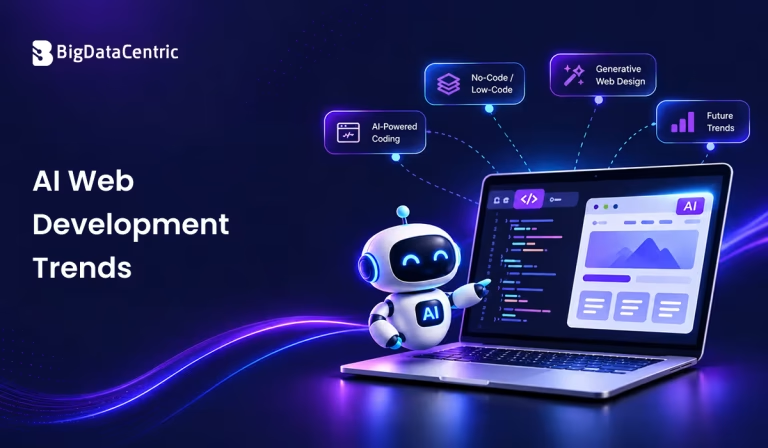
This blog covers the latest AI Web Development Trends in 2026, highlighting how AI is transforming website design, coding, testing, security, and optimization. It explores popular AI development tools, key business benefits, implementation challenges, and best practices. It also explains how businesses can use AI to build smarter, scalable, and user-focused web applications.
Artificial intelligence is changing how websites are designed, developed, and maintained. AI-powered tools can now handle tasks such as code generation, testing, debugging, and performance optimization more efficiently, helping developers save time and improve productivity.
In 2026, AI is playing a bigger role in modern web development through intelligent chatbots, personalized user experiences, automated testing, predictive analytics, and AI-assisted coding. These technologies are helping businesses build smarter, faster, and more responsive websites while improving overall user engagement.
Understanding the latest AI Web Development Trends can help businesses make better technology decisions and stay competitive in a rapidly evolving digital landscape. This blog covers the key developments, popular AI tools, business benefits, challenges, and best practices shaping the future of web development.
Latest Statistics and Market Growth
The global web development market continues to expand as businesses invest in modern websites, digital platforms, and AI-powered solutions. According to Mordor Intelligence, the market is projected to reach $87.75 billion in 2026 and grow to $134.17 billion by 2031, at a CAGR of approximately 8.03%. This growth reflects the increasing demand for advanced web technologies, automation, and personalized digital experiences.
AI adoption is also gaining momentum among developers and enterprises. According to McKinsey, 40% of large enterprises are scaling AI agents, highlighting the growing role of intelligent automation in business operations.
However, increased AI adoption also brings quality and verification challenges. While AI tools can improve development productivity, developers still need to review generated code, check security, and validate functionality before deployment. These developments indicate that AI is becoming an important part of modern website development, with businesses focusing on both development efficiency and reliable digital experiences.
How is AI Transforming the Web Development Industry?
AI is transforming the web development industry by making development processes faster, more automated, and data-driven. Developers can use AI-powered tools to generate code, identify errors, optimize website performance, and automate repetitive tasks that previously required significant manual effort. This allows development teams to focus more on complex functionality, architecture, and project-specific requirements.
AI is also changing how businesses approach website design and user experience. By analyzing user behavior, preferences, and interactions, AI systems can support personalized content recommendations, intelligent search, and responsive customer support. Businesses can use these capabilities to create websites that better match visitor expectations and improve engagement.
Another major change is integrating AI throughout the development lifecycle, from initial planning and design to testing, deployment, and maintenance. AI-powered analytics and automation can help teams identify potential issues, make informed decisions, and maintain website quality. As a result, AI is becoming a valuable part of modern web development, helping businesses build scalable and user-focused digital platforms.
Top 12 AI Web Development Trends
AI is influencing almost every stage of website development, from writing code and designing interfaces to improving security and analyzing user interactions. These 12 trends show how businesses and developers use AI to build more efficient, intelligent, and user-focused web solutions.
AI-powered Code Generation and Automation
AI-powered code generation is helping developers create website components, write functions, and automate repetitive programming tasks using natural language prompts. Instead of writing every line manually, developers can describe the required functionality and use AI tools to generate initial frontend and backend code.
This approach can reduce development time and simplify routine tasks such as creating forms, implementing layouts, and generating API integrations. Developers can also use AI to refactor existing code and identify possible improvements. However, generated code still requires manual review and testing to ensure it meets project requirements.
AI Coding Assistants and Autonomous Agents
AI coding assistants are becoming valuable development partners by suggesting code, explaining complex functions, identifying errors, and helping developers navigate large codebases.
Tools such as GitHub Copilot and Cursor can provide contextual suggestions directly within development environments, making everyday coding tasks more efficient.
Autonomous coding agents take this further by handling multi-step tasks, such as analyzing project requirements, modifying multiple files, running tests, and suggesting fixes. They can support larger development workflows with less manual intervention, while developers remain responsible for reviewing changes, managing architecture, and approving critical decisions.
AI-driven Website Builders
AI-driven website builders let businesses create website layouts and initial page structures with simple text prompts. Users can describe their business, preferred design, and required features, and the platform can generate layouts, content, and design elements without requiring extensive coding knowledge.
These platforms are particularly useful for startups and small businesses that need to establish an online presence quickly. They can also help developers create prototypes and test design ideas before full-scale development.
However, complex websites with custom functionality, integrations, and specific performance requirements may still need professional development.
Hyper-personalized Website Experiences
AI enables websites to deliver personalized experiences by analyzing user preferences, browsing history, previous interactions, and purchasing behavior. Based on these insights, websites can display relevant product recommendations, customized content, and targeted offers that match individual visitor interests.
For example, an eCommerce website can recommend products based on past purchases, while a SaaS platform can customize dashboard content based on user activity. This approach helps businesses make website interactions more relevant, improve engagement, and create experiences that adapt to changing customer needs.
AI-powered UI/UX Design
AI-powered design tools are helping designers create website layouts, generate interface elements, suggest color combinations, and develop wireframes based on project requirements. These capabilities can speed up the initial design process and reduce repetitive prototyping work.
AI can also analyze user interactions, identify navigation difficulties, and highlight areas where visitors may struggle to complete an action. Designers can use these insights to improve page structure, navigation, and interface usability. Human design expertise remains important for maintaining brand consistency and ensuring that the final experience meets user expectations.
AI-driven SEO and Content Optimization
AI is making website optimization more data-driven by helping teams analyze search intent, identify keyword opportunities, and structure website content around relevant topics.
AI-powered tools can also suggest improvements to headings, metadata, internal linking, and content readability based on SEO requirements.
Beyond content creation, AI can support technical SEO by identifying broken links, analyzing page performance, and detecting optimization opportunities.
Businesses can use these insights to improve their organic search strategy, but content accuracy, search intent alignment, and editorial quality still require human evaluation.
Conversational AI and Intelligent Chatbots
Conversational AI is improving how websites interact with visitors through intelligent chatbots and virtual assistants. Using natural language processing and large language models, these systems can understand user questions, provide relevant responses, guide visitors through website features, and assist with common customer support requests.
Unlike traditional rule-based chatbots, modern AI chatbots can maintain conversational context and handle a wider range of questions. Businesses can integrate them with CRM systems, product databases, and support platforms to provide more relevant assistance. For complex queries, they should also offer a smooth option to connect with a human representative.
Automated Website Testing and Debugging
AI-powered testing tools can analyze website functionality, identify potential bugs, and automate repetitive quality assurance activities. They can generate test cases, detect unexpected behavior, and help developers identify issues across different browsers, devices, and user interactions.
AI can also assist with regression testing by identifying areas that may be affected when developers update existing code. This helps teams validate changes more efficiently and reduce the risk of functionality breaking after deployment. However, manual testing remains necessary for complex workflows, usability checks, and critical business operations.
AI-powered Website Security
AI is strengthening website security by analyzing traffic patterns, identifying unusual activities, and detecting potential threats. Machine learning models can examine login attempts, access behavior, and network activity to identify suspicious patterns that traditional rule-based systems may overlook.
AI-powered security solutions can also help detect automated bot attacks, identify vulnerabilities, and prioritize potential risks for investigation.
When integrated with existing security measures, they can improve threat monitoring and response times. Businesses must still maintain encryption, access controls, regular security audits, and human-led incident management.
Predictive Analytics and User Behavior Insights
Predictive analytics uses AI and machine learning to examine historical website data and estimate future user behavior. By analyzing page visits, navigation patterns, engagement, and conversion activity, businesses can identify trends and understand which website elements influence customer decisions.
These insights can help businesses anticipate customer requirements, identify visitors who may leave without converting, and improve website journeys.
For example, an online store can use predictive models to identify products customers are more likely to purchase. This supports better marketing decisions and more effective website optimization.
AI-based Web Accessibility Improvements
AI is helping developers identify accessibility issues and make websites easier to use for people with different needs. AI-powered tools can analyze website elements, detect missing image descriptions, identify certain contrast issues, and suggest improvements to page structure and navigation.
AI can also support automatic caption generation, voice-based interactions, and image descriptions to improve access to digital content. These features can make websites more inclusive, but automated checks cannot guarantee full accessibility. Developers should combine AI assistance with manual testing and established accessibility standards such as WCAG.
AI-optimized Website Performance
Website performance directly affects user experience, engagement, and conversions. AI-powered optimization tools can analyze loading behavior, server responses, resource usage, and traffic patterns to identify performance bottlenecks and recommend suitable improvements.
AI can also support image optimization, caching strategies, resource allocation, and predictive infrastructure scaling based on changing traffic demands. For businesses managing high-traffic websites, these capabilities can help maintain responsiveness and stability.
Developers should still monitor Core Web Vitals, test performance across devices, and validate optimization changes before deployment.
The development approach behind these trends is also evolving, with AI supporting more than code generation. Industry research highlights growing use of AI agents across code generation, testing, documentation, and planning.
Bring Intelligent Web Experiences to Life
From AI-powered chatbots to personalized website features, BigDataCentric develops custom solutions that help businesses create more engaging and efficient digital platforms.
Popular AI Tools for Modern Web Development
AI development tools are helping developers write code, build website interfaces, automate workflows, and manage complex software projects. From coding assistants to autonomous development agents, these tools support different stages of the development process.
Here are six popular tools used in modern web development.
GitHub Copilot
GitHub Copilot is an AI-powered coding assistant that helps developers write code, generate suggestions, explain functions, and identify potential errors. It integrates with popular development environments, including Visual Studio Code, so developers can get coding assistance without frequently switching tools.
Its agent capabilities can also help with multi-step development tasks, such as editing files, running commands, and validating code changes. Developers can use it to improve coding efficiency, generate tests, and handle repetitive programming activities while maintaining control over the final code.
Cursor
Cursor is an AI-focused code editor designed to help developers understand and modify existing codebases. Its AI features can search project files, suggest code changes, explain code, and assist with debugging, making it useful for both new and ongoing development projects.
Cursor’s Agent mode can handle larger tasks by editing multiple files, executing terminal commands, and working through errors. Developers can describe a required feature in natural language and review the proposed changes before accepting them. This makes it useful for feature development, code refactoring, and project maintenance.
Claude Code
Claude Code is an agentic coding tool from Anthropic that helps developers work directly with their codebases through a terminal-based workflow. It can understand project structures, modify files, execute commands, and support tasks such as debugging, code refactoring, and implementing new features.
Developers can use Claude Code to manage multi-step programming tasks instead of requesting individual code suggestions.
It is particularly useful for complex projects that require understanding existing logic and making coordinated changes across multiple files. You should still review and test its output before implementing it.
OpenAI Codex
OpenAI Codex is an AI coding agent that supports software development tasks such as writing, reviewing, debugging, and modifying code. Developers can assign it tasks involving existing codebases and use it through supported interfaces, including the Codex app, command-line interface, and IDE integrations.
Codex can help with routine fixes, test creation, complex refactoring, and codebase modernization. It can also work through multi-step engineering tasks and prepare changes for developer review. This makes it useful for teams that want to delegate repetitive development work while keeping engineers involved in key technical decisions.
Vercel v0
Vercel v0 helps developers generate website interfaces and application code using natural language prompts. It can create React components, landing pages, dashboards, and full-stack applications based on design requirements, reducing the time spent on initial UI development.
Developers can refine generated designs, connect projects with databases and APIs, and deploy applications through Vercel. It is particularly useful for quickly creating prototypes, testing interface ideas, and building frontend components that can later be customized to match project requirements.
Replit Agent
Replit Agent lets users build websites and applications by describing their requirements in natural language. It can generate application code, configure project components, connect databases, and help create functional applications without requiring developers to handle every setup step manually.
One useful capability is its iterative development workflow, where users can provide feedback, request changes, and ask the agent to test and fix issues.
This makes it suitable for building prototypes, internal business applications, and early-stage products. Developers can also refine the generated code to meet specific functionality, security, and scalability requirements.
Key Benefits of AI-Powered Web Development for Businesses
Integrating AI into web development offers businesses several advantages, from faster project delivery to improved website experiences. It helps development teams automate repetitive tasks, use resources more effectively, and build digital platforms that can adapt to changing business requirements.
Faster Development and Deployment
AI-powered tools speed up website development by automating repetitive coding tasks, generating reusable components, and helping with debugging. Developers can complete routine tasks faster, streamline testing, and reduce the time needed to release new features and website updates.
Reduced Development Costs
AI helps businesses reduce development expenses by automating tasks such as code generation, documentation, and basic testing. It also speeds up prototyping and reduces manual effort, allowing development teams to use resources more efficiently while managing project budgets.
Enhanced User Experience and Engagement
AI enables businesses to deliver personalized website experiences through intelligent recommendations, conversational chatbots, and dynamic content. By analyzing visitor preferences and interactions, websites can provide more relevant information, improve navigation, and increase user engagement and conversion opportunities.
Improved Code Quality and Productivity
AI coding assistants help developers generate code, identify potential errors, suggest improvements, and create test cases. These capabilities reduce repetitive work, support code reviews, and allow developers to focus on complex programming tasks while maintaining proper testing and quality checks.
Better Scalability and Maintenance
AI-powered monitoring and analytics help businesses track website performance, detect technical issues, and identify optimization opportunities. These capabilities support ongoing maintenance, smoother updates, and better resource management as website traffic and business requirements increase.
Challenges and Limitations of Using AI in Web Development
Although AI can improve development efficiency, it also brings challenges related to security, reliability, integration, and cost. Businesses need to understand these limitations to adopt AI responsibly and maintain website quality.
Data Privacy and Security Concerns
AI-powered development tools may process sensitive information, including source code, customer details, and business data.
Sharing confidential information without proper security controls can create privacy risks and expose data. Businesses must choose secure tools, implement access controls, and follow applicable data protection regulations.
AI-Generated Code Quality and Reliability
AI-generated code may contain logical errors, security vulnerabilities, or solutions that do not fully match project requirements. Developers must review generated code, test it properly, and validate functionality before deployment to maintain application quality and reliability.
Integration with Existing Web Technologies
Integrating AI capabilities into existing websites can be challenging, especially when businesses use legacy systems, custom applications, or multiple third-party platforms.
API limitations and compatibility issues may require additional development work to ensure smooth communication between AI solutions and existing technologies.
Overdependence on AI Development Tools
Excessive reliance on AI tools can reduce developers’ involvement in problem-solving and critical technical decisions.
Accepting generated suggestions without understanding the underlying code may create maintenance difficulties. Human expertise, code reviews, and technical oversight remain essential for reliable development.
Implementation Costs and Technical Complexity
AI implementation may involve costs for subscriptions, API usage, infrastructure, integration, and ongoing maintenance. Advanced solutions may also require specialized expertise. Businesses should evaluate their requirements and budget carefully before selecting AI technologies for their development projects.
Best Practices for Adopting AI in Web Development
Adopting AI successfully requires more than selecting development tools and integrating them into existing workflows. Businesses should identify practical use cases, maintain proper security standards, and ensure that AI-generated results meet their technical and business requirements.
Identify the Right AI Use Cases
Start by identifying development tasks where AI can provide measurable value, such as code generation, automated testing, chatbot integration, or website performance monitoring.
Prioritize repetitive tasks and areas that require significant manual effort to improve development efficiency without introducing unnecessary complexity.
Select Tools Based on Project Requirements
Choose AI tools according to your project’s technology stack, development requirements, budget, and team expertise. Evaluate integration capabilities, supported programming languages, security features, and scalability before deciding. The right tools should complement existing workflows rather than create additional technical challenges.
Maintain Human Oversight and Code Reviews
AI-generated code and recommendations should always be reviewed by experienced developers before implementation.
Conduct code reviews, run automated tests, and verify functionality to identify errors, security vulnerabilities, and performance issues. Human oversight keeps AI-assisted development reliable and aligned with project requirements.
Prioritize Data Security and Compliance
Protect sensitive business information by selecting AI platforms with appropriate security and privacy controls. Avoid sharing confidential customer data, credentials, or proprietary code without authorization.
Implement access restrictions, encryption, and appropriate data-handling practices to maintain compliance with relevant privacy regulations.
Monitor AI Performance and Development Outcomes
Regularly evaluate how AI tools affect development speed, code quality, website performance, and project costs. Track relevant metrics such as error rates, testing time, deployment frequency, and maintenance requirements to identify areas for improvement.
Continuous monitoring helps businesses determine whether their AI investments are delivering meaningful results.
How BigDataCentric Helps Businesses Adopt AI in Web Development?
BigDataCentric helps businesses build intelligent, scalable, and user-focused digital solutions by integrating AI capabilities into modern web applications.
Its expertise in artificial intelligence, machine learning, generative AI, and custom software development helps businesses implement solutions that align with their technical requirements and operational goals.
From AI-powered chatbot development and intelligent automation to custom web application development and AI integration, BigDataCentric creates solutions that improve functionality, streamline workflows, and enhance user experiences.
By combining modern development technologies with practical AI applications, businesses can build digital platforms that support long-term growth and changing customer expectations.
Whether you want to integrate AI into an existing website or develop a new AI-powered web application, BigDataCentric can help you plan and implement a solution based on your business needs.
Want to Build a Smarter Website with AI?
BigDataCentric helps businesses develop intelligent web solutions with AI-powered automation, personalized experiences, and advanced functionalities tailored to their requirements.
Conclusion
AI is reshaping the web development industry by making coding, designing, testing, and website optimization more efficient. From AI coding assistants and intelligent chatbots to predictive analytics and automated security, these technologies help businesses create smarter, more personalized digital experiences.
Adopting the right AI Web Development Trends can help businesses improve development productivity, reduce manual effort, and build scalable web applications.
However, successful implementation requires choosing the right tools, maintaining code quality, and addressing security and integration challenges. With the right development approach, businesses can use AI to strengthen their digital presence and prepare for future technological changes.
At BigDataCentric, we help businesses integrate AI capabilities into web applications and build custom digital solutions aligned with their goals. Connect with our team to discuss how AI-powered web development can support your next project.
FAQs
Can AI build a complete website without coding?
Yes, AI-powered website builders can generate complete websites using natural language prompts, including layouts, content, and basic functionality. However, complex features, custom integrations, and advanced requirements may still need developer involvement.
How does AI improve website performance and user experience?
AI analyzes user behavior and website performance data to identify optimization opportunities. It also enables personalized recommendations, intelligent chatbots, faster issue detection, and adaptive content to improve user engagement.
How can businesses integrate AI into existing websites?
Businesses can integrate AI through APIs, plugins, and custom solutions such as chatbots, recommendation engines, predictive analytics, and automated support systems. The integration approach depends on the website's technology stack and business requirements.
Can AI replace traditional web development frameworks?
No, AI cannot fully replace traditional web development frameworks. Frameworks such as React, Angular, and Vue.js provide the structure for building applications, while AI assists developers with coding, debugging, testing, and optimization.

About Author
Jayanti Katariya is the CEO of BigDataCentric, a leading provider of AI, machine learning, data science, and business intelligence solutions. With 18+ years of industry experience, he has been at the forefront of helping businesses unlock growth through data-driven insights. Passionate about developing creative technology solutions from a young age, he pursued an engineering degree to further this interest. Under his leadership, BigDataCentric delivers tailored AI and analytics solutions to optimize business processes. His expertise drives innovation in data science, enabling organizations to make smarter, data-backed decisions.
Latest From Our Blog
Stay updated with technical insights, industry trends, and the latest technology developments.