




Big Data Analytics vs Data Science: Key Differences Explained
Blog Summary:
Big Data Analytics and Data Science help businesses turn complex data into valuable insights and smarter decisions. This guide covers their key features, tools, benefits, applications, and major differences. Explore how both fields work together and how BigDataCentric helps businesses build data-driven solutions for growth.
Data has become essential to modern business decision-making. From understanding customer behavior to improving operational efficiency, organizations rely on data to identify opportunities, solve problems, and plan for future growth.
However, collecting large amounts of information is only the beginning. Businesses also need the right techniques and technologies to turn that information into meaningful insights.
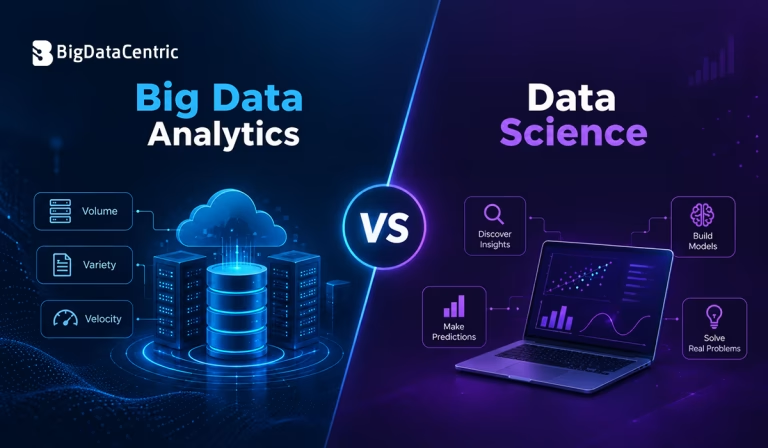
This is where big data analytics and data science come in. Both fields help organizations extract value from data, but they differ in their objectives, methods, and applications. Big data analytics focuses on examining large and complex datasets to identify patterns, trends, and actionable business insights.
Data science takes a broader approach by combining statistics, programming, machine learning, and analytical methods to understand data and develop predictive solutions.
Understanding the difference between these two fields is important for businesses planning to invest in data-driven technologies. One may focus on improving existing processes and supporting business decisions, while the other may help develop intelligent models and uncover new possibilities.
In this blog, we will explore the key features, business benefits, and practical applications of Big Data Analytics vs Data Science. We will also compare their tools, objectives, and roles to help you understand how these fields differ and how they can work together to support business growth.
Introduction to Big Data Analytics
Big data analytics is the process of examining large and complex datasets to identify patterns, trends, and meaningful insights that help businesses make informed decisions. It combines data-processing technologies, statistical techniques, and analytical methods to turn raw data into valuable business information.
Modern businesses generate massive amounts of data through customer transactions, social media, websites, IoT devices, and business applications. Traditional data analysis methods may struggle to handle this information efficiently, especially when data is generated at high speed and in different formats. Big data analytics helps organizations process and analyze such information to uncover useful insights.
For example, an e-commerce business can analyze customer purchases, browsing behavior, and product reviews to understand buying preferences. These insights can help improve product recommendations, optimize inventory, and enhance customer experiences.
Big data analytics is widely used across industries such as healthcare, finance, retail, manufacturing, and transportation. It supports applications ranging from fraud detection and customer behavior analysis to operational monitoring and demand forecasting.
By using big data analytics, organizations can move beyond simply collecting information and start using it to identify opportunities, improve efficiency, and support strategic business decisions.
Key Features of Big Data Analytics
Big data analytics offers several capabilities that help businesses process large datasets, identify valuable insights, and improve decision-making. Its key features include large-scale data processing, real-time data analysis, predictive analytics, and data visualization.
These capabilities allow organizations to manage complex information efficiently and turn raw data into actionable business insights.
Large-Scale Data Processing
Big data analytics enables businesses to process massive volumes of structured, semi-structured, and unstructured data from multiple sources. It uses scalable data processing technologies to handle information that may be difficult to manage with traditional systems.
For example, a retail business can analyze customer transactions, website activity, and social media interactions together to understand purchasing patterns. This helps organizations identify trends and make data-driven decisions without relying on isolated datasets.
Real-time Data Analysis
Real-time data analysis allows businesses to examine information as it is generated or received. This helps organizations respond quickly to changing conditions, detect potential issues, and make timely decisions.
For instance, financial institutions can monitor transactions to identify suspicious activities, while logistics companies can analyze live vehicle data to track deliveries and improve route planning.
Predictive Analytics
Predictive analytics uses historical data, statistical techniques, and machine learning methods to identify patterns and estimate possible future outcomes. It helps businesses anticipate customer needs, operational challenges, and market changes.
For example, a manufacturing company can analyze equipment performance data to identify signs of potential failures. This lets the business plan maintenance and reduce unexpected downtime.
Data Visualization
Data visualization presents complex analytical findings through charts, graphs, dashboards, and other visual formats. It makes large amounts of information easier to understand and helps business teams identify important trends and patterns.
For example, a sales dashboard can display revenue trends, product performance, and customer demand across different regions. This enables managers to quickly understand business performance and make informed decisions.
Together, these features make big data analytics useful for organizations that need to process large amounts of information, identify business opportunities, and improve operational efficiency.
Why Use Big Data Analytics for Your Business?
Big data analytics helps businesses turn large amounts of information into meaningful insights that support better decisions and improved operations. By analyzing data from different sources, organizations can understand customer behavior, identify inefficiencies, and respond to changing market conditions.
Here are some key benefits of using big data analytics for your business.
Improve Business Decision-Making
Big data analytics provides valuable insights into business performance, customer preferences, and market trends. Instead of relying only on assumptions, businesses can use data to make more informed decisions.
For example, a retail company can analyze sales data to identify best-selling products and adjust inventory based on customer demand.
Enhance Customer Experience
Businesses can analyze customer interactions, purchase history, and feedback to understand what their customers need. These insights help organizations personalize services, improve recommendations, and deliver better experiences.
For example, an e-commerce platform can use customer behavior data to suggest products based on past purchases and browsing activity.
Increase Operational Efficiency
Big data analytics helps organizations identify bottlenecks, unnecessary expenses, and areas for improvement. By examining operational data, businesses can optimize workflows and use resources more effectively.
A manufacturing company can analyze production data to identify delays, monitor equipment performance, and improve production planning.
Identify New Business Opportunities
Analyzing market trends and customer behavior can help businesses discover new opportunities. Organizations can identify changing customer needs, explore new markets, and develop products or services that meet demand.
For example, a company may discover increasing demand for a particular product category and use that insight to expand its offerings.
Support Risk Management
Big data analytics can help businesses identify unusual patterns and potential risks by examining large volumes of historical and real-time information.
For example, financial institutions can analyze transaction data to detect suspicious activity and support fraud prevention efforts.
Gain a Competitive Advantage
Organizations that use their data effectively can respond faster to market changes and improve their business strategies. Insights from big data analytics can support better planning, efficient operations, and customer-focused services.
However, the value of big data analytics depends on data quality, appropriate technologies, and the ability to act on the insights generated. When implemented effectively, it can become an important part of a business’s data-driven strategy.
Turn Your Business Data Into Growth
Unlock the power of big data analytics with BigDataCentric to uncover valuable insights, improve decisions, and drive business growth.
Introduction to Data Science
Data science is an interdisciplinary field that combines statistics, mathematics, programming, and machine learning to extract meaningful insights from data. It helps businesses understand complex information, identify patterns, and solve real-world problems.
Businesses generate data through customer interactions, financial transactions, websites, and mobile applications. Data science analyzes this information, uncovers valuable relationships, and supports informed decision-making.
For example, an e-commerce company can use data science to study customer preferences and purchase history. By applying machine learning, it can develop recommendation models that suggest relevant products and improve customer experiences.
Data science is widely used in healthcare, finance, retail, and manufacturing for applications such as predictive modeling, fraud detection, demand forecasting, and intelligent automation. By combining analytical techniques with programming and machine learning, it helps organizations turn data into practical solutions.
Key Features of Data Science
Data science combines statistical methods, programming, and machine learning to help businesses understand data and develop practical solutions. Its key features include statistical analysis, machine learning, predictive modeling, and data visualization.
Statistical Analysis
Statistical analysis helps businesses identify patterns, relationships, and trends within datasets. It uses mathematical methods to understand data, measure uncertainty, and support informed decision-making.
For example, a business can analyze customer survey results to understand satisfaction levels and identify areas that need improvement. Statistical analysis also helps data scientists evaluate findings and determine whether observed patterns are meaningful.
Machine Learning
Machine learning enables systems to learn from data and identify patterns without explicit programming for every task. It is an important part of data science and supports applications such as customer recommendations, fraud detection, and automation.
Businesses can use machine learning to analyze customer behavior, recognize unusual transactions, and improve business processes. As models learn from relevant data, they can support more effective predictions and personalized experiences.
Predictive Modeling
Predictive modeling uses historical data, statistical techniques, and machine learning algorithms to estimate possible future outcomes. It helps businesses anticipate customer demand, identify risks, and improve planning.
For example, a retail company can build a predictive model to forecast product demand based on previous sales, seasonal trends, and customer behavior. These predictions can help businesses prepare inventory and make better operational decisions.
Data Visualization
Data visualization presents complex information through charts, graphs, and dashboards, making it easier to understand patterns and communicate findings. It helps data scientists and business teams interpret analytical results.
For example, a business can use visual reports to compare sales performance, identify customer trends, and monitor important business metrics. Effective visualizations make complex data easier to understand and support data-driven decisions.
Why Use Data Science for Your Business?
Data science helps businesses turn raw data into meaningful insights, improve decision-making, and develop intelligent solutions. By combining statistical analysis, machine learning, and predictive modeling, organizations can solve complex problems and identify new opportunities.
Make Better Business Decisions
Data science helps businesses analyze information, identify patterns, and understand trends. These insights allow decision-makers to make informed choices based on data rather than assumptions.
Improve Customer Experience
Businesses can use data science to understand customer preferences, purchase behavior, and interactions. This helps deliver personalized recommendations, improve services, and build stronger customer relationships.
Predict Future Trends
Predictive models help organizations estimate future demand, identify potential risks, and plan business activities. For example, retailers can forecast product demand and optimize inventory based on historical sales data.
Automate Business Processes
Machine learning models can automate repetitive tasks such as fraud detection, customer segmentation, and data classification. This reduces manual effort and allows employees to focus on more complex responsibilities.
Develop Intelligent Products
Data science supports the development of AI-powered applications, recommendation systems, and predictive tools. These solutions help businesses improve efficiency, create new services, and deliver greater value to customers.
Unlock the Power of Data Science
Turn your data into smarter decisions with BigDataCentric’s data science solutions, designed to uncover insights, solve complex challenges, and drive business growth.
Big Data Analytics vs Data Science – A Quick Tabular Comparison
Big data analytics and data science both help businesses extract value from data, but they differ in their primary focus, methods, and applications. The following table highlights the key differences between these two fields.
| Comparison | Big Data Analytics | Data Science |
|---|---|---|
| Definition | Examines large and complex datasets to identify patterns, trends, and business insights. | Uses statistics, programming, and machine learning to extract insights and develop data-driven solutions. |
| Main Focus | Processing and analyzing large volumes of data to support business decisions. | Understanding data, solving complex problems, and building predictive models. |
| Data Types | Structured, semi-structured, and unstructured data, often at large scale. | Structured, semi-structured, and unstructured data, depending on the project. |
| Primary Goal | Improve business performance, identify trends, and support operational decisions. | Discover insights, predict outcomes, and develop intelligent applications. |
| Common Applications | Fraud detection, customer behavior analysis, operational monitoring, and demand forecasting. | Predictive modeling, recommendation systems, customer segmentation, and AI applications. |
| Key Technologies | Apache Hadoop, Apache Spark, Apache Kafka, and distributed data processing platforms. | Python, R, Jupyter, TensorFlow, PyTorch, and machine learning frameworks. |
| Professionals | Big Data Analyst, Big Data Engineer, and Data Analytics Specialist. | Data Scientist, Machine Learning Engineer, and Data Science Specialist. |
While big data analytics focuses on extracting insights from large-scale information, data science combines analytical and computational methods to solve broader data-related problems. Both can be valuable depending on a business’s objectives and data requirements.
Big Data Analytics vs Data Science: An Extensive Comparison Analysis
Big data analytics and data science both help businesses extract meaningful insights from data, but their objectives and approaches can differ. Big data analytics focuses on processing and examining large datasets to identify trends, patterns, and actionable insights.
Data science takes a broader approach by combining statistics, programming, and machine learning to solve complex problems and develop predictive solutions.
Understanding these differences helps businesses choose the right approach for their requirements. Some organizations may need large-scale data processing to improve operational efficiency, while others may focus on predictive modeling or developing AI-powered applications.
The following comparison explores the key differences between big data analytics and data science.
Scope and Objectives
Big data analytics focuses on analyzing large volumes of structured, semi-structured, and unstructured data to uncover valuable business insights. Its scope includes data processing, trend identification, performance analysis, and reporting. Organizations use it to understand what happened in their business and identify patterns that can support operational and strategic decisions.
Data science has a broader scope, extending from data collection and preparation to statistical analysis, machine learning, and predictive modeling. It helps businesses explore complex problems, understand relationships within data, and develop solutions for future scenarios. Data scientists may also create intelligent systems that automate tasks or support business processes.
Data Processing and Analysis
Big data analytics uses scalable technologies to process massive datasets generated from sources such as customer transactions, websites, IoT devices, and business applications. Distributed processing frameworks help organizations handle large volumes of information efficiently. The analysis focuses on identifying patterns, trends, and insights that can improve business performance and decision-making.
Data science also involves collecting, cleaning, and analyzing data, but the methods depend on the problem and the dataset. Data scientists may work with small or large datasets and apply statistical techniques, exploratory analysis, and machine learning algorithms. Their goal is to understand the data and develop solutions that address specific business requirements.
Tools and Technologies
Big data analytics commonly uses technologies such as Apache Hadoop, Apache Spark, and Apache Kafka to manage and process large datasets. These tools support distributed computing, data processing, and real-time data handling. Businesses use them to analyze information from multiple sources and build scalable analytical workflows.
Data science relies on tools such as Python, R, Jupyter, TensorFlow, and PyTorch for data analysis and model development. Python and R support statistical analysis and data preparation, while machine learning frameworks help build and evaluate predictive models. The choice of technology depends on the project requirements, data complexity, and desired outcomes.
Machine Learning and AI
Big data analytics can incorporate machine learning techniques to identify patterns, detect anomalies, and generate predictions from large datasets. For example, financial institutions can analyze transaction data to identify suspicious activities, while retailers can study customer behavior to forecast demand. However, machine learning is not required for every big data analytics project.
Data science places greater emphasis on developing and applying machine learning models to solve complex problems. Data scientists use AI techniques for applications such as recommendation systems, natural language processing, image recognition, and predictive maintenance. These models help businesses automate tasks and develop intelligent, data-driven solutions.
Career Opportunities
Big data analytics offers career opportunities such as Big Data Analyst, Big Data Engineer, and Data Analytics Specialist. These professionals work with large datasets, data processing systems, and analytical tools. Their responsibilities may include preparing data, identifying trends, managing analytical workflows, and supporting business decision-making.
Data science offers roles such as Data Scientist, Machine Learning Engineer, and Data Science Specialist. These professionals may focus on statistical analysis, predictive modeling, machine learning, and developing AI-powered applications. Their work often involves solving complex problems and creating data-driven solutions for different industries.
Business Applications
Big data analytics is widely used in industries such as retail, finance, healthcare, and manufacturing. Businesses apply it to customer behavior analysis, fraud detection, operational monitoring, and demand forecasting. For example, a retail company can analyze sales data to understand product performance and improve inventory planning.
Data science supports applications such as personalized recommendations, predictive maintenance, customer segmentation, and AI-powered products. It helps businesses understand complex patterns and build data-driven solutions. For example, an e-commerce company can use machine learning to recommend products based on customer preferences and purchase history.
How Do Big Data Analytics and Data Science Work Together?
Big data analytics and data science work together to help businesses turn large amounts of information into meaningful insights and practical solutions.
Big data analytics focuses on processing and analyzing complex datasets, while data science uses statistical methods, machine learning, and predictive modeling to uncover deeper patterns. Combining these capabilities allows organizations to understand existing data and explore future possibilities.
For example, an e-commerce business can use big data analytics to process customer transactions, browsing activity, and product reviews. Data science can then use this information to build recommendation models, predict customer demand, and identify purchasing patterns. Together, they help businesses improve customer experiences and make more informed decisions.
Big data analytics provides data-processing capabilities, while data science contributes analytical methods and intelligent models. Together, they support applications such as fraud detection, predictive maintenance, customer segmentation, and demand forecasting. Collaboration between these fields helps organizations make better use of their data and develop data-driven business solutions.
Which is Best for Your Business – Big Data Analytics or Data Science?
Choosing between big data analytics and data science depends on your business goals, data requirements, and the type of solutions you want to develop. Both fields help organizations use data effectively, but their applications may differ. Understanding your business needs can help you select the right approach.
When to Choose Big Data Analytics
Big data analytics suits businesses that need to process and analyze large volumes of information to improve operations and support decision-making. It can help organizations identify trends, monitor performance, and understand customer behavior.
For example, a retail company handling millions of transactions may use big data analytics to analyze sales patterns, optimize inventory, and identify changes in customer demand. It is also useful for businesses that need real-time data analysis and scalable data processing.
When to Choose Data Science
Data science suits businesses that want to develop predictive models, build intelligent applications, or solve complex problems with data. It combines statistical analysis, programming, and machine learning to discover patterns and create data-driven solutions.
For example, an e-commerce company may use data science to build product recommendation systems, predict customer preferences, and develop personalized experiences. Businesses planning AI-powered applications or predictive solutions may benefit from data science expertise.
Can Your Business Use Both?
Yes, businesses can use big data analytics and data science together to address different requirements. Big data analytics can help process and organize large datasets, while data science can use that information to develop predictive models and intelligent solutions.
For example, a manufacturing company can use big data analytics to process machine sensor data and monitor equipment performance. Data science can then analyze these patterns to build predictive maintenance models that help identify potential equipment failures.
Ready to Make Your Business More Data-Driven?
BigDataCentric helps businesses leverage AI, data science, and big data analytics to uncover insights, improve efficiency, and drive smarter business growth.
Wrapping it Up
Big data analytics and data science both play an important role in helping businesses make better use of their data. While big data analytics focuses on processing large datasets and identifying meaningful patterns, data science combines statistical analysis, programming, and machine learning to solve complex problems and develop predictive solutions.
Choosing the right approach depends on your business requirements, data volume, and desired outcomes. Big data analytics can support operational efficiency and business insights, while data science can help develop intelligent applications and predictive models.
Businesses can also combine both fields to improve decision-making, enhance customer experiences, and develop data-driven solutions. By understanding their differences and applications, organizations can make better use of their data and support long-term business growth.
At BigDataCentric, we help businesses explore the potential of data-driven technologies through our AI, machine learning, data science, and business intelligence services. Whether you need to analyze complex datasets, build predictive models, or develop intelligent business solutions, our team can help you identify the right approach for your goals. Explore our AI and data science solutions to discover how we can support your digital transformation journey.
FAQs
Can Big Data Analytics and Data Science be used together?
Yes, Big Data Analytics and Data Science can be used together to process large datasets, identify patterns, and build predictive models. Big data analytics provides insights, while data science helps develop intelligent solutions.
What programming languages are used in Data Science and Big Data?
Python, R, and SQL are commonly used in Data Science for data analysis and machine learning. Big Data projects also use Java, Scala, and Python with technologies such as Apache Spark and Hadoop.
Can Big Data Analytics be used without machine learning?
Yes, Big Data Analytics can be used without machine learning. Businesses can use statistical analysis, data querying, reporting, and visualization to identify trends and support decision-making.
What is the role of cloud computing in Big Data Analytics?
Cloud computing provides scalable storage and computing resources for processing large datasets. It helps businesses manage data efficiently, scale analytics workloads, and reduce the need for maintaining physical infrastructure.
How do analytics and Data Science support digital transformation?
Analytics and Data Science help businesses improve decision-making, automate processes, and develop intelligent solutions. They support digital transformation by turning data into actionable insights and enabling more efficient business operations.


Jayanti Katariya is the CEO of BigDataCentric, a leading provider of AI, machine learning, data science, and business intelligence solutions. With 18+ years of industry experience, he has been at the forefront of helping businesses unlock growth through data-driven insights. Passionate about developing creative technology solutions from a young age, he pursued an engineering degree to further this interest. Under his leadership, BigDataCentric delivers tailored AI and analytics solutions to optimize business processes. His expertise drives innovation in data science, enabling organizations to make smarter, data-backed decisions.


