




How to Build an AI Model: A Complete Step-by-Step Guide
Blog Summary:
Building an AI model involves defining objectives, preparing data, selecting algorithms, training, and evaluating performance. This blog covers AI model types, key components, development steps, and deployment considerations. It also highlights factors such as scalability, security, cost, and responsible AI development.
Artificial intelligence has evolved from an emerging technology into a practical tool for modern businesses, helping organizations automate tasks, analyze large datasets, personalize experiences, and improve decision-making. The global AI market reached approximately $184 billion in 2024 and is projected to exceed $826 billion by 2030.
Generative AI adoption is also growing rapidly, with spending increasing from $29 billion in 2022 to $50 billion in 2024. This growth is encouraging businesses to develop AI capabilities tailored to their specific products, processes, and customer needs.
However, developing an AI solution involves much more than selecting an algorithm and feeding it data. Building an AI model requires a clearly defined objective, relevant and high-quality data, an appropriate algorithm, sufficient computing resources, model training, and thorough evaluation.
Enterprise AI model development can typically cost around $40,000 to $400,000, while projects may take 6 to 18 months to move from initial planning to production. Data preparation can also take much longer than algorithm design, making proper data collection, cleaning, and preparation critical to the development process.
In this blog, we’ll cover the fundamentals of AI models, their different types and key components, and the major stages involved in How to Build AI Model effectively. We’ll also discuss the factors that influence model performance, scalability, security, and development costs, giving you a practical understanding of what it takes to develop and deploy a reliable AI model.
What is an AI Model?
An AI model is a computational system trained to identify patterns in data and use those patterns to produce predictions, classifications, recommendations, or generated outputs. Instead of following only a fixed set of manually programmed rules, an AI model learns relationships from examples and applies what it has learned to new inputs.
For example, a model trained on historical customer data can predict whether a new customer is likely to make a purchase, while an image recognition model can identify objects or classify images based on visual patterns.
An AI model typically consists of several interconnected elements, including training data, algorithms, parameters, and an objective or loss function. During training, the model processes data, compares its predictions with the expected results, and adjusts its parameters to reduce errors.
The trained model can then be evaluated using previously unseen data to determine how well it generalizes beyond the examples used during training. The complexity of this process depends on the type of problem, the amount and quality of available data, and the architecture selected for the model.
AI models can be developed for a wide range of applications, from relatively simple predictive systems to complex deep learning and generative AI solutions. Some models are trained from scratch for highly specific requirements, while others use pre-trained models that can be fine-tuned or adapted for a particular task.
Understanding these different approaches is essential when planning building an AI model, because the right model type and development strategy depend largely on the business objective, available resources, data, and expected output.
Types of AI Models
AI models can be categorized based on how they learn from data, the type of problem they solve, and the output they produce. Choosing the right model type depends on factors such as data availability, business objectives, task complexity, and the required level of accuracy.
The major types include supervised learning, unsupervised learning, reinforcement learning, deep learning, generative AI, and foundation or specialized models.
Supervised Learning
Supervised learning uses labeled datasets containing input data and corresponding expected outputs. The model learns the relationship between them and applies that knowledge to make predictions on new data.
It is commonly used for classification and regression tasks, such as fraud detection, customer churn prediction, image classification, sales forecasting, and demand prediction. The quality and accuracy of labeled training data play a major role in how reliably the model performs.
Unsupervised Learning
Unsupervised learning works with data that has no predefined labels or expected outputs. Instead, the model identifies hidden patterns, similarities, relationships, or groups within the dataset. Common applications include customer segmentation, anomaly detection, recommendation systems, and pattern discovery.
Techniques such as clustering and dimensionality reduction can help organizations analyze complex datasets and uncover useful insights that may not be immediately apparent.
Reinforcement Learning
Reinforcement learning involves an agent interacting with an environment and learning through rewards or penalties based on its actions. Rather than receiving the correct answer for each situation, the agent gradually learns which actions are more likely to produce desirable outcomes.
This approach is used in areas such as robotics, autonomous systems, game-playing, resource optimization, and other decision-making applications where the model needs to determine the best sequence of actions over time.
Deep Learning (Neural Networks)
Deep learning uses multi-layered neural networks to identify complex patterns and relationships within large datasets. These models are particularly effective for processing unstructured information such as images, speech, video, and natural language.
Different architectures suit different tasks, including convolutional neural networks for image processing and transformer-based architectures for language and other sequential data. Deep learning models can contain millions or billions of parameters and often require substantial training data and computing resources.
Generative AI Models
Generative AI models produce new content based on patterns learned from their training data. They can generate text, images, audio, video, code, and other content, depending on their architecture and training.
Large language models and image generation models are common examples, with applications ranging from virtual assistants and content creation to software development and document processing. Organizations can also customize existing generative models for specific business requirements using approaches such as fine-tuning and retrieval-augmented generation.
Foundation & Specialized Models
Foundation models are broadly trained models that can support multiple tasks and applications, while specialized models are designed or adapted for a specific domain, task, or industry requirement. Foundation models can provide a starting point for customization, reducing the need to develop every capability from scratch.
Specialized models may be more suitable when an application requires domain-specific knowledge, predictable performance, or tighter control over its outputs, such as models used for financial analysis, medical document processing, fraud detection, or industrial monitoring.
Create AI That Fits Your Business
Develop a custom AI solution designed around your unique workflows, data, performance requirements, and long-term business objectives.
Key Components of an AI Model
An AI model relies on several components that work together to learn from data and produce useful outputs. The choice of algorithm, training data quality, number of parameters, available computing resources, and objective function can all affect how effectively a model learns and performs.
Understanding these components provides a foundation for making informed decisions during AI model development.
Algorithms
Algorithms define the mathematical and computational methods an AI model uses to identify patterns in data and generate predictions or outputs.
Different algorithms suit different problems, such as regression for numerical predictions, decision trees for classification, clustering for grouping data, and neural networks for complex patterns. Choosing an appropriate algorithm depends on the data type, problem complexity, accuracy requirements, interpretability needs, and available resources.
Training Data
Training data provides the examples from which an AI model learns patterns and relationships. It can include text, images, audio, video, numerical records, or other structured and unstructured information, depending on the intended application.
The data should be relevant, sufficiently representative, and properly prepared because incomplete, biased, duplicated, or inaccurate data can hurt model performance and produce unreliable results.
Parameters
Parameters are internal values that an AI model adjusts during training to improve its predictions. In neural networks, these commonly include weights and biases that determine how strongly different inputs influence the model’s output.
More parameters let a model represent complex patterns, but they can also increase training requirements, memory usage, and computational costs. The right number depends on the model architecture and the task’s complexity.
Compute Power
Compute power provides the processing capacity required to train, test, and run an AI model. Smaller models may train effectively on CPUs, while larger machine learning and deep learning models often require GPUs or other specialized hardware to process large datasets efficiently.
Computing requirements depend on factors such as dataset size, model complexity, training duration, and deployment requirements, making infrastructure planning an important part of AI development.
Objective Function
An objective function defines what the model optimizes during training. It measures the difference between the model’s predictions and the desired results, allowing the training process to adjust the model’s parameters.
For example, a classification model may use a loss function that measures prediction errors, while a regression model may use a function based on the difference between predicted and actual numerical values.
How to Build AI Model Step by Step
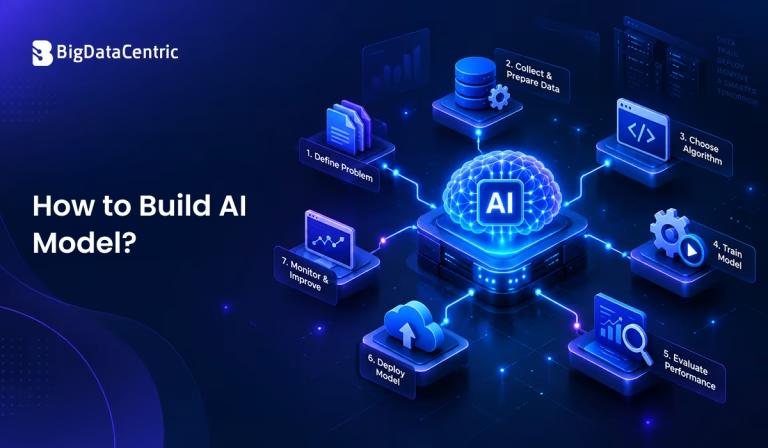
Building an AI model involves a structured process that starts with defining the problem and ends with deploying and maintaining the trained system. Each stage influences the next, from selecting suitable data and algorithms to evaluating performance and preparing the model for real-world use.
A successful development process requires both technical planning and a clear understanding of the intended business outcome. The following steps outline how organizations can move from an initial AI concept to a functional and maintainable model.
Define the AI Model Requirements and Objectives
The first step is to clearly define what the AI model needs to accomplish. Identify the business problem, expected outcome, target users, input data, and type of output required. Objectives may include predicting customer churn, classifying images, detecting fraud, forecasting demand, or generating content.
Also establish measurable technical requirements before development begins. These may include expected accuracy, response time, scalability, integration needs, security requirements, and compliance considerations. A clearly defined scope helps determine the most suitable development approach.
Collect and Prepare the Data
Data forms the foundation of an AI model, so collect relevant information from suitable, reliable sources. Depending on the use case, data may come from internal databases, application logs, APIs, sensors, public datasets, or customer interactions. The collected data should represent the situations the model will encounter after deployment.
Raw data usually requires considerable preparation before training. This may involve removing duplicates, handling missing values, correcting inconsistencies, managing outliers, and transforming data into usable formats. The dataset is then commonly divided into training, validation, and testing sets for different stages of development.
Choose the Right Model and Algorithm
The right algorithm or model architecture depends on the problem, data type, performance requirements, and application complexity. Classification, regression, clustering, computer vision, natural language processing, and generative tasks can require different approaches. Developers should also consider interpretability, computational requirements, and available resources.
For some applications, traditional machine learning algorithms may provide sufficient performance with lower complexity. More demanding use cases may require neural networks, deep learning architectures, or a pre-trained model adapted to the specific task. Comparing suitable approaches using representative data can help identify the right option.
Train and Optimize the AI Model
During training, the selected model processes the training data and adjusts its internal parameters to improve predictions. An objective or loss function measures the model’s errors, while an optimization method determines how to update its parameters. Training typically runs for multiple iterations until the model reaches an acceptable performance level.
Optimization may involve adjusting hyperparameters such as learning rate, batch size, model depth, or regularization settings. Developers can use techniques such as cross-validation and early stopping to improve generalization and reduce overfitting.
AI model optimization can improve performance and efficiency while balancing accuracy with computational requirements. Multiple training experiments may be required before reaching the desired results.
Evaluate and Validate the Model
After training, test the model on data it did not use to train. This helps determine whether it can generalize to new inputs rather than simply memorizing training examples. Depending on the task, evaluation may use metrics such as accuracy, precision, recall, F1 score, or mean absolute error.
Evaluation should also consider how the model performs across different data segments and realistic operating conditions. Developers can analyze incorrect predictions and compare results against predefined performance requirements. If the results are insufficient, the model may require additional data, algorithm changes, parameter tuning, or further training.
Deploy, Monitor, and Maintain the Model
Once the model meets the required performance criteria, it can be deployed into the intended application or production environment. Deployment may involve exposing the model through an API, integrating it into an application, or hosting it on cloud or on-premises infrastructure. Containers and API frameworks can also help package and serve models consistently.
Model development does not end after deployment because real-world data and user behavior can change over time. Monitoring should track prediction quality, response time, availability, data drift, and resource usage. Regular evaluation, retraining, and updates can help maintain performance and ensure the model continues to meet business requirements.
Factors to Consider When Building an AI Model
Developing an AI model requires more than selecting an algorithm and training it on available data. Data quality, performance requirements, infrastructure, security, cost, and responsible development can all influence the reliability and long-term success of the solution. Considering these factors early can help you build a practical, scalable model.
Data Quality and Availability
High-quality data is essential for developing a reliable AI model. Training data should be accurate, relevant, diverse, and representative of real-world scenarios, and teams should address missing values, duplicates, inconsistencies, and bias. Organizations should also plan how they will collect, label, store, and update data over time.
Model Accuracy and Performance
Measure model performance with metrics that match the use case, such as accuracy, precision, recall, F1 score, or mean absolute error. Developers should also evaluate response time, reliability, and performance on unseen data. The goal is to balance prediction quality with the application’s practical requirements.
Scalability and Infrastructure
AI infrastructure should support both model development and future production requirements. Depending on model complexity and data volume, projects may require CPUs, GPUs, cloud platforms, distributed computing, or specialized hardware. Planning infrastructure for expected growth helps maintain performance without introducing unnecessary complexity.
Security and Privacy
Security and privacy are particularly important when AI models process personal, financial, or confidential business data. Organizations should implement appropriate access controls, encryption, secure storage, authentication, and monitoring. They should also assess risks such as data leakage, unauthorized access, and exposure of sensitive information through model outputs.
Cost and Resource Requirements
AI development costs depend on factors such as data preparation, model complexity, computing resources, engineering expertise, deployment, and ongoing maintenance.
A realistic budget helps organizations choose an approach that meets their requirements without unnecessary infrastructure or development expenses. Resource planning should also account for future retraining and monitoring.
Ethical AI and Responsible Development
Responsible AI development involves considering fairness, transparency, privacy, safety, and potential bias throughout the model lifecycle. Developers should evaluate training data and model outputs for unintended biases and establish appropriate human oversight for sensitive applications. Continuous monitoring and clear documentation can help identify and address issues after deployment.
How Much Does It Cost to Build an AI Model?
The cost of developing an AI model can vary significantly depending on the project’s complexity, data requirements, model architecture, development approach, and infrastructure. A basic machine learning model using an existing dataset may require a relatively modest investment, while a custom AI model trained on large datasets can require substantially more resources.
Development expenses may include data collection and preparation, AI and software engineering, model training, testing, cloud or hardware infrastructure, deployment, and ongoing maintenance.
For enterprise-level projects, development costs can range from approximately $40,000 to $400,000, although complex solutions can exceed this range. The timeline can also vary from a few months to more than a year depending on the scope and technical requirements.
Organizations can manage costs by defining a focused use case, using suitable pre-trained models where practical, optimizing computing resources, and planning maintenance requirements from the beginning.
Build Custom AI Models With BigDataCentric
BigDataCentric helps businesses develop AI solutions aligned with their specific goals, data, workflows, and technical requirements. Its AI development capabilities cover machine learning, deep learning, generative AI, computer vision, and intelligent automation, supporting projects from initial planning through deployment and optimization.
For organizations considering custom AI model development, the approach can be tailored to the use case’s complexity, available data, performance requirements, and deployment environment.
BigDataCentric also supports AI integration, monitoring, optimization, and ongoing maintenance, helping businesses move from an AI concept to a production-ready solution and continue improving it as requirements evolve.
If you’re planning a custom AI model for predictive analytics, automation, natural language processing, computer vision, or another business application, BigDataCentric can help define the right development strategy and technology approach for your requirements.
Ready to Build Your AI Model?
From data preparation and model training to deployment and optimization, our AI development team can help turn your requirements into a reliable AI solution.
Conclusion
Building an AI model is a structured process that starts with a clearly defined objective and continues through data preparation, algorithm selection, training, evaluation, deployment, and ongoing maintenance. The right approach depends on the use case, data availability, performance requirements, infrastructure, budget, and required level of customization.
From selecting the appropriate model type to maintaining performance after deployment, each stage can influence the reliability and effectiveness of the final solution. Whether an organization is developing a predictive model, generative AI application, or specialized machine learning system, careful planning and responsible development are essential for turning an AI concept into a practical business solution.
FAQs
How Long Does It Take to Build an AI Model?
The timeline can range from a few weeks to several months, depending on the model's complexity, data availability, customization, and deployment requirements. Enterprise-level projects can take 6–18 months from planning to production.
Which tools and frameworks are used to build AI models?
Common tools and frameworks include Python, TensorFlow, PyTorch, scikit-learn, Keras, Jupyter, and Hugging Face. The right choice depends on the model type, data, development requirements, and deployment environment.
Can I build an AI model without coding?
Yes, no-code and low-code AI platforms can help create and train certain models without extensive programming knowledge. However, custom or complex AI solutions usually require coding and expertise in data science, machine learning, and model deployment.
What challenges do businesses face when building AI models?
Common challenges include limited or poor-quality data, high computing costs, model accuracy, scalability, data privacy, security, and finding skilled AI professionals. Maintaining model performance after deployment can also require continuous monitoring and retraining.


Jayanti Katariya is the CEO of BigDataCentric, a leading provider of AI, machine learning, data science, and business intelligence solutions. With 18+ years of industry experience, he has been at the forefront of helping businesses unlock growth through data-driven insights. Passionate about developing creative technology solutions from a young age, he pursued an engineering degree to further this interest. Under his leadership, BigDataCentric delivers tailored AI and analytics solutions to optimize business processes. His expertise drives innovation in data science, enabling organizations to make smarter, data-backed decisions.


