




Reinforcement Learning Applications in Real-World Systems
Blog Summary:
This guide explains how reinforcement learning enables intelligent systems to learn from experience and improve decision-making over time. It covers key benefits, real-world reinforcement learning applications, and industry use cases across robotics, healthcare, finance, gaming, and automation. It also highlights major challenges businesses face while implementing reinforcement learning models in practical environments.
Machines are no longer limited to following predefined instructions. Today, they can learn from experience, adapt to changing situations, and improve their decisions over time. This is where reinforcement learning becomes important. It is a branch of machine learning in which an agent learns by interacting with an environment and receiving rewards or penalties based on its actions.
From recommendation engines and robotics to autonomous vehicles and financial systems, businesses are increasingly exploring Reinforcement Learning Applications to solve complex decision-making problems. Unlike traditional models that depend heavily on labeled datasets, reinforcement learning focuses on trial-and-error learning, making it highly effective for dynamic and unpredictable environments.
Many modern industries are already using these intelligent systems to improve automation, optimize operations, and deliver personalized experiences. The growing demand for advanced decision-making systems has also increased the need for scalable systems that support real-time learning and adaptation.
In this blog, we will explore how reinforcement learning works, its major benefits, real-world use cases, and the challenges organizations face when implementing it in practical environments.
What is Reinforcement Learning?
Reinforcement learning is a machine learning approach where an agent learns to make decisions by interacting with an environment. Instead of being trained using predefined answers, the model continuously performs actions, observes outcomes, and adjusts its behavior based on rewards or penalties.
The primary objective is to maximize long-term rewards through repeated learning cycles. Over time, the system identifies which actions produce the best results and improves its strategy accordingly.
A reinforcement learning model mainly consists of:
- Agent — The decision-maker that performs actions
- Environment — The system or scenario the agent interacts with
- Actions — The choices made by the agent
- Rewards — Feedback received after performing actions
- Policy — The strategy the agent follows to achieve better outcomes
For example, a self-driving car learns how to navigate roads safely by continuously analyzing traffic conditions, detecting obstacles, and making driving decisions. Positive outcomes improve the learning process, while unsafe actions generate penalties.
Unlike supervised learning, reinforcement learning does not rely heavily on labeled training data. This makes it suitable for situations where systems must adapt dynamically and make real-time decisions. Businesses working on advanced automation and predictive systems often combine reinforcement learning to build more intelligent and adaptive solutions.
Key Benefits of Reinforcement Learning Applications
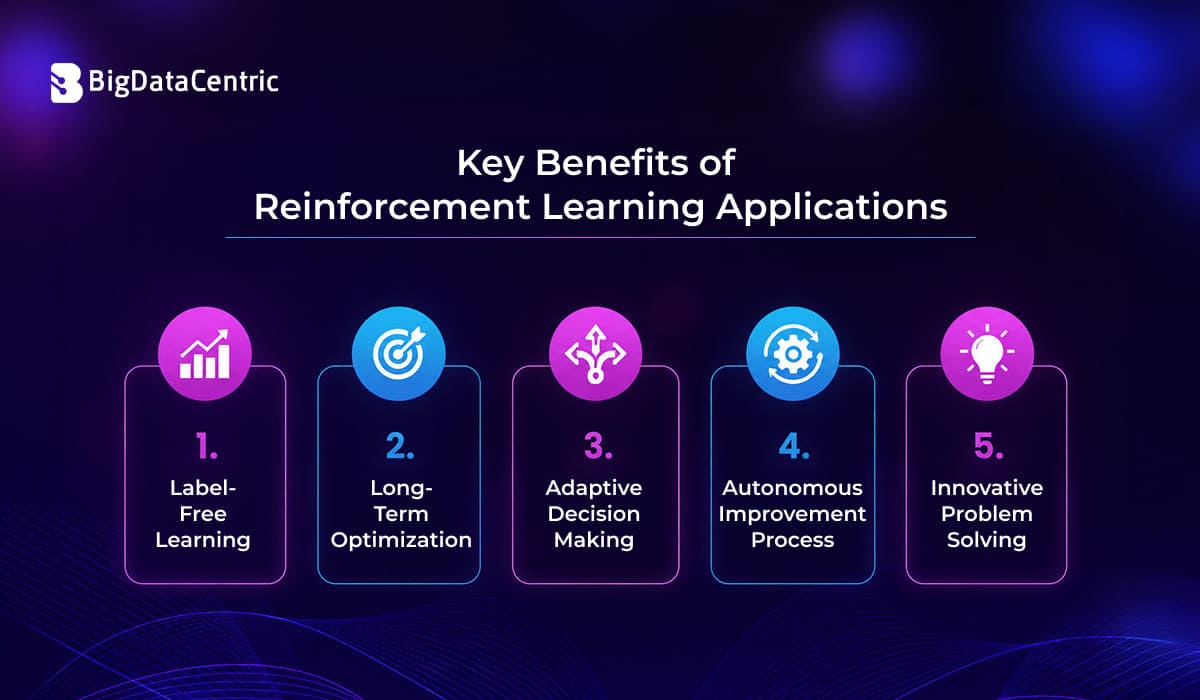
Reinforcement learning is widely used because of its ability to learn continuously, adapt to changing environments, and improve decision-making over time. Unlike learning models, it focuses on experience-based learning, making it suitable for solving complex real-world problems across multiple industries.
No Labeled Data Required
One of the biggest advantages of reinforcement learning is that it does not rely heavily on labeled datasets. Traditional machine learning models often require manually tagged data, which takes significant time and effort to prepare. Reinforcement learning systems learn through rewards and penalties instead of predefined answers.
This approach makes reinforcement learning highly useful in dynamic environments where data changes frequently. Businesses can train systems more efficiently without continuously labeling new information, making the overall learning process more flexible and scalable.
Long-Term Goal Optimization
Reinforcement learning focuses on maximizing long-term rewards instead of only immediate results. The model evaluates how current decisions may impact future outcomes and adjusts its actions accordingly. This helps create more strategic and optimized decision-making systems.
For example, logistics platforms can optimize delivery routes by considering future traffic conditions rather than immediately selecting the shortest route. Such reinforcement learning use cases are helping businesses improve efficiency across complex operational processes.
High Adaptability & Dynamic Handling
Modern business environments change rapidly, and reinforcement learning systems are designed to adapt continuously. These models learn from new interactions and adapt their behavior to changing conditions without requiring frequent retraining.
This adaptability makes reinforcement learning suitable for industries such as finance, healthcare, and automation, where real-time decisions are critical. Systems can respond to unpredictable situations more effectively while maintaining operational accuracy.
Autonomous Learning & Improvement
Reinforcement learning models continuously improve through experience. As the system interacts with the environment, it identifies better strategies and gradually enhances its performance without constant human intervention.
This autonomous learning capability is especially valuable in robotics and industrial automation. Companies using advanced technologies often implement self-improving systems to increase productivity and reduce manual optimization efforts.
Innovative Problem-Solving
Reinforcement learning allows systems to explore multiple strategies and discover solutions independently. Instead of following fixed rules, the model experiments with different actions to identify the most effective approach over time.
Many reinforced learning examples show how intelligent systems can solve highly complex problems more efficiently than traditional rule-based methods. This ability is driving innovation across gaming, robotics, resource management, and predictive decision-making systems.
Build Intelligent Learning Systems
Transform complex business processes with advanced reinforcement learning solutions designed for automation, prediction, and smarter decision-making across industries.
Reinforcement Learning Examples and Applications
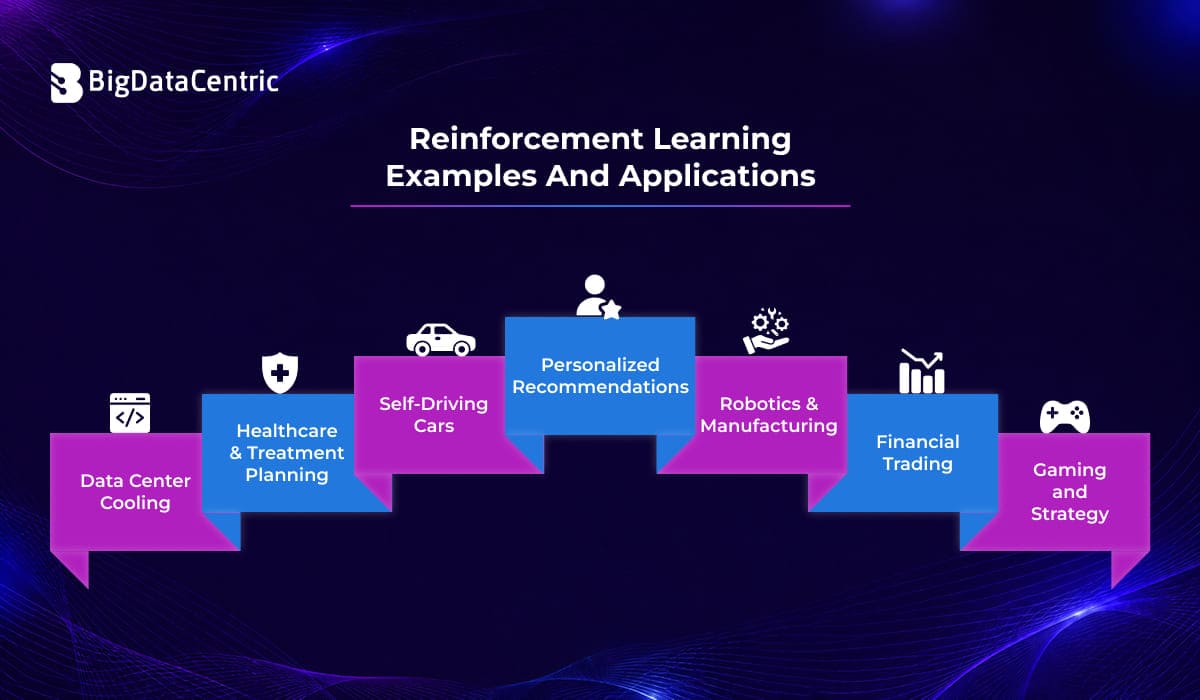
Reinforcement learning is being adopted across multiple industries to solve problems that require continuous decision-making and adaptive learning.
From automation and healthcare to finance and gaming, businesses are using these intelligent systems to improve efficiency, accuracy, and overall performance.
Robotics & Manufacturing
Robotics is one of the most common applications of reinforcement learning in modern industries. Robots can learn movements, improve task execution, and optimize workflows through continuous interaction with their environment. This helps reduce operational errors and increase production efficiency.
In manufacturing facilities, reinforcement learning is used for automated assembly lines, quality inspections, and warehouse automation. Many organizations also combine it with services to build smarter industrial automation systems that handle complex tasks with minimal human intervention.
Self-Driving Cars
Autonomous vehicles rely heavily on reinforcement learning to make driving decisions in real time. These systems continuously analyze road conditions, traffic patterns, obstacles, and driver behavior to improve navigation and safety.
Self-driving cars learn through repeated simulations and real-world interactions. Over time, the model becomes better at lane detection, braking, route planning, and accident prevention, making it one of the most advanced reinforcement learning use cases today.
Personalized Recommendations
Streaming platforms, e-commerce websites, and social media applications use reinforcement learning to deliver personalized recommendations. The system analyzes user behavior, interests, and interactions to suggest search-relevant products, videos, or content.
As users continue interacting with the platform, the recommendation engine keeps improving its predictions. These reinforced learning examples help businesses increase engagement, improve customer experiences, and drive higher conversions.
Healthcare & Treatment Planning
Healthcare organizations are using reinforcement learning to support treatment planning and medical decision-making. The system can analyze patient responses, treatment outcomes, and medical histories to recommend more personalized healthcare strategies.
Reinforcement learning also helps optimize hospital resource management and improve diagnostic support systems. Businesses working in healthcare innovation often integrate these models to improve predictive analysis and patient care efficiency.
Financial Trading
Financial institutions use reinforcement learning to analyze market trends and automate trading decisions. These systems can process large amounts of real-time data and identify patterns that support better investment strategies.
Unlike traditional models, reinforcement learning continuously adapts to changing market conditions. This allows trading systems to improve risk management, optimize portfolios, and respond more effectively to market fluctuations.
Data Center Cooling
Large data centers consume massive amounts of energy, especially for cooling systems. Reinforcement learning helps optimize temperature control by continuously monitoring server loads, environmental conditions, and energy usage.
By making real-time cooling adjustments, businesses can reduce operational costs and improve energy efficiency. This is becoming one of the most practical Reinforcement Learning Applications for sustainable infrastructure management.
Gaming and Strategy
Gaming played a major role in the growth of reinforcement learning technologies. Intelligent agents can learn strategies, improve gameplay, and compete against human players by continuously analyzing outcomes and adjusting decisions.
Many advanced gaming systems now use reinforcement learning to create adaptive opponents and realistic simulations. These models have also contributed to broader innovations in decision-making systems, robotics, and automated planning technologies.
Challenges in Real-World Reinforcement Learning
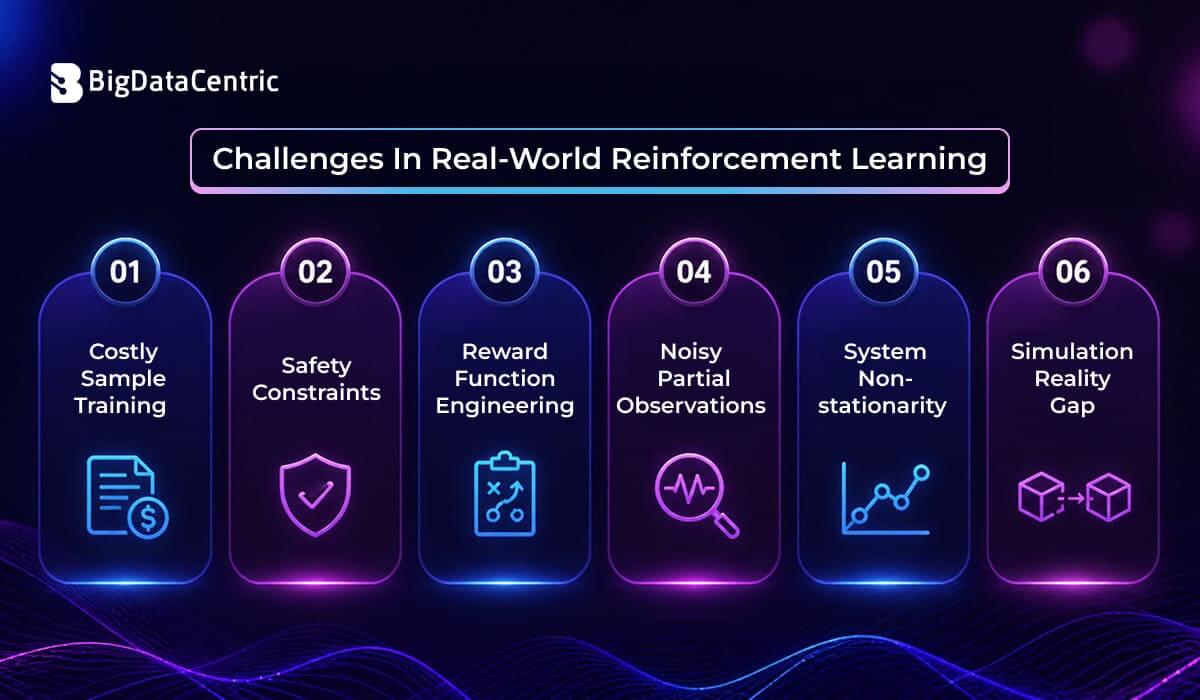
Although reinforcement learning offers significant advantages, implementing it in real-world environments comes with several learning challenges. Factors such as high training costs, safety concerns, and unpredictable environments often make deployment more complex than traditional machine learning models.
Sample Inefficiency & Cost
Reinforcement learning models usually require a large number of interactions before achieving accurate results. Training the system through repeated trial-and-error processes can consume significant time, computational power, and resources.
In industries such as robotics and autonomous vehicles, running continuous simulations or real-world experiments can become expensive. This is one of the major limitations businesses face while scaling reinforcement learning solutions.
Safety Constraints
In many real-world scenarios, allowing systems to learn through mistakes can create safety risks. Applications such as healthcare, robotics, and self-driving cars require highly controlled learning environments to avoid harmful outcomes.
Even small decision-making errors may lead to operational failures or safety concerns. Because of this, organizations must carefully monitor and test models before deploying them in real-world systems.
Reward Function Engineering
Designing an effective reward system is one of the most difficult parts of reinforcement learning. If the reward function is not properly structured, the model may learn incorrect behaviors or optimize the wrong objectives.
For example, a system might focus on maximizing short-term rewards while ignoring long-term performance. Creating balanced reward structures requires continuous testing and domain expertise.
Partial Observability & Noise
Real-world environments often contain incomplete, noisy, or constantly changing data. Reinforcement learning systems may struggle when they cannot fully observe all relevant information required for decision-making.
This limitation can reduce model accuracy and create inconsistent outcomes. Businesses operating in complex environments often combine reinforcement learning with advanced analytics to enhance data visibility and operational insights.
System Non-stationarity
Many real-world systems change over time, making it difficult for reinforcement learning models to maintain stable performance. Market trends, customer behavior, and environmental conditions may evolve continuously after deployment.
As conditions shift, previously learned strategies may become ineffective. Models must therefore adapt regularly to maintain accuracy and decision-making efficiency in changing environments.
Bridging Sim-to-Real Gaps
Reinforcement learning models are often trained in simulated environments before real-world deployment. However, simulation conditions may not fully represent real operational scenarios, leading to performance gaps.
A strategy that works effectively in simulation may fail when exposed to unpredictable real-world variables. Reducing this gap remains one of the biggest challenges in deploying large-scale reinforcement learning use cases across industries.
Develop intelligent systems that learn continuously, automate decision-making, and improve operational efficiency across modern business environments.
Conclusion
Reinforcement learning is transforming the way intelligent systems learn, adapt, and make decisions in dynamic environments. Its ability to improve continuously through experience makes it highly valuable for industries such as healthcare, finance, robotics, manufacturing, and autonomous systems.
From personalized recommendations to self-driving vehicles, modern Reinforcement Learning Applications are helping businesses automate complex processes and optimize long-term decision-making.
At the same time, challenges such as safety constraints, training costs, and real-world unpredictability underscore the importance of careful implementation and continuous optimization.
As organizations continue investing in intelligent automation, reinforcement learning is expected to play a major role in building adaptive and data-driven systems. Businesses looking to develop scalable AI-powered solutions are increasingly combining reinforcement learning with advanced technologies to improve operational efficiency, customer experiences, and business performance.
FAQs
How does reinforcement learning help recommendation systems?
Reinforcement learning improves recommendation systems by continuously analyzing user behavior and interactions. It learns which suggestions drive greater engagement and gradually delivers more personalized content, products, or media recommendations.
How does reinforcement learning support smart robotics?
Reinforcement learning helps robots learn tasks through trial and error without requiring constant manual programming. It enables robotic systems to improve movements, adapt to changing environments, and perform tasks more efficiently with continuous learning.
What tools are used to build reinforcement learning models?
Popular tools for building reinforcement learning models include TensorFlow, PyTorch, OpenAI Gym, Stable Baselines, and Ray RLlib. These frameworks help developers train, test, and deploy reinforcement learning algorithms for different applications.
Can reinforcement learning optimize resource allocation?
Yes, reinforcement learning can optimize resource allocation by analyzing real-time conditions and making adaptive decisions. It is widely used in supply chains, cloud computing, and energy management to improve efficiency and reduce operational costs.


Jayanti Katariya is the CEO of BigDataCentric, a leading provider of AI, machine learning, data science, and business intelligence solutions. With 18+ years of industry experience, he has been at the forefront of helping businesses unlock growth through data-driven insights. Passionate about developing creative technology solutions from a young age, he pursued an engineering degree to further this interest. Under his leadership, BigDataCentric delivers tailored AI and analytics solutions to optimize business processes. His expertise drives innovation in data science, enabling organizations to make smarter, data-backed decisions.


