

AI Data Integration: Types, Challenges, Techniques, Benefits, and Future Trends
Blog Summary:
AI Data Integration helps businesses connect, manage, and process information from multiple sources using intelligent automation. This blog covers its different types, key benefits, essential AI techniques, business use cases, and common integration challenges. It also highlights emerging trends such as autonomous AI agents, self-healing pipelines, and real-time data streaming. Understanding these capabilities can help organizations build scalable data environments, improve information quality, and support better business decisions.
Businesses generate large volumes of data from different sources, including customer relationship management (CRM) systems, enterprise applications, cloud platforms, databases, and IoT devices.
However, managing this information across disconnected systems makes it difficult to maintain consistency, access accurate insights, and support timely business decisions. Traditional data integration methods often require significant manual effort to connect sources, transform information, and resolve data quality issues.
AI is changing how organizations manage these processes by introducing intelligent automation into data workflows. Businesses can use machine learning, natural language processing, and predictive analytics to identify data patterns, automate data integration, detect inconsistencies, and simplify complex transformations.
These capabilities help organizations bring information from multiple sources into a unified environment faster and more accurately.
As data volumes continue to grow, adopting intelligent integration approaches is becoming increasingly important for building scalable data infrastructure. It also helps businesses prepare their information for advanced analytics, business intelligence, and AI-powered applications.
What is AI Data Integration?
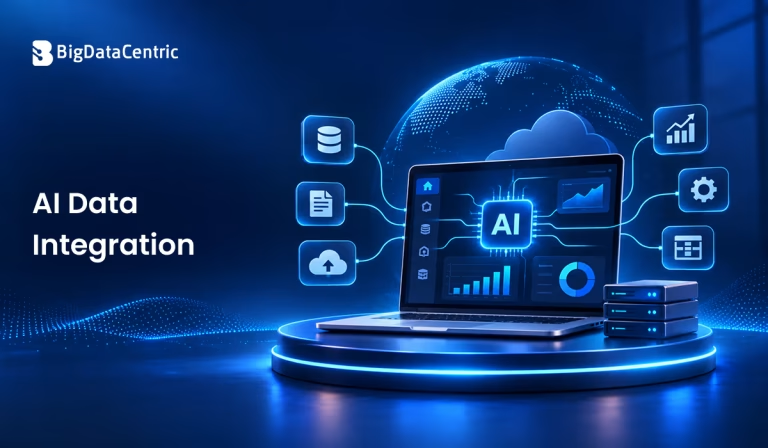
AI data integration connects, combines, transforms, and manages information from multiple sources using artificial intelligence technologies. It uses machine learning, natural language processing, and automation to simplify data workflows, identify inconsistencies, and improve how information moves between databases, business applications, cloud platforms, and other systems.
Unlike traditional methods that rely heavily on predefined rules and manual configurations, AI-powered integration can identify data patterns, recommend suitable mappings, detect duplicate records, and automate complex transformations.
For example, a business can combine customer information from CRM systems, websites, and marketing platforms into a unified dataset, making information more consistent and accessible for business intelligence, analytics, and decision-making.
Understanding the Different Types of Data Integration
Businesses use different data integration methods depending on their data sources, infrastructure, and operational requirements. Each method serves a specific purpose, from combining information into a central repository to providing access to data across distributed systems.
Understanding these approaches helps organizations select the right integration strategy for managing information efficiently.
Data Consolidation
Data consolidation combines information from multiple sources into a centralized repository, such as a data warehouse or database. It helps businesses eliminate duplicate records, maintain consistent information, and create a unified view of their data.
AI can support this process by identifying duplicate entries, matching related records, and improving data quality during consolidation.
Data Propagation
Data propagation involves transferring information from one system or database to another whenever updates occur. It helps maintain data consistency across connected applications without requiring repeated manual updates. AI can improve this process by identifying relevant changes, automating data transfers, and detecting synchronization errors.
Data Virtualization
Data virtualization provides a unified view of information stored across different systems without physically moving it into a single repository. Businesses can access and analyze distributed data through a common interface. AI can help identify relevant data sources, understand relationships between datasets, and optimize data access based on specific requirements.
Data Warehousing
Data warehousing involves collecting and storing information from multiple sources in a centralized repository for reporting and analytical purposes. AI can automate data extraction, transformation, and loading processes while identifying inconsistencies and improving data organization. This allows businesses to maintain reliable datasets for business intelligence and advanced analytics.
Data Federation
Data federation connects information from multiple databases and systems, allowing users to access data through a unified interface while keeping it in its original location.
AI can support this approach by understanding different data structures, mapping related fields, and optimizing queries across connected sources. It helps organizations access distributed information without creating multiple copies of the same data.
Key Benefits of AI Data Integration for Businesses
Businesses need accurate, accessible, and well-organized information to manage operations and make informed decisions. AI-powered integration simplifies data management by automating repetitive processes, improving data quality, and connecting information across different systems.
Here are some key benefits businesses can gain from adopting this approach.
Improved Operational Efficiency
AI automates repetitive integration tasks, including data extraction, mapping, validation, and transformation. This reduces manual intervention and allows teams to spend less time managing disconnected systems. Automated workflows also help businesses process large datasets more efficiently and maintain consistent operations.
Enhanced Data Security
AI can help monitor data movement, identify unusual access patterns, and detect potential security threats across connected systems. It also supports automated compliance checks and access monitoring, helping businesses maintain better control over sensitive information. However, effective security still requires proper encryption, access controls, and governance policies.
Better Data Accuracy
Inconsistent formats, duplicate records, and missing values can affect the reliability of business information. AI helps identify these issues through automated validation, anomaly detection, and data cleansing. This improves data consistency and ensures that connected systems work with more reliable information.
Faster Business Decisions
When information is scattered across multiple platforms, gathering insights can take considerable time. AI helps combine relevant datasets and make them available for analytics and reporting. Businesses can use these insights to identify trends, understand performance, and make timely decisions based on more complete information.
Seamless Data Connectivity
Organizations often use multiple cloud applications, databases, and enterprise platforms to manage their operations. AI can simplify connectivity by identifying relationships between different data structures and recommending suitable integration methods. This makes information more accessible across departments and business applications.
Reduced Operational Costs
Manual data management, repetitive integration tasks, and ongoing maintenance can increase operational expenses. AI-driven automation reduces the effort required to manage these processes and helps identify workflow inefficiencies. Businesses can use existing resources more effectively while reducing the time and cost associated with routine data operations.
Essential AI Techniques and Capabilities for Data Integration
AI uses different technologies and techniques to simplify data integration, improve information quality, and automate complex workflows.
These capabilities help businesses process information from multiple sources, identify relationships between datasets, and maintain reliable data pipelines. Some essential techniques include:
Machine Learning Algorithms
Machine learning algorithms analyze large datasets to identify patterns, recognize relationships, and automate data mapping. They can learn from historical integration activities to recommend suitable transformations, detect anomalies, and improve data matching accuracy over time.
Natural Language Processing
Natural Language Processing (NLP) enables systems to understand and process human language. It helps businesses extract useful information from unstructured sources such as emails, documents, customer feedback, and text-based records. NLP can also simplify data mapping by identifying similar meanings across differently named fields.
Generative AI Integration
Generative AI can support integration workflows by generating transformation scripts, suggesting data mappings, and assisting with complex queries. It can also help developers understand unfamiliar data structures and automate documentation. This reduces manual development effort and makes integration workflows easier to manage.
Automated Metadata Management
Metadata describes information about datasets, including their structure, format, source, and relationships. AI can automatically identify metadata patterns, classify datasets, and recommend relevant data connections.
This helps organizations improve data visibility, boost discoverability, and manage information across systems.
Intelligent Data Cleansing
AI-powered data cleansing identifies and corrects common data quality issues, including duplicate records, missing values, inconsistent formats, and incorrect entries. Machine learning models can recognize unusual patterns and recommend appropriate corrections, helping businesses maintain cleaner, more reliable datasets.
Predictive Analytics
Predictive analytics uses historical data and statistical models to identify potential trends and future outcomes. In integration workflows, it can help anticipate pipeline failures, identify unusual data patterns, and predict processing requirements. This allows businesses to address potential issues before they affect data availability or operational performance.
Key Use Cases of AI in Data Integration
Businesses across industries use AI to connect information from multiple sources and make it more accessible for operations and analytics. From managing large datasets to improving customer insights, intelligent integration supports several business applications.
Some important use cases include:
AI-Driven Data Warehousing
AI helps businesses automate data extraction, transformation, and loading (ETL) processes when transferring information from different sources into a centralized warehouse. It can identify data inconsistencies, recommend suitable transformations, and improve how information is organized for reporting and analytics.
It also supports workload optimization by identifying query patterns and monitoring data processing activities. This helps organizations manage growing data volumes, maintain reliable datasets, and make information available for business intelligence applications.
Data Lake Development
Data lakes allow businesses to store large volumes of structured, semi-structured, and unstructured information in a centralized environment. AI helps organize this information by automatically classifying datasets, identifying metadata, and recognizing relationships between different data sources.
Machine learning can also support data quality monitoring and intelligent data discovery within these environments. This makes it easier for organizations to access relevant information for advanced analytics, machine learning models, and other AI applications.
Unified Customer View
Businesses collect customer information from websites, CRM platforms, mobile applications, social media, and sales systems. AI helps combine these records by matching customer identities, identifying duplicate profiles, and connecting related information across different platforms.
A unified customer view allows organizations to understand customer preferences, purchase patterns, and interactions across multiple touchpoints. Marketing, sales, and customer support teams can use this information to deliver more relevant experiences and make informed business decisions.
Business Intelligence and Reporting
AI-powered integration brings information from different business systems into a consistent format for reporting and analysis. It can automate data preparation, identify missing information, and help keep datasets updated for business intelligence platforms.
When connected with BI tools, these capabilities allow organizations to generate more reliable reports and identify performance patterns. Decision-makers can use consolidated information to monitor KPIs, understand business performance, and respond to changing operational requirements.
IoT Data Processing
IoT devices generate continuous data from sensors, connected equipment, vehicles, and industrial systems. AI helps process and integrate this information by identifying relevant patterns, filtering unnecessary data, and detecting unusual readings across connected devices.
For example, manufacturing businesses can combine sensor information with equipment maintenance records to identify potential failures and monitor machine performance. This supports predictive maintenance, improves operational visibility, and helps organizations respond to equipment issues more efficiently.
Common Data Integration Challenges and How AI Addresses Them
Businesses often struggle to connect information from multiple sources, especially when systems use different formats, technologies, and data management practices.
These challenges can affect data accuracy, accessibility, security, and overall operational efficiency. AI helps address these issues through intelligent automation, data validation, and more flexible integration workflows.
Eliminating Data Silos
Data silos occur when information remains separated across departments, applications, or databases, making it difficult to access a complete view of business operations. AI helps identify related information across disconnected systems and automate data connections, allowing organizations to bring relevant datasets together and improve cross-departmental data accessibility.
Data Compatibility Issues
Different systems often store information in different formats, structures, and naming conventions, creating compatibility issues during integration. AI can analyze data structures, identify matching fields, and recommend suitable transformations to standardize information, making it easier to exchange data between different applications and platforms.
Complex Data Transformation
Data transformation becomes challenging when information requires extensive cleaning, formatting, mapping, and restructuring before it can be used.
AI simplifies these activities by recommending transformation rules, identifying inconsistencies, and automating repetitive processing tasks, helping businesses prepare information for analytics and operational applications.
Limited Data Scalability
As businesses grow, their data volumes and integration requirements increase, putting pressure on existing infrastructure and processing capabilities. AI can optimize data workflows, identify processing bottlenecks, and predict resource needs, helping organizations manage growing workloads and maintain efficient data operations.
Security and Compliance
Integrating information across multiple systems increases the complexity of managing sensitive data and meeting regulatory requirements. AI can support security monitoring by detecting unusual data access patterns, identifying potential vulnerabilities, and automating compliance checks.
However, organizations must also implement appropriate encryption, access controls, and governance policies to protect their information.
Future Trends Shaping AI Data Integration
As businesses continue adopting AI-driven technologies, data integration is becoming more automated, intelligent, and adaptable.
Emerging capabilities are changing how organizations connect information, manage data pipelines, and maintain data quality across distributed environments. The following trends are expected to influence the future of enterprise data management.
Generative AI Integration
Generative AI is expected to simplify complex integration workflows by assisting with data mapping, transformation logic, query generation, and pipeline documentation. It can also help developers understand unfamiliar data structures and generate code for connecting different applications, reducing manual development effort.
As these capabilities mature, businesses will be able to use natural language instructions to configure certain integration tasks and resolve common data issues. This will make integration processes more accessible while allowing technical teams to focus on complex data requirements.
Autonomous AI Agents
Autonomous AI agents can perform specific data management tasks with limited human intervention. They can monitor integration workflows, identify processing errors, recommend corrective actions, and coordinate activities across connected systems based on predefined objectives.
In the future, businesses may use multiple specialized agents to manage data extraction, validation, transformation, and monitoring. Human oversight will remain important for reviewing critical decisions, managing permissions, and ensuring that automated actions follow business requirements.
Self-Healing Data Pipelines
Self-healing data pipelines are designed to automatically identify and respond to common workflow failures. AI can monitor pipeline performance, detect unusual processing patterns, and trigger predefined recovery actions when issues such as failed connections or missing records occur.
This capability can reduce downtime and minimize manual troubleshooting. As monitoring and automation technologies improve, businesses will be better equipped to maintain reliable data flows and address integration problems before they significantly affect operations.
Real-Time Data Streaming
Real-time data streaming enables organizations to collect and process information continuously as it is generated. AI can help analyze incoming data, identify relevant patterns, and prioritize processing activities across connected applications and systems.
This is particularly useful for industries such as finance, healthcare, retail, and manufacturing, where timely information supports operational decisions. Improved streaming capabilities help businesses respond faster to changing conditions and keep information updated across platforms.
Intelligent Data Observability
Intelligent data observability monitors the health, quality, and reliability of data throughout its lifecycle. AI can analyze pipeline performance, detect unexpected changes in datasets, identify missing records, and highlight potential data quality issues.
These capabilities provide better visibility into how information moves across different systems and where problems occur. Businesses can use intelligent monitoring to identify issues earlier, maintain trustworthy datasets, and improve the reliability of their analytics and AI applications.
How BigDataCentric Helps Businesses With AI Data Integration
BigDataCentric helps businesses build intelligent data solutions that simplify information management and improve connectivity across different systems. Our team develops customized AI and data integration solutions that bring information from multiple sources into a unified environment.
By combining AI, machine learning, and data engineering capabilities, we help organizations automate data workflows, improve data quality, and make information more accessible for analytics and business intelligence.
From designing scalable data pipelines to integrating AI capabilities into existing infrastructure, our solutions are aligned with specific business requirements and long-term growth objectives.
Our approach focuses on creating reliable, scalable, and efficient data environments that support better operational visibility and informed decision-making. Whether businesses need to modernize their data infrastructure, streamline complex integrations, or prepare enterprise data for AI-powered applications, BigDataCentric provides customized solutions to support their data management goals.
Ready to Simplify Your Data Integration?
Connect your business systems with intelligent AI solutions that streamline data workflows, improve accuracy, and support smarter decisions.
Conclusion
AI is changing how businesses connect, manage, and process information across different systems. From automating data workflows and improving accuracy to supporting real-time analytics and intelligent decision-making, it helps organizations overcome traditional integration challenges and build more efficient data environments.
As data volumes and business requirements continue to grow, adopting intelligent integration approaches can help organizations improve scalability, maintain data quality, and use their information better.
With the right technologies and implementation strategy, businesses can create a connected data infrastructure that supports long-term growth and successful AI adoption strategies.
FAQs
What industries benefit most from AI Data Integration?
Industries such as healthcare, finance, retail, manufacturing, insurance, and logistics benefit from intelligent data integration. It helps them connect information, automate workflows, improve data accuracy, and support faster business decisions.
Can AI integrate structured and unstructured data?
Yes, AI can process both structured and unstructured data from databases, spreadsheets, documents, emails, images, and other sources. Technologies such as machine learning and natural language processing help extract, organize, and combine relevant information.
Can AI Data Integration eliminate data silos?
AI can help reduce data silos by identifying relationships between disconnected systems and automating data connections. However, completely eliminating data silos also requires proper system integration, data governance, and organizational coordination.
How does AI support data mapping and transformation?
AI analyzes data structures, identifies matching fields, and recommends suitable mapping rules across different systems. It also helps automate format conversion, data standardization, and transformation processes to maintain consistency across datasets.

About Author
Jayanti Katariya is the CEO of BigDataCentric, a leading provider of AI, machine learning, data science, and business intelligence solutions. With 18+ years of industry experience, he has been at the forefront of helping businesses unlock growth through data-driven insights. Passionate about developing creative technology solutions from a young age, he pursued an engineering degree to further this interest. Under his leadership, BigDataCentric delivers tailored AI and analytics solutions to optimize business processes. His expertise drives innovation in data science, enabling organizations to make smarter, data-backed decisions.
Latest From Our Blog
Stay updated with technical insights, industry trends, and the latest technology developments.