




Top 12 AI Tools for Customer Support and Service in 2026
Blog Summary:
In this guide, we explored the top ai tools for customer support that are helping businesses improve customer service operations in 2026. We covered the key benefits of AI-powered support systems, including faster response times, personalized customer interactions, and improved agent productivity. The blog also highlights leading customer support platforms, emerging AI trends, and how businesses can use intelligent automation to enhance customer experiences. Additionally, we discussed how BigDataCentric helps organizations build scalable and data-driven customer support solutions.
Customer expectations are changing faster than ever. Today’s customers want quick responses, personalized interactions, and support that is available whenever they need it.
Managing all these expectations manually can become challenging for businesses, especially when support teams handle large volumes of queries every day. This is where BigDataCentric believes intelligent automation can make a major difference.
Modern businesses are now adopting ai tools for customer support to streamline support operations, improve response accuracy, and deliver better customer experiences across multiple channels.
From automated chat assistance and ticket routing to intelligent response suggestions and predictive support, these tools are helping companies reduce workloads while maintaining high service quality.
The growing demand for faster and smarter support has also increased the adoption of advanced technologies such as conversational assistants, AI copilots, and automated workflows.
Similar innovations are already transforming industries through solutions like BI Services and intelligent automation platforms that help organizations make faster operational decisions.
To further enhance efficiency and streamline end-to-end processes, businesses are increasingly adopting AI workflow automation solutions that connect systems, reduce manual effort, and enable seamless decision-making across departments.
In this blog, we will explore the best AI-powered customer support tools in 2026, their features, benefits, and how they are reshaping modern customer service operations.
Why are Businesses Using AI in Customer Support?
Businesses today are handling customer interactions across multiple platforms, including websites, mobile apps, email, live chat, and social media. Managing all these conversations manually often leads to delayed responses, inconsistent support quality, and increased operational pressure.
This is one of the biggest reasons why companies are investing in AI-driven support technologies. Modern customer support is no longer limited to solving tickets. Businesses now focus on delivering faster, more personalized, and proactive experiences that improve customer retention and brand loyalty.
An advanced ai solution for customer support helps organizations automate repetitive tasks, assist support agents, and improve overall service efficiency without compromising customer experience.
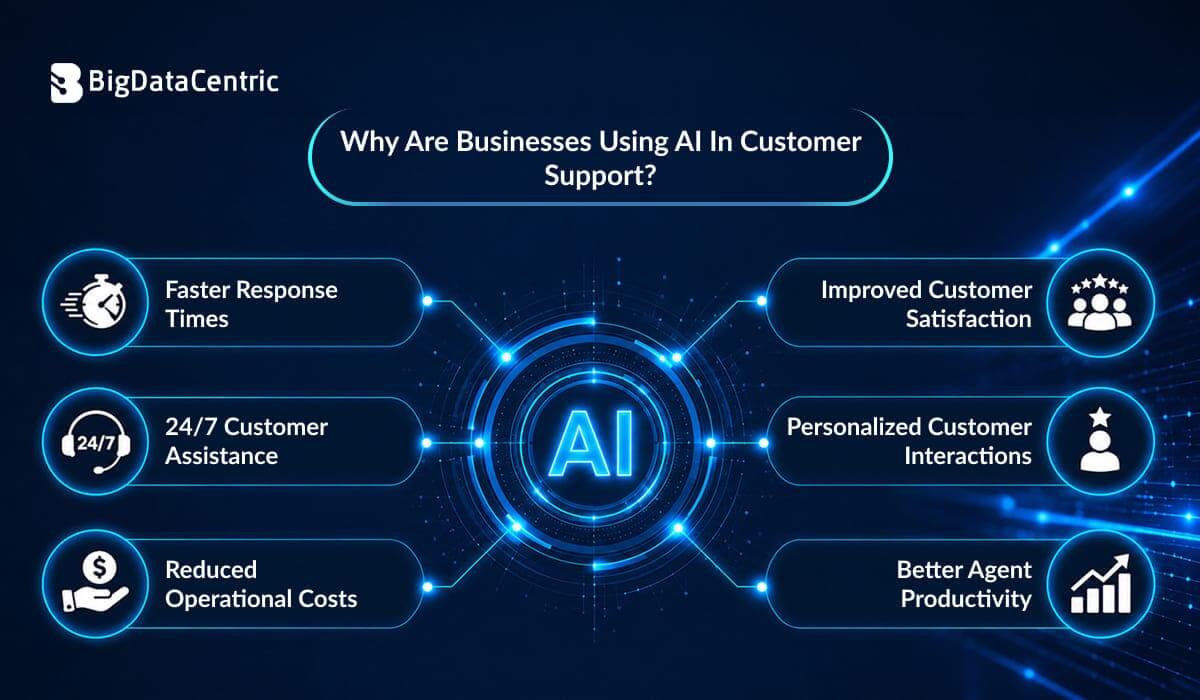
Faster Response Times
Customers expect immediate assistance whenever they reach out to a business. Long waiting times can quickly impact customer satisfaction and lead to lost opportunities.
AI tools for customer support, powered chat systems, and automated ticketing workflows help businesses respond instantly to common customer queries.
These tools can automatically answer FAQs, guide users to relevant resources, and prioritize urgent support requests. Similar automation strategies are also widely used in intelligent systems like Chatbot Development Services to improve communication efficiency and reduce manual workload.
24/7 Customer Assistance
Unlike traditional support teams, AI-powered systems can operate continuously without downtime. This allows businesses to provide customer assistance outside standard working hours, including weekends and holidays.
For global businesses serving customers across different time zones, round-the-clock support becomes essential. AI chat assistants help companies maintain consistent service availability while reducing dependency on large support teams.
Reduced Operational Costs
Handling thousands of customer interactions manually requires significant staffing and operational resources. AI automation helps businesses reduce repetitive workloads by automating tasks such as ticket categorization, query routing, follow-up responses, and self-service support.
By reducing the need for excessive manual intervention, companies can optimize support costs while allowing human agents to focus on more complex customer issues.
Improved Customer Satisfaction
Quick resolutions and accurate responses directly influence customer satisfaction levels. AI-driven support systems analyze customer intent, previous interactions, and behavior patterns to provide more relevant responses.
Many businesses are combining support automation with data-driven insights through solutions to better understand customer behavior and improve support quality over time.
Personalized Customer Interactions
Modern customers prefer support experiences tailored to their needs. AI systems can analyze customer history, purchase behavior, preferences, and previous conversations to deliver more personalized recommendations and responses.
This level of personalization helps businesses create stronger customer relationships while improving engagement across different communication channels.
Better Agent Productivity
AI not only supports customers but also assists customer service agents. Many modern tools for customer support include AI copilots that suggest responses, summarize conversations, recommend solutions, and automate repetitive administrative work.
This helps support teams resolve issues faster, reduce agent burnout, and improve productivity. Businesses adopting intelligent automation solutions often experience better workflow management and operational efficiency across departments.
Ready to Transform Your Customer Support Operations?
Upgrade customer support with AI-powered solutions that automate workflows, improve response times, and enhance customer experiences.
Top AI Tools for Customer Support – Quick Comparison Table
| Tool | Best For | Key Features | Ideal Business Size |
|---|---|---|---|
| Freshdesk | Omnichannel customer support | AI chatbots, ticket automation, workflow management | Small to Enterprise |
| Zendesk AI | Scalable support automation | AI-powered ticketing, smart routing, conversational support | Medium to Enterprise |
| Intercom | Conversational customer engagement | AI agents, live chat, proactive messaging | Startups to Enterprise |
| Ada | Automated customer interactions | No-code chatbot builder, multilingual support | Medium to Enterprise |
| HubSpot Service Hub | CRM-integrated customer support | Help desk automation, customer insights, ticket tracking | Small to Medium |
| Zoho Desk | Affordable support automation | Context-aware assistance, workflow automation | Small to Enterprise |
| Tidio | Live chat and chatbot support | AI chatbots, visitor tracking, multichannel messaging | Small Businesses |
| Drift | Sales and support conversations | Conversational AI, lead qualification, live messaging | Medium to Enterprise |
| Help Scout | Simple customer communication | Shared inbox, knowledge base, automation tools | Small to Medium |
| Gorgias | Ecommerce customer support | Shopify integration, automated responses, ticket management | Ecommerce Businesses |
| Salesforce Service Cloud | Enterprise customer service | AI insights, case management, predictive support | Enterprise |
| LivePerson | AI-driven customer engagement | Conversational AI, voice support, messaging automation | Large Enterprises |
These platforms helping businesses simplify customer interactions, automate support operations, and deliver faster service experiences. Many organizations also combine these tools with advanced analytics platforms and AI Services to improve customer engagement strategies and operational decision-making.
12 Best AI Tools for Customer Support in 2026
Businesses today need customer support platforms that can handle increasing customer expectations while improving operational efficiency. Modern support tools are no longer limited to basic ticket management, as they now include automation, conversational assistants, predictive insights, and intelligent workflows powered by ai tools for customer support.
Choosing the right platform depends on factors such as business size, customer interaction channels, integration requirements, and automation capabilities.
Below are some of the best platforms helping businesses improve customer communication, automate repetitive tasks, and deliver faster support experiences in 2026.
Freshdesk
Freshdesk is widely used for its user-friendly interface and strong automation capabilities. It helps businesses manage customer conversations across email, chat, phone, and social media from a single dashboard.
The platform includes AI-powered ticket management, automated responses, and intelligent ticket routing to reduce manual effort for support teams. Businesses adopting ai tools for customer support often use platforms like Freshdesk to improve response times and automate customer interactions.
Its Freddy AI assistant can suggest responses, detect customer sentiment, and automate repetitive support tasks, making it a strong option for businesses looking to improve support efficiency without complex implementation.
Freshdesk is especially suitable for growing businesses that want scalable support automation with easy deployment and omnichannel support management.
Zendesk AI
Zendesk AI is designed to help businesses deliver faster and more personalized customer support experiences, making it one of the leading best tools for customer support in modern service ecosystems.
The platform combines AI-powered automation with advanced ticketing and omnichannel communication features. It offers intelligent workflows, automated ticket categorization, and conversational assistance that helps support teams resolve issues more efficiently.
Zendesk also provides detailed analytics and reporting features, helping businesses monitor support performance and improve customer satisfaction over time.
Intercom
Intercom focuses heavily on conversational support and customer engagement, making it a well-known choice among modern ai tools for customer support. Its AI chatbot system can handle customer questions, qualify leads, and guide users through different stages of the customer journey.
The platform also includes proactive messaging, customer segmentation, and workflow automation. Businesses looking for conversational engagement and modern messaging support often consider Intercom among the best ai customer service platforms available today.
Its real-time communication capabilities help businesses create faster and more interactive customer experiences.
Ada
Ada is known for its no-code automation platform that allows businesses to create AI-powered support experiences without technical expertise. It helps automate repetitive customer interactions while maintaining natural conversational flows.
The platform supports multilingual conversations and integrates with various CRM and customer support systems, making it suitable for businesses with global customer bases. Ada is particularly useful for organizations aiming to reduce support ticket volumes through intelligent self-service automation.
HubSpot Service Hub
HubSpot Service Hub combines customer support tools with CRM capabilities to provide a more connected customer experience.
Businesses can manage tickets, automate workflows, track customer interactions, and create self-service knowledge bases from a centralized platform.
Its automation features help businesses improve response efficiency while maintaining customer context across support interactions. Companies already using HubSpot’s ecosystem can easily streamline support and customer relationship management together.
Zoho Desk

Zoho Desk offers intelligent ticket management and workflow automation features designed for businesses of all sizes. Its AI assistant, Zia, helps agents by suggesting responses, analyzing customer sentiment, and prioritizing tickets based on urgency.
The platform also provides customizable workflows and omnichannel support management, making it a flexible AI customer support software solution for growing businesses. Zoho Desk is also appreciated for its affordability and strong integration support within the Zoho ecosystem.
Tidio
Tidio is popular among small businesses and ecommerce brands for its simple live chat and chatbot features, making it one of the useful ai tools for customer support available today.
It allows businesses to automate customer conversations, capture leads, and answer frequently asked questions in real time.
Its easy setup and affordable pricing make it suitable for businesses looking to introduce AI-powered support without major infrastructure changes. Tidio also helps businesses improve customer engagement by combining live chat and automation within a single platform.
Drift
Drift specializes in conversational marketing and customer communication. As one of the advanced ai tools for customer support, its AI-powered chat system helps businesses engage website visitors, qualify leads, and provide instant support.
Drift is commonly used by sales and support teams to improve customer engagement while reducing response delays through automated conversations. The platform is especially useful for businesses focused on lead generation and personalized customer communication.
Help Scout

Help Scout is a strong modern ai tools for customer support provides a clean and collaboration-focused customer support platform. It includes shared inboxes, workflow automation, knowledge base management, and customer conversation tracking.
The platform is particularly useful for small and medium-sized businesses that want simple yet effective support management without overly complex enterprise features. Help Scout also focuses heavily on improving team collaboration and customer communication transparency.
Gorgias

Gorgias is built specifically for ecommerce customer support and is a strong example of modern ai tools for customer support. It integrates directly with platforms like Shopify and helps businesses automate responses related to orders, shipping, refunds, and customer inquiries.
Its automation capabilities help ecommerce brands manage high volumes of customer interactions more efficiently while maintaining personalized communication. Gorgias is especially valuable for online stores handling repetitive customer queries daily.
Salesforce Service Cloud

Salesforce Service Cloud is an enterprise-grade customer service platform that combines automation, analytics, and AI-driven customer insights. It offers advanced case management, predictive support, and workflow automation features.
Businesses already using CRM and analytics platforms often integrate Service Cloud with solutions to improve customer behavior analysis and support optimization. Its enterprise-level scalability makes it ideal for large organizations managing complex support operations.
LivePerson

LivePerson focuses on conversational AI and digital customer engagement, making it a powerful solution among modern ai tools for customer support. The platform supports messaging across websites, mobile apps, and social media channels while automating customer interactions using intelligent virtual assistants.
Its AI-driven conversational system helps businesses deliver scalable support experiences while improving communication consistency across multiple customer touchpoints. LivePerson is commonly adopted by enterprises that require advanced conversational automation and omnichannel engagement capabilities.
Find the Right AI Customer Support Platform
Compare leading AI customer support tools to automate workflows, improve engagement, and deliver faster customer experiences.
How AI Tools Improve Customer Support Operations?
Modern customer support teams often handle large volumes of customer interactions daily. Managing these requests manually can slow down response times, increase operational pressure, and affect overall customer experience.
This is why businesses are increasingly adopting intelligent support automation to streamline workflows and improve service efficiency.
Advanced ai tools for customer support help organizations automate repetitive tasks, assist support agents, and deliver faster customer resolutions across multiple channels. These tools not only improve operational efficiency but also help businesses create more consistent and personalized customer experiences.
Automating Repetitive Customer Queries
A large percentage of customer support requests are repetitive and predictable, such as password resets, order tracking, refund policies, and account-related questions. AI-powered chatbots and virtual assistants can instantly handle these common queries without requiring human intervention.
This automation reduces support workload while allowing agents to focus on more complex customer issues. Businesses using intelligent automation solutions often improve operational efficiency and significantly reduce customer wait times.
Enhancing Agent Productivity with AI Copilots
Modern support platforms now include AI copilots, which are becoming an important part of ai tools for customer support. These copilots assist agents during live customer conversations by suggesting responses, summarizing interactions, recommending solutions, and retrieving relevant information in real time.
By reducing manual effort, AI copilots help agents resolve issues faster and improve overall productivity. Many organizations also integrate these capabilities to create smarter and more scalable customer support ecosystems.
Reducing Ticket Resolution Time
AI-powered ticket management systems automatically categorize, prioritize, and assign support tickets based on urgency and customer intent. This eliminates delays caused by manual ticket handling and improves response accuracy.
Faster ticket routing and automated workflows help businesses resolve customer issues more efficiently, leading to improved service performance and higher customer satisfaction rates.
Improving Customer Engagement Across Channels
Customers now interact with businesses through websites, mobile apps, social media platforms, email, and messaging applications. Managing all these conversations manually can become difficult for support teams.
AI-powered platforms centralize customer communication across multiple channels and maintain conversation continuity. This helps businesses provide more consistent support experiences while improving customer engagement throughout the support journey.
Delivering Personalized Support Experiences
Personalization has become a major factor in customer satisfaction. AI systems analyze customer history, behavior patterns, preferences, and previous interactions to deliver more relevant responses and recommendations.
Businesses leveraging customer analytics and intelligent automation can create more personalized support experiences that improve customer loyalty and long-term engagement. Similar data-driven personalization strategies are also widely used to improve decision-making and customer experience management.
AI Trends Shaping Customer Support in 2026
Customer support technologies are evolving rapidly as businesses continue to focus on faster, smarter, and more personalized customer experiences. Modern support systems are no longer limited to basic automation, as companies are now adopting advanced conversational technologies, predictive analytics, and intelligent virtual assistants to improve customer interactions.
The growing adoption of ai tools for customer support and AI for customer service solution platforms is reshaping how businesses communicate with customers across digital channels. Below are some of the major trends expected to influence customer support operations in 2026.
Generative AI-powered Conversations
Generative AI is transforming customer support by enabling more natural and context-aware conversations. Unlike traditional rule-based chatbots, generative AI systems can understand customer intent, generate human-like responses, and handle more complex interactions.
Businesses are increasingly using these technologies to improve customer communication quality while reducing response times. This helps create more engaging and efficient support experiences across websites, apps, and messaging platforms.
Voice-enabled AI Support
Voice-based support systems are becoming more advanced with the integration of speech recognition and conversational AI technologies. Customers can now interact with virtual assistants through voice commands for faster issue resolution and self-service support.
Businesses adopting ai tools for customer support are increasingly implementing voice-enabled systems to automate customer interactions, improve response efficiency, and deliver more accessible support experiences across multiple communication channels.
Voice-enabled systems are especially useful for industries handling large call volumes, as they help businesses automate customer interactions while improving accessibility and support availability.
Predictive Customer Service
Predictive support systems use customer behavior data and analytics to identify potential issues before customers report them. These systems analyze historical interactions, usage patterns, and support trends to proactively assist customers.
Businesses adopting predictive support strategies often combine automation with advanced analytics to improve customer retention and operational efficiency.
Hyper-personalized Customer Experiences
Modern customers expect businesses to understand their preferences, behavior, and previous interactions. AI-powered systems now deliver highly personalized recommendations, responses, and support experiences based on real-time customer data.
This level of personalization helps businesses strengthen customer relationships while improving engagement and satisfaction across different communication channels.
AI Copilots for Support Agents
AI copilots are becoming an essential part of modern customer support operations. These intelligent assistants help agents by suggesting responses, summarizing tickets, retrieving customer history, and automating repetitive tasks during live conversations.
By improving agent productivity and reducing manual effort, AI copilots help businesses deliver faster and more accurate support experiences. Many organizations are also integrating these technologies to create smarter customer interaction systems and scalable support automation.
Leverage AI automation, intelligent copilots, and predictive support tools to deliver faster and more personalized customer experiences.
Why Choose BigDataCentric for AI Customer Support Solutions?
Businesses today need customer support systems that are scalable, intelligent, and capable of handling growing customer expectations across multiple channels. At BigDataCentric, we help organizations build advanced support ecosystems powered by automation, analytics, and intelligent conversational technologies.
Our team specializes in developing customized ai customer service solution platforms that help businesses automate support workflows, improve customer engagement, and enhance operational efficiency. From intelligent chatbots and virtual assistants to predictive analytics and workflow automation, we create solutions tailored to your business goals and customer requirements.
With expertise, we help businesses modernize their customer support operations with scalable and data-driven technologies.
Whether you want to automate repetitive customer queries, improve agent productivity, or deliver personalized customer experiences, BigDataCentric provides intelligent support solutions designed to improve both customer satisfaction and business performance.
Conclusion
Customer expectations continue to evolve, and businesses can no longer rely solely on traditional support methods to manage growing customer demands. Modern ai tools for customer support are helping organizations automate repetitive tasks, improve response times, deliver personalized interactions, and enhance overall customer satisfaction across multiple channels.
From conversational chatbots and AI copilots to predictive analytics and workflow automation, these technologies are reshaping how businesses handle customer service operations in 2026. Choosing the right platform depends on your business requirements, customer communication channels, and long-term support goals.
As businesses continue investing in intelligent automation and customer experience technologies, adopting the right AI-powered support solution can help improve operational efficiency, reduce support costs, and create stronger customer relationships in the long run.
FAQs
What is the 10 20 70 rule for AI?
The 10-20-70 rule in AI refers to the idea that successful AI implementation depends on 10% algorithms, 20% data and technology, and 70% people, processes, and business adoption. It highlights that organizational strategy and execution matter more than the technology itself.
Is it what is the #1 AI agent for customer service?
There is no single officially recognized “#1” AI agent for customer service, as it depends on business needs. However, platforms like Zendesk AI, Intercom, and Freshdesk are widely considered among the leading AI customer support solutions in 2026.
What is an example of AI customer service?
An example of AI customer service is a chatbot that instantly answers customer questions, tracks orders, resets passwords, or routes tickets without human intervention. Companies like banks, ecommerce stores, and telecom providers commonly use these systems for 24/7 support.
Is AI going to replace customer support?
AI is not expected to fully replace customer support teams. Instead, it helps automate repetitive tasks and supports agents with faster responses, while human agents continue handling complex, emotional, and high-priority customer issues.
Who are the Big 4 AI agents?
The term “Big 4 AI agents” does not have an official industry definition, but commonly recognized leading AI assistant ecosystems include OpenAI ChatGPT, Google Gemini, Microsoft Copilot, and Anthropic Claude due to their wide adoption and advanced conversational capabilities.


Jayanti Katariya is the CEO of BigDataCentric, a leading provider of AI, machine learning, data science, and business intelligence solutions. With 18+ years of industry experience, he has been at the forefront of helping businesses unlock growth through data-driven insights. Passionate about developing creative technology solutions from a young age, he pursued an engineering degree to further this interest. Under his leadership, BigDataCentric delivers tailored AI and analytics solutions to optimize business processes. His expertise drives innovation in data science, enabling organizations to make smarter, data-backed decisions.


