



What Are the Key Use Cases of Big Data Analytics for Telecom?
Blog Summary:
Big data analytics plays a vital role in helping telecom companies manage complex networks and growing data volumes. It supports better network performance, customer retention, and personalized services. Real-world implementations show how data-driven insights improve operational efficiency and innovation. Big Data Analytics for Telecom enables telecom providers to stay competitive in a rapidly evolving industry.
Telecommunication networks generate enormous volumes of data every second—from call detail records and network performance logs to customer interactions across digital channels. Managing and extracting value from this data is no longer optional for telecom operators working in a highly competitive, customer-driven market.
This is where Big Data Analytics for Telecom plays a critical role by turning raw, high-velocity data into actionable insights that support smarter decisions.
As subscriber expectations continue to rise, telecom providers are under constant pressure to improve service quality, reduce churn, optimize network performance, and introduce new digital offerings faster.
Traditional data processing methods struggle to keep pace with the scale and complexity of modern telecom data. Advanced analytics techniques help bridge this gap by enabling real-time visibility, predictive insights, and data-driven automation across operations.
From improving customer experience to strengthening network reliability and revenue growth, analytics has become deeply embedded in telecom strategy.
In the sections ahead, we’ll explore how data analytics is reshaping the telecom landscape, its most impactful use cases, real-world success stories, key challenges, and the trends shaping its future.
Big Data Analytics Overview
According to the Valuates Reports, the global Big Data and Business Analytics market was valued at US$ million in 2024 and is projected to reach US$ million by 2031, growing at a CAGR of % during the forecast period. This growth highlights the increasing reliance on data-driven technologies as organizations generate massive volumes of digital information.
As data collection, storage, and processing continue to scale, big data and business analytics have become essential for companies managing complex, high-velocity datasets.
Rising investments in artificial intelligence are accelerating the adoption of advanced analytics tools and platforms. These technologies are enabling more efficient data analysis while also driving changes in enterprise roles and responsibilities.
Big data and business analytics now play a central role in solving data-related challenges, supporting operational efficiency, and enabling smarter, insight-led decision-making across industries.
The market analysis combines quantitative and qualitative insights to help organizations evaluate growth strategies, assess competitive positioning, and make informed business decisions. Market size estimates and forecasts are presented in revenue terms (USD million), with 2024 as the base year, covering historical data from 2020 and projections through 2031.
The market is segmented by type, application, region, and key companies, offering a comprehensive view of industry trends, technological developments, and competitive dynamics.
The Importance of Big Data Analytics in Telecom
The telecom industry operates in an environment defined by high data velocity, complex big data infrastructure, and constantly evolving customer expectations. Every interaction—calls, messages, data usage, network events, and digital touchpoints—creates valuable information.
Big Data Analytics for Telecom enables operators to convert this continuous data flow into actionable intelligence that improves decision-making across technical and business functions.
One of the most critical reasons analytics has become essential in the analytics in telecom industry is its ability to enhance network performance and service reliability. By analyzing real-time and historical network data, telecom providers can identify congestion patterns, predict outages, and optimize resource allocation.
This proactive approach reduces downtime, improves the quality of service, and supports efficient management of large-scale network environments.
Beyond network operations, analytics plays a vital role in customer-centric strategies. Telecom companies rely on data insights to understand subscriber behavior, usage trends, and service preferences. This allows them to design relevant offerings, reduce churn, and improve engagement through personalized experiences.
As competition intensifies and margins tighten, data-driven insights have become a foundational element for sustainable growth, innovation, and operational resilience in modern telecom ecosystems.
Key Use Cases of Big Data Analytics in Telecom
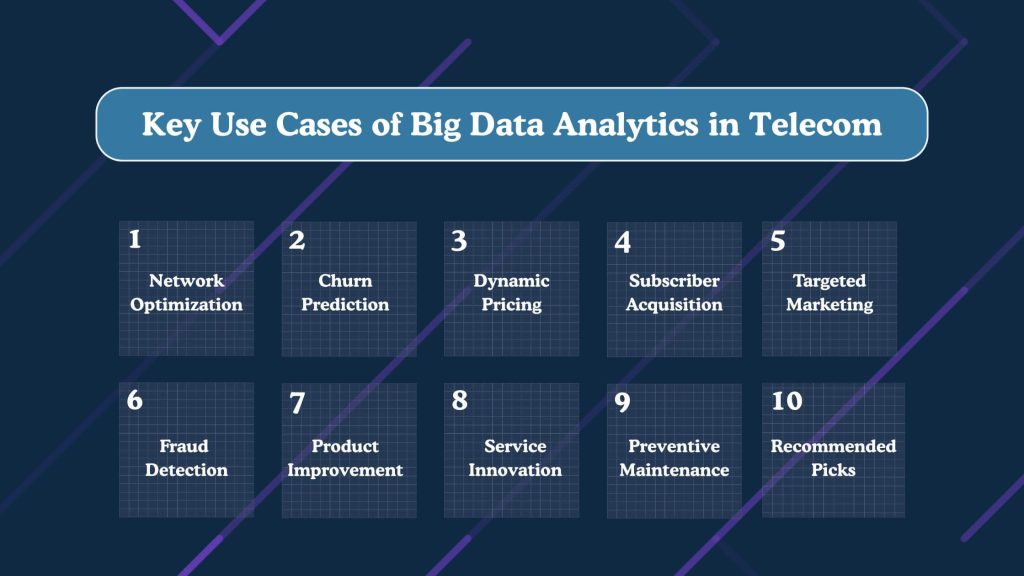
Big data has become a practical enabler for solving real operational and business challenges in the telecom sector. By analyzing large-scale, real-time, and historical datasets, telecom operators can improve efficiency, customer experience, and revenue outcomes.
Below are some of the most impactful telecom data analytics use cases shaping the industry today –
Network Optimization
Telecom networks generate massive volumes of performance data from base stations, network nodes, and connected devices. By analyzing this data in real time, telecom operators can gain visibility into traffic patterns, bandwidth utilization, and network latency.
This enables faster identification of congestion points and performance degradation that could impact service quality.
Advanced analytics models help operators forecast demand, optimize spectrum usage, and balance network loads more efficiently.
As data consumption continues to grow, analytics-driven network optimization ensures stable connectivity, reduced outages, and better service reliability for subscribers across regions.
Churn Prediction
Customer churn is one of the most costly challenges for telecom providers. Analytics models evaluate customer usage behavior, billing history, service complaints, and interaction data to identify early indicators of dissatisfaction.
These insights enable operators to identify high-risk customers before they switch providers.
Once churn risks are identified, telecom companies can take targeted actions such as personalized offers, service improvements, or proactive support.
This data-driven approach improves customer retention while reducing the cost of acquiring new subscribers.
Dynamic Pricing
Telecom pricing models must adapt to changing usage patterns, competition, and customer expectations. Big data analytics enables operators to analyze consumption trends, peak usage periods, and customer preferences in near real time. This insight supports the development of flexible, demand-based pricing strategies.
Dynamic pricing allows telecom companies to optimize revenue while offering plans that better match individual usage needs. By aligning pricing with actual behavior, operators can remain competitive while improving customer satisfaction and plan adoption rates.
Subscriber Acquisition
Acquiring the right subscribers is just as important as increasing subscriber numbers.
Analytics helps telecom providers identify high-value customer segments by analyzing demographics, digital behavior, and historical conversion data. This ensures acquisition efforts are focused on audiences with higher long-term value.
Data-driven insights also improve campaign targeting and messaging across digital channels. As a result, telecom operators can reduce acquisition costs, improve conversion rates, and build a more profitable subscriber base from the outset.
Targeted Marketing
Telecom operators manage diverse customer segments with varying usage patterns and preferences. Big data analytics enables detailed customer segmentation based on behavior, service consumption, and engagement history.
This helps marketers deliver personalized, relevant campaigns rather than generic promotions.
Targeted marketing improves engagement by aligning offers with individual needs and timing. With analytics-driven personalization, telecom companies can increase campaign effectiveness, boost customer loyalty, and maximize return on marketing investments.
Fraud Detection
Telecom fraud poses serious financial and operational risks, including subscription fraud and unauthorized usage. Analytics systems monitor large volumes of transaction and network data to detect anomalies and suspicious behavior patterns in real time. This allows for faster identification of potential fraud incidents.
By acting on these insights early, telecom operators can prevent revenue losses and minimize service abuse. Analytics-driven fraud detection also strengthens customer trust by ensuring secure and reliable telecom services.
Want to Unlock Value From Telecom Data?
Turn complex telecom datasets into meaningful insights with expert support.
Product Improvement
Understanding how customers use telecom products and services is essential for continuous improvement.
Analytics evaluates usage data, feature adoption, and customer feedback to identify areas where services underperform or fail to meet expectations. These insights help prioritize enhancements based on real usage patterns.
Data-driven product improvement ensures that new features and updates are aligned with customer needs. This approach reduces development risks and helps telecom providers deliver services that offer genuine value to subscribers.
Service Innovation
Telecom companies are increasingly expanding beyond traditional connectivity services. Big data analytics helps identify emerging usage trends and unmet customer needs that can inspire new digital services. This insight supports innovation in areas such as bundled offerings and value-added services.
By leveraging analytics, telecom providers can introduce services that are both relevant and scalable. Service innovation driven by data allows operators to differentiate themselves and create new revenue streams in competitive markets.
Preventive Maintenance
Network equipment failures can disrupt services and increase operational costs. Analytics enables predictive maintenance by analyzing historical performance data and identifying patterns that indicate potential failures. This allows operators to address issues before they impact service delivery.
Preventive maintenance improves network reliability while reducing downtime and repair costs. By shifting from reactive to proactive maintenance strategies, telecom companies can extend asset lifecycles and improve overall operational efficiency.
Smart Recommendations
Telecom customers often struggle to find plans and add-ons that truly match their usage needs. Analytics-driven recommendation systems analyze individual behavior, data consumption, and service history to suggest relevant options. This creates a more personalized customer experience.
Smart recommendations improve customer satisfaction while increasing cross-sell and upsell opportunities. By using telecommunications big data effectively, telecom providers can guide customers toward better-fitting services without overwhelming them with unnecessary choices.
Real-World Success Stories of Big Data Analytics in Telecom
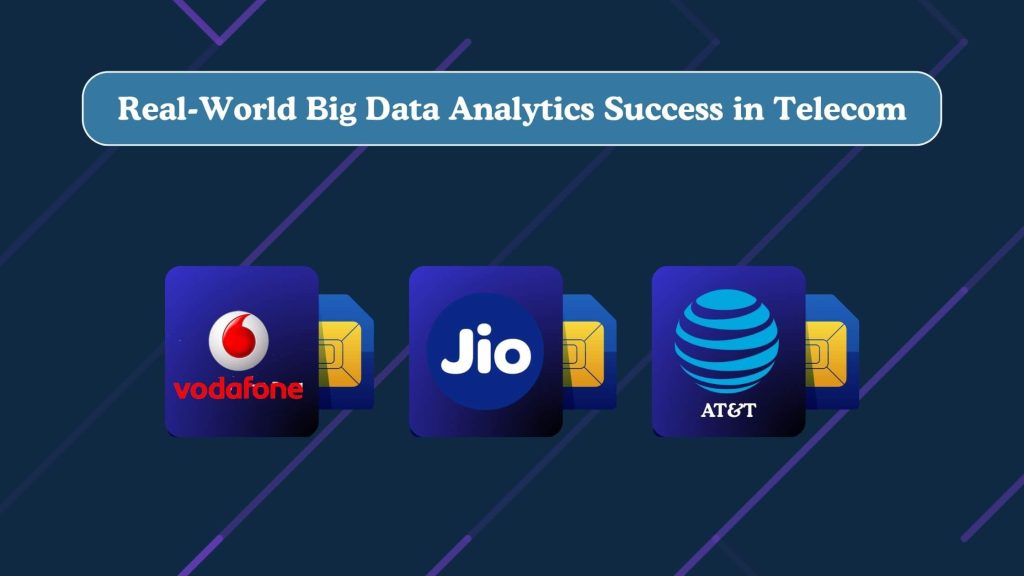
Across the telecom industry, leading operators are actively using data-driven insights to improve network performance, enhance customer experience, and support large-scale digital operations.
Real-world implementations highlight how analytics enables better decision-making, operational efficiency, and service innovation.
The following examples show how major telecom companies have successfully applied analytics at scale to address both technical and business challenges –
Vodafone
Vodafone uses large-scale analytics to gain deeper visibility into network performance and customer behavior across its global operations. By analyzing network traffic, call records, and usage patterns, the company can proactively identify congestion issues and service degradation before they affect customers.
This data-driven approach helps Vodafone maintain consistent service quality across regions with varying demand levels.
On the customer side, analytics supports churn reduction and personalized engagement strategies. By combining usage data with customer interaction history, Vodafone can predict potential churn and design targeted retention initiatives.
These insights also guide the development of tailored plans and services that better align with customer expectations.
Reliance Jio
Jio has built its operations around data-first decision-making, leveraging analytics to manage one of the largest subscriber bases in the world. Real-time data analysis helps Jio monitor network load, optimize spectrum usage, and maintain performance even during peak traffic periods.
This capability has been critical in supporting rapid subscriber growth without compromising service reliability.
Analytics also plays a major role in understanding user consumption patterns across digital services. Insights derived from data enable Jio to design affordable plans, bundle services effectively, and personalize user experiences.
This strong alignment between data insights and business strategy has helped Jio scale efficiently in a highly competitive market.
AT&T (USA)
AT&T applies advanced analytics across network operations, customer experience management, and predictive maintenance.
By analyzing massive datasets generated by its infrastructure, the company can anticipate equipment failures and address potential issues before they cause service disruptions. This proactive approach improves network uptime and reduces operational costs.
In addition, AT&T uses customer analytics to refine service offerings and improve engagement. By studying usage behavior and service preferences, the company delivers more relevant plans and support experiences.
These insights allow AT&T to balance operational efficiency with customer-centric innovation in a mature telecom market.
Challenges in Telecom Data Analytics and Ways to Overcome Them
Telecom companies deal with complex data environments that combine scale, speed, and variety. While analytics delivers significant value, implementing it effectively comes with several technical, operational, and organizational challenges.
Addressing these barriers is essential for turning telecom data into reliable, actionable insights.
Massive Data Volume
Telecom networks generate enormous volumes of data from calls, messages, internet usage, network devices, and customer interactions.
Processing and storing this data in real time can overwhelm traditional systems and slow down analytics initiatives. As data continues to grow, scalability becomes a critical concern for telecom operators.
To overcome this challenge, telecom companies adopt distributed big data architectures and cloud-based platforms that support high-volume processing. Scalable storage and real-time analytics frameworks help manage data efficiently, enabling faster access to insights without performance bottlenecks.
Outdated Technology
Legacy systems are still widely used in many telecom organizations, making data integration and advanced analytics difficult.
These outdated platforms often lack the flexibility needed to support modern analytics tools and real-time processing requirements. As a result, data remains underutilized or fragmented across systems.
Modernizing infrastructure through a gradual migration to cloud-native, modular platforms helps address this issue. Integrating advanced analytics tools with updated architectures allows telecom providers to unlock the full potential of their data without disrupting existing operations.
Data Quality & Silos
Telecom data often comes from multiple sources, such as billing systems, network logs, and customer platforms.
Inconsistent formats, duplicate records, and isolated data silos degrade data quality and limit the accuracy of analytics. Poor data quality directly impacts decision-making and predictive models.
Implementing strong big data governance frameworks and centralized data management practices helps improve consistency and accessibility.
By breaking down silos and standardizing data pipelines, telecom companies can ensure cleaner, more reliable datasets for analytics.
Data Security & Privacy
Telecom operators handle sensitive customer and operational data, making security and privacy a major concern.
Unauthorized access, data breaches, and regulatory non-compliance can result in financial losses and reputational damage. Ensuring data protection while enabling analytics is a delicate balance.
Robust encryption, access controls, and compliance-driven data policies help safeguard sensitive information. Secure analytics environments allow telecom companies to analyze data responsibly while meeting regulatory and customer trust requirements.
Skilled Workforce Shortage
Advanced analytics initiatives require expertise in data engineering, analytics, and domain-specific telecom knowledge. Many telecom organizations struggle to find and retain skilled professionals who can manage complex data ecosystems and interpret analytics outputs effectively.
To address this gap, telecom companies invest in training programs and collaborate with analytics service providers. Building cross-functional teams and leveraging external expertise helps accelerate analytics adoption without being limited by internal skill shortages.
Emerging Trends Shaping Big Data Analytics in the Telecom Industry
The telecom industry is undergoing rapid transformation driven by evolving network technologies, rising data volumes, and changing customer expectations.
Advanced analytics is becoming a core enabler for managing this complexity while supporting innovation and operational efficiency.
The following trends highlight how data-driven approaches are shaping the future of telecom operations and customer experiences.
AI-Native Networks and Agentic AI
Telecom networks are increasingly evolving toward AI-native architectures where analytics and intelligent agents are embedded directly into network operations.
These systems analyze real-time data to automate decision-making, optimize performance, and respond dynamically to changing network conditions. This shift reduces manual intervention and enables faster, more adaptive network management.
5G Expansion and Network Slicing
The expansion of 5G has significantly increased data volume and network complexity. Analytics plays a key role in managing network slicing by monitoring performance, allocating resources efficiently, and ensuring service-level requirements are met for different use cases.
This allows telecom operators to support diverse applications while maintaining network stability and efficiency.
Sustainability and Green Networks
Sustainability has become a strategic priority for telecom providers. Data analytics helps monitor energy consumption, identify inefficiencies, and optimize network operations to reduce carbon footprints.
By leveraging insights from operational data, telecom companies can design greener networks while controlling operational costs.
Hyper-Personalization of Customer Experience
Customer expectations are shifting toward highly personalized services and interactions. Analytics enables telecom providers to analyze behavior, usage patterns, and preferences to deliver tailored plans, recommendations, and support experiences.
This level of personalization improves customer satisfaction, loyalty, and long-term engagement.
How BigDataCentric Supports Telecom Companies with Big Data Analytics Solutions?
Telecom companies operate in data-intensive environments where performance, reliability, and customer experience must move in sync. BigDataCentric supports telecom operators by building analytics solutions that turn large, complex datasets into clear, actionable insights aligned with business goals.
The focus is on creating scalable analytics frameworks that work seamlessly across network operations, customer data, and enterprise systems.
From data engineering and big data integration to advanced analytics and visualization, BigDataCentric helps telecom providers modernize their data ecosystems. Solutions are designed to support real-time analytics, predictive insights, and operational intelligence while maintaining data quality, security, and regulatory compliance.
This enables telecom teams to make faster decisions, reduce operational friction, and improve service outcomes.
By combining domain understanding with strong analytics capabilities, BigDataCentric helps telecom organizations unlock value from their data assets.
The result is improved network efficiency, better customer engagement, and analytics-driven innovation that supports long-term growth in a competitive telecom landscape.
Looking to Improve Telecom Data Insights?
Get expert support to turn telecom data into actionable analytics outcomes.
Conclusion
Data has become one of the most valuable assets in the telecom industry, influencing everything from network performance to customer engagement and service innovation.
By applying analytics effectively, telecom companies can gain deeper operational visibility, anticipate challenges, and respond more quickly to changing market demands.
From optimizing networks and reducing churn to enabling personalization and supporting sustainable growth, big data analytics for telecom has moved beyond experimentation to become a core business capability.
As data volumes and network complexity continue to grow, telecom operators that invest in scalable, insight-driven analytics will be better positioned to compete, innovate, and deliver consistent value to their customers.
FAQs
-
What are the top 3 trends in data analytics?
The top trends include real-time analytics for faster decision-making, automation enabled by advanced analytics models, and hyper-personalization driven by customer data insights. These trends help organizations improve efficiency and responsiveness.
-
How is customer behavior analyzed in the telecom industry?
Telecom companies analyze usage patterns, service interactions, billing data, and digital touchpoints to understand customer preferences. This helps identify behavior trends and improve engagement strategies.
-
Does telecom analytics support 5G planning?
Yes, analytics supports 5G planning by analyzing traffic demand, network performance, and location-based usage data. This helps optimize infrastructure deployment and resource allocation.
-
How does analytics reduce customer churn in telecom?
Analytics identifies early signs of dissatisfaction by monitoring usage changes, complaints, and service issues. Telecom providers use these insights to take proactive retention actions.
-
How does analytics support telecom growth?
Analytics enables data-driven decisions across network optimization, customer experience, and service innovation. This helps telecom companies scale efficiently and remain competitive.

Jayanti Katariya is the CEO of BigDataCentric, a leading provider of AI, machine learning, data science, and business intelligence solutions. With 18+ years of industry experience, he has been at the forefront of helping businesses unlock growth through data-driven insights. Passionate about developing creative technology solutions from a young age, he pursued an engineering degree to further this interest. Under his leadership, BigDataCentric delivers tailored AI and analytics solutions to optimize business processes. His expertise drives innovation in data science, enabling organizations to make smarter, data-backed decisions.


