

A Complete Guide to Food Delivery App Development
Blog Summary:
This blog covers the food delivery market, its growth opportunities, and the different types of applications businesses can build. It explains essential features for customers, restaurant partners, delivery personnel, and administrators. It also outlines the development process, estimated costs, popular business models, and common technical challenges. Finally, it highlights how businesses can plan a scalable food delivery platform that supports customer satisfaction and long-term growth.
Food delivery apps have changed how people order meals by making it easier to browse menus, customize dishes, make payments, and track orders in real time. For restaurants and food businesses, these platforms create opportunities to reach more customers, simplify order management, and generate revenue beyond traditional dine-in services.
As customer expectations for convenience and faster service continue to grow, businesses are investing in digital platforms that support a smoother ordering experience.
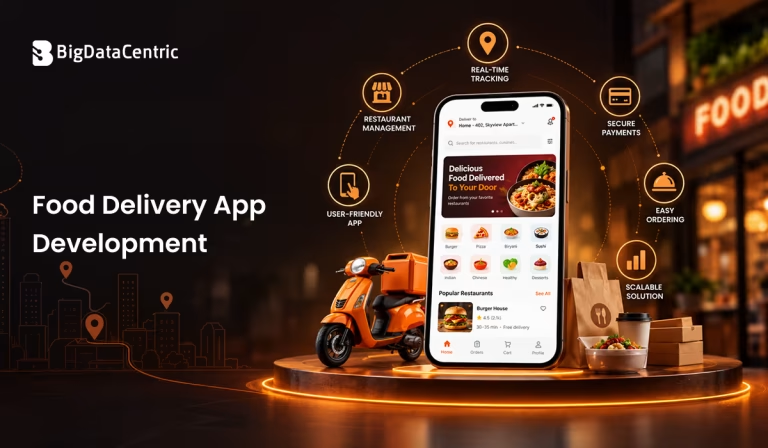
Successful Food Delivery App Development involves more than building an ordering interface. It requires a reliable system connecting customers, restaurant partners, delivery personnel, and administrators through coordinated workflows.
Features such as secure payments, live order tracking, personalized recommendations, and efficient delivery management help businesses improve service quality and customer retention.
The right approach depends on the business model, target audience, operational requirements, and budget. Whether launching a single-restaurant application or a multi-vendor marketplace, businesses need a scalable solution that can adapt to changing demand and future growth.
I’ve kept the introduction focused and used the primary keyword once. I’ll wait for your instruction before writing the next section.
Food Delivery App Development Market: Trends, Growth, and Business Potential
The global online food delivery market is estimated to reach $355.6 billion in 2026 and is projected to grow to $505.5 billion by 2030, at a CAGR of 9.4%.
This growth is driven by increasing smartphone adoption, demand for convenient meal ordering, digital payments, and real-time delivery tracking. Asia-Pacific is a major contributor, accounting for 41.6% of global market revenue in 2024. Platform-based services and prepared meal delivery continue to drive the industry’s expansion.
India also presents strong opportunities, supported by growing internet usage, expanding cloud kitchens, and increasing demand for online food ordering in Tier-2 and Tier-3 cities. Established platforms such as Zomato and Swiggy demonstrate the market’s scale, while niche platforms and restaurant-owned apps offer opportunities for new businesses.
Companies investing in Food Delivery App Development can target specific customer segments, streamline restaurant operations, and build convenient ordering experiences with secure payments and efficient delivery management.
For businesses entering this market, success depends on choosing the right business model, understanding local customer needs, and creating a scalable food delivery app solution.
Features such as personalized recommendations, transparent pricing, and reliable order tracking can help improve customer satisfaction and encourage repeat orders.
Essential Features to Include in a Food Delivery App
A successful food delivery platform needs features that make ordering convenient, simplify restaurant operations, and support reliable deliveries. Each interface should provide the tools its users need while keeping the overall experience simple and consistent.
Customer App Features
Frictionless Onboarding
Offer quick registration through email, phone number, or social login, along with OTP-based verification where appropriate. A simple onboarding process with easy address selection helps customers start ordering without unnecessary steps.
Detailed Menu & Customization
Display clear food descriptions, high-quality images, prices, portion sizes, and dietary information. Allow customers to customize ingredients, select add-ons, specify preferences, and check item availability before adding meals to their cart.
Multiple Payment Gateways
Integrate secure payment options such as credit and debit cards, UPI, digital wallets, and, where applicable, cash on delivery. A reliable checkout process with clear billing details and payment confirmation helps reduce failed transactions and abandoned orders.
Push Notifications & Alerts
Send timely notifications about order confirmation, preparation, dispatch, delivery progress, and promotional offers. Keep alerts relevant and allow users to manage their notification preferences to avoid unnecessary interruptions.
Ratings & Reviews
Allow customers to rate restaurants, individual dishes, and delivery experiences after an order is completed. Feedback helps other customers make informed decisions and enables businesses to identify service issues and improve food quality.
In-App Support & Chat
Provide access to support through in-app chat, FAQs, or complaint forms. Customers should be able to report missing items, delayed deliveries, payment issues, or incorrect orders and receive timely assistance.
Restaurant Partner Dashboard
The restaurant dashboard should help partners manage daily operations, keep menus accurate, and monitor performance from one place.
Order Management Panel
Display incoming orders with clear preparation deadlines and order statuses. Restaurant staff should be able to accept or reject orders, update preparation progress, and notify the platform when an order is ready for pickup.
Menu & Inventory Control
Let restaurants update dish names, prices, descriptions, and images without technical support. Availability controls let staff mark items as sold out and prevent customers from ordering meals that cannot be prepared.
Analytics & Payout Reports
Provide reports covering order volumes, sales, popular dishes, cancellations, and earnings. Transparent payout statements and commission breakdowns help restaurant partners track revenue and reconcile payments.
Customer Review Response
Allow restaurant partners to view customer feedback and respond professionally to complaints or suggestions. This helps businesses address recurring issues, build customer trust, and identify opportunities to improve their menus and services.
Delivery Driver (Courier) App
The courier app should make delivery assignments easy to manage while helping delivery partners navigate routes and track their earnings.
Order Request & Acceptance
Show essential details, including pickup location, delivery destination, estimated distance, and applicable earnings, before a courier accepts an assignment. Clear order information helps delivery partners make informed decisions and reduces confusion during busy periods.
In-App Navigation
Integrate mapping and GPS to guide couriers to restaurants and customers. Accurate directions, location updates, and pickup instructions help reduce delays and improve delivery coordination.
Availability Toggle
Allow delivery partners to switch between online and offline modes based on their working hours. This helps the platform assign orders according to courier availability and manage delivery demand more effectively.
Earnings & History Dashboard
Display completed deliveries, incentives, deductions, tips where supported, and payment summaries. Access to delivery history and earnings reports helps couriers understand their performance and verify payouts.
Safety & SOS Features
Include emergency contact options, an SOS feature, and a simple way to report accidents or unsafe situations. These tools can help delivery partners request assistance when needed and support safer delivery operations.
Central Admin Panel
The central admin panel brings the entire platform together, allowing administrators to manage users, monitor transactions, and maintain operational consistency.
User & Vendor Management
Enable administrators to manage customer accounts, verify restaurant partners, and oversee delivery personnel profiles. Account controls and access permissions help maintain platform integrity and address suspicious activity.
Commission & Pricing Engine
Allow administrators to configure restaurant commissions, delivery fees, service charges, and applicable taxes. Flexible pricing rules help businesses manage different locations, order values, and delivery conditions while keeping charges transparent.
Promo Code & Campaign Manager
Provide tools to create discount codes, referral offers, and time-limited campaigns. Administrators should be able to set eligibility rules, usage limits, and campaign budgets to measure promotional effectiveness and control costs.
System Analytics
Display key metrics such as total orders, revenue, average order value, cancellations, and delivery performance. These insights help administrators identify operational bottlenecks, evaluate business growth, and make data-informed decisions.
Food Delivery App Development Process From Planning to Launch
Building a food delivery platform requires a structured process that covers business planning, interface design, development, testing, and ongoing improvements.
Each stage helps ensure the app meets user expectations, supports daily operations, and scales as the business grows.
Step 1: Research, Strategy & Business Model
Start by identifying your target audience, competitors, service locations, and customer expectations. Decide whether the platform will serve a single restaurant, multiple vendors, or a specific food category.
Define revenue streams, such as commissions, delivery charges, subscriptions, or restaurant partnerships, before finalizing the project scope.
Step 2: Core User Panels & Modules
Determine the essential modules for customers, restaurant partners, delivery personnel, and administrators. Map how orders, payments, notifications, and delivery updates will move between these interfaces. Prioritizing core functionality helps control development costs and prevents unnecessary features from delaying the initial launch.
Step 3: UI/UX Design & Wireframing
Create wireframes and interactive prototypes to establish the application’s structure and navigation. Design clear menus, simple checkout flows, readable order statuses, and accessible controls for each user group. Testing these designs with potential users before development helps identify usability issues early.
Step 4: Tech Stack Selection & Architecture
Choose technologies based on scalability, security, performance, and the available budget. The architecture may include a mobile application framework, a backend, a database, cloud hosting, mapping services, and payment integrations. A well-planned technical foundation supports reliable order processing and future feature expansion.
Step 5: Development & Integrations
Develop the customer application, restaurant dashboard, courier interface, and central admin panel, connecting them through shared APIs and backend services. Integrate essential services such as payment gateways, GPS tracking, push notifications, and order management. A phased approach allows the team to prioritize core features before introducing advanced capabilities.
Step 6: Testing & Quality Assurance (QA)
Test the application across devices, operating systems, network conditions, and user scenarios. Verify payment processing, order status updates, location accuracy, security, and performance during peak demand. Resolving bugs before launch helps prevent failed orders, confusing workflows, and disruptions to daily operations.
Step 7: Launch & Post-Launch Iteration
Release the application after completing testing, deployment, and production configuration. After launch, monitor order completion rates, customer feedback, crashes, delivery delays, and payment issues.
Regular updates, performance improvements, and feature enhancements help the platform adapt to user needs and changing business requirements.
Launch a Scalable Food Delivery Solution
Build a platform that connects customers, restaurants, and delivery partners through streamlined workflows and reliable technology designed to support future expansion.
How Much Does It Cost to Develop a Food Delivery App?
The cost of developing a food delivery app depends on its features, number of user interfaces, design complexity, technology stack, and third-party integrations. A basic application for a single restaurant generally costs less than a multi-vendor marketplace with separate customer, restaurant, courier, and admin interfaces.
As a general estimate, development costs may range from $15,000 to $30,000 for a basic app, $30,000 to $70,000 for a mid-level solution, and $70,000 to $150,000 or more for an advanced platform with features such as real-time tracking, analytics, automated dispatch, and personalized recommendations.
These figures are indicative, not fixed quotes; actual costs vary by the development team’s location, project scope, and technical requirements.
Other expenses include cloud hosting, payment gateway fees, map services, security updates, and ongoing maintenance. Businesses can manage their budgets by launching an MVP with essential features first and adding advanced functionality as demand grows.
Partnering with an experienced delivery app development company can help define the right scope, select suitable technologies, and plan development around business goals. Integrating payment gateways, order management systems, and other business tools also requires a well-planned enterprise application integration strategy to ensure smooth data exchange between different application components.
Popular Business Models for Food Delivery Apps
Choosing the right business model determines how a food delivery platform earns revenue, manages operations, and serves customers. The ideal approach depends on the target market, restaurant partnerships, delivery capabilities, and available resources.
Order Aggregator Model
An order aggregator connects customers with multiple restaurants through a single platform. It earns revenue through restaurant commissions, advertising placements, and promotional listings, while restaurants may handle their own deliveries or use third-party services. This model suits businesses that want to offer customers a wide range of dining options without operating their own kitchens.
Restaurant-Owned Delivery Model
In this model, a restaurant or restaurant chain runs its own ordering app and manages customer relationships directly.
Revenue comes from food sales, while the restaurant controls menus, pricing, promotions, and delivery arrangements. It is particularly useful for established restaurants seeking to encourage repeat orders and reduce dependence on third-party platforms.
Logistics and Delivery Partner Model
This model provides delivery infrastructure for restaurants and food businesses that need courier support. Revenue may come from delivery fees, service contracts, or per-order charges.
It suits businesses that want to specialize in pickup, route coordination, and last-mile delivery without necessarily running a customer-facing food marketplace.
Cloud Kitchen and Direct-to-Consumer Model
Cloud kitchens prepare food specifically for delivery, often operating without traditional dine-in facilities. They can use their own ordering platforms or partner with existing marketplaces to reach customers.
This model helps businesses serve specific cuisines or customer segments while managing kitchen operations, menu experimentation, and delivery-focused promotions.
Multi-Restaurant Marketplace Model
A multi-restaurant marketplace combines restaurant listings, customer ordering, payment processing, and delivery coordination within one platform. It can generate revenue through commissions, delivery charges, subscriptions, and advertising.
Although it requires more complex infrastructure and partner management, it offers opportunities to expand into new locations and serve a larger customer base.
Common Food Delivery App Development Challenges and Their Solutions
Building a reliable food delivery platform involves coordinating customers, restaurants, payments, and delivery partners in real time. Identifying common challenges early helps businesses reduce operational issues and provide a consistent customer experience.
Real-Time Tracking and Order Coordination
Accurate delivery tracking can be challenging when GPS signals fluctuate, traffic conditions change, or restaurant preparation takes longer than expected.
Integrating reliable mapping services, location updates, and automated order-status notifications helps keep customers informed. Efficient dispatch logic and clear communication between restaurants and couriers can also reduce delays.
Price Discrepancies and Hidden Fees
Unexpected delivery charges, service fees, or differences between menu prices and checkout totals can frustrate customers and lead to abandoned orders. Display item prices, applicable taxes, delivery fees, and discounts clearly before payment.
Keeping restaurant menus synchronized with the platform and showing the final payable amount at checkout helps maintain transparency and customer trust.
Payment Failures, Fraud, and Refund Disputes
Failed transactions, duplicate payments, unauthorized activity, and delayed refunds can affect customer confidence. Integrate secure payment gateways, use appropriate authentication and fraud detection measures, and maintain clear transaction records.
Automated payment status checks and a structured refund process help resolve disputes efficiently while protecting both customers and business partners.
Why Invest in Food Delivery App Development With BigDataCentric?
Building a successful food delivery platform requires the right combination of technology, usability, and operational efficiency. BigDataCentric provides custom software development services to help businesses build digital solutions aligned with their goals, customer needs, and growth plans.
From defining application requirements to developing user-friendly interfaces and integrating essential features, the focus is on creating scalable solutions that support business operations.
AI, machine learning, and data analytics capabilities can also help businesses introduce personalized recommendations, analyze ordering patterns, and gain insights into customer behavior where relevant.
Whether you are launching a restaurant ordering application or planning a multi-vendor marketplace, BigDataCentric can help you plan a solution around your requirements. The goal is to build a reliable platform that simplifies ordering, improves coordination, and supports long-term business growth.
Have a Food Delivery App Idea?
Let’s turn your vision into a practical digital solution with customized features, secure integrations, and a user-friendly experience built for your food delivery business.
Conclusion
Growing demand for convenient online ordering creates opportunities for restaurants, startups, and food businesses to build digital platforms that improve the customer experience and streamline operations.
From choosing the right business model to integrating key features and managing delivery workflows, every decision affects the platform’s long-term success.
A well-planned Food Delivery App Development strategy should focus on usability, secure payments, efficient order coordination, and scalability. Start with essential features and expand based on customer feedback to manage costs while adapting to changing market needs.
With the right technology partner, businesses can turn their food delivery ideas into reliable digital solutions designed for sustainable growth.
FAQs
Are any food delivery apps profitable?
Yes, some food delivery apps are profitable, but profitability depends on order volume, delivery costs, commissions, marketing expenses, and operational efficiency. For example, DoorDash reported positive GAAP net income of $213 million in Q4 2025, demonstrating that large-scale delivery platforms can generate profits.
Is DoorDash growing or shrinking?
DoorDash is growing based on its latest reported business results. In Q4 2025, its revenue increased 38% year over year to $4 billion, while total orders rose 32% to 903 million.
Can I Launch A Food Delivery App Without Owning A Restaurant?
Yes, you can launch a food delivery app without owning a restaurant by partnering with local restaurants, cloud kitchens, and independent food vendors. You can earn revenue through commissions, delivery fees, subscriptions, or promotional listings.
What is a white label food delivery app?
A white-label food delivery app is a pre-built application that businesses can customize with their own brand name, logo, colors, and selected features. It generally offers a faster and more affordable launch than building a completely custom platform from scratch.
What is the cost of creating a food delivery app?
Creating a food delivery app can cost approximately 15,000–30,000 for a basic version, 30,000–70,000 for a mid-level solution, and 70,000–150,000+ for an advanced platform. The final cost depends on features, integrations, design complexity, and development team rates.

About Author
Jayanti Katariya is the CEO of BigDataCentric, a leading provider of AI, machine learning, data science, and business intelligence solutions. With 18+ years of industry experience, he has been at the forefront of helping businesses unlock growth through data-driven insights. Passionate about developing creative technology solutions from a young age, he pursued an engineering degree to further this interest. Under his leadership, BigDataCentric delivers tailored AI and analytics solutions to optimize business processes. His expertise drives innovation in data science, enabling organizations to make smarter, data-backed decisions.
Latest From Our Blog
Stay updated with technical insights, industry trends, and the latest technology developments.