




LLM Optimization: Powerful Strategies for Better AI Performance
Blog Summary:
Large language models support AI assistants, chatbots, content generation, document processing, and business automation. This blog covers LLM Optimization techniques, business applications, optimization tools, implementation steps, and common challenges to help organizations improve AI performance, efficiency, scalability, and cost management.
LLM Optimization helps businesses improve the performance, efficiency, and scalability of large language model applications. As 88% of organizations now increasingly adopt AI assistants, chatbots, content generation, and intelligent automation, optimizing these models becomes important for achieving reliable business outcomes.
However, deploying an LLM alone does not guarantee consistent performance or efficient resource usage. Businesses need to improve how models process prompts, generate responses, use computational resources, and handle different workloads. Effective optimization can help reduce latency, control operational costs, and improve response quality.
It also enables organizations to adapt AI systems to changing workloads while maintaining reliable performance and efficient resource usage.
As AI workloads continue to evolve, businesses need efficient approaches that can support different models, applications, and performance requirements. Optimization provides a way to refine AI systems while maintaining a balance between quality, efficiency, and scalability.
What Is LLM Optimization?
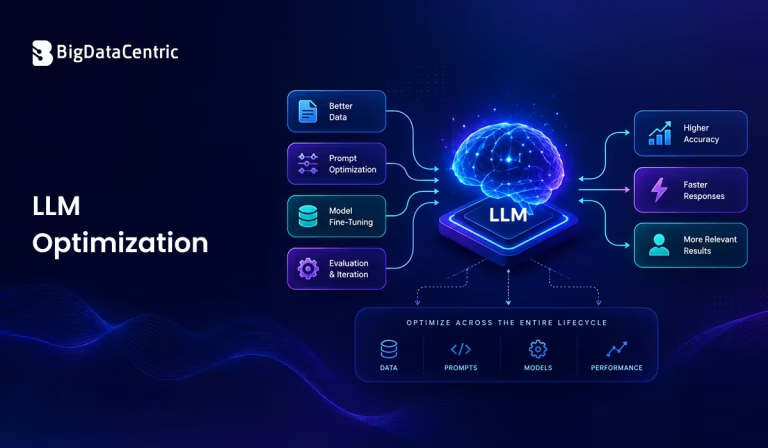
LLM Optimization is the process of improving a large language model’s performance, efficiency, and resource usage for specific applications and workloads. It involves refining prompts, selecting suitable models, improving inference processes, and managing computational resources to achieve better results.
The goal is not simply to make a model produce better responses. Organizations also need to balance response quality with latency, scalability, resource consumption, and operational costs. LLM Performance Enhancement can therefore involve several techniques depending on the application’s requirements and the model’s behavior.
Another important aspect is LLM Tuning, which focuses on adjusting model behavior to better suit specific tasks or business requirements. This may include prompt refinement, fine-tuning, context optimization, or other changes that improve how the model responds to a particular workload.
Organizations can apply different LLM Optimization Strategies based on their objectives. These strategies may focus on improving output quality, reducing inference time, lowering token usage, or making AI applications more efficient at scale.
In practice, optimization is an ongoing process. Teams evaluate model performance, identify bottlenecks, apply improvements, and monitor results to maintain reliable performance as workloads and business requirements change.
You Might Also Like:
Why Optimization Matters for Businesses?
Businesses using large language models need more than accurate outputs. They also need efficient systems that can handle growing workloads, deliver consistent responses, and operate within practical cost and performance limits. The LLM market is expected to increase by USD 29.05 billion at a 36.5% CAGR from 2025 to 2030, driving demand for scalable AI solutions.

LLM Optimization can help organizations improve response quality by refining prompts, context, and model behavior according to specific business requirements. It can also help reduce operational expenses by improving token usage, model selection, and inference efficiency. This supports llm cost optimization while reducing unnecessary resource consumption.
Optimized inference processes can further lower response latency, helping AI applications deliver faster and smoother user experiences. Organizations can also align computing resources with workload requirements instead of using excessive capacity for every task. As usage increases, efficient AI systems can handle growing workloads while maintaining reliable performance.
Continuous testing and monitoring help businesses identify performance issues and make timely improvements. By balancing quality, cost, latency, and resource usage, organizations can build AI applications that remain efficient across different workloads and business requirements.
Types of LLM Optimization
Different optimization techniques address different aspects of language model performance. Businesses can select an approach based on their application requirements, model capabilities, infrastructure, and desired outcomes.
Prompt Optimization
Prompt optimization focuses on improving the structure, clarity, and context of prompts used to interact with language models. Well-designed prompts can help models understand instructions more effectively and produce more relevant and consistent responses. Techniques such as prompt restructuring, few-shot examples, and context refinement can improve output quality without changing the underlying model.
Model Optimization
Model optimization focuses on improving a model’s efficiency and suitability for specific workloads. Organizations can select models based on performance requirements, use fine-tuning for specialized tasks, or apply techniques such as model compression to reduce resource requirements. These approaches can help balance model capabilities with deployment needs.
Inference Optimization
Inference optimization focuses on improving how efficiently a model generates responses during deployment. It can involve reducing processing time, improving llm inference optimization, throughput, managing memory usage, and selecting efficient serving methods. These improvements are particularly useful for applications that require fast and consistent responses at scale.
Cost Optimization
Cost optimization focuses on controlling the expenses associated with model usage and infrastructure. Organizations can reduce unnecessary token consumption, select models according to workload complexity, use caching where appropriate, and optimize resource allocation. These practices help maintain performance while keeping AI operations financially sustainable.
Transform Your AI Performance
Strengthen model efficiency and streamline AI workloads with practical optimization approaches designed around your performance and scalability requirements.
Steps for Effective LLM Optimization
A structured approach helps organizations improve model performance while keeping quality, cost, and efficiency aligned with business requirements. The following steps can help teams optimize LLM-based applications effectively.
Define Optimization Goals
Start by identifying the specific areas that need improvement in the AI application. Goals may include better response quality, lower latency, reduced costs, improved throughput, or greater scalability. Clear objectives help teams select suitable optimization techniques and establish measurable targets. They also provide direction for evaluating optimization efforts. Defined goals make it easier to measure overall improvements.
Set a Performance Baseline
Establish a performance baseline before making changes to the model or application. Teams can measure response quality, latency, token usage, throughput, and resource consumption. These measurements provide a reference point for evaluating future optimization efforts. A baseline can also help identify existing performance bottlenecks. Teams can then determine whether changes deliver measurable improvements.
Evaluate Model Quality
Assess the model against the requirements and expected outcomes of the intended application. An llm evaluation framework can help measure accuracy, relevance, consistency, and other quality metrics. Evaluation can identify areas where responses require improvement or additional context. Teams should also assess performance across different workloads and use cases. Regular evaluation helps maintain reliable output quality.
Optimize Prompts & Context
Refine prompts and context to help the model interpret instructions more effectively. Teams can improve prompt structure, remove unnecessary information, and provide relevant context for specific tasks. Clear instructions can produce more consistent and relevant responses across workloads. Reducing unnecessary context can also control token usage and processing requirements. These improvements can enhance results without changing the underlying model.
Choose the Right LLM
Select a model based on the application’s complexity, performance requirements, data needs, and resources. Organizations should compare accuracy, latency, scalability, capabilities, and operational costs. Different workloads may require different models depending on their complexity and outcomes. Teams should also consider integration, security, and deployment requirements. Choosing the right model helps balance performance and resource efficiency.
Fine-Tune or Compress the Model
Fine-tuning can adapt a model to specialized tasks, domains, or business requirements. Compression techniques can reduce model size and resource requirements for deployment. These approaches can support LLM Tuning when a general-purpose model does not meet specific needs. Organizations should evaluate expected performance improvements before model development. Testing ensures optimization does not negatively affect output quality.
Optimize Inference & Deployment
Improve deployment by managing memory, processing resources, and inference workloads efficiently. Organizations can optimize serving configurations, resource allocation, and workload distribution to improve performance. They may also evaluate cloud, hybrid, or self hosted llm deployment options based on requirements. Deployment decisions should consider scalability, security, maintenance, and operational costs. Efficient deployment supports reliable performance as usage increases.
Monitor & Improve Continuously
Optimization should continue after deployment because model performance and workloads can change. Teams can monitor response quality, latency, costs, resource usage, and user feedback to identify issues. These insights help determine when prompts, models, infrastructure, or configurations need adjustment. Organizations can refine their LLM Optimization Strategies as requirements evolve. Continuous improvement helps maintain reliable and efficient AI performance.
Business Applications of LLMs
Large language models can support various business functions by automating repetitive tasks and improving access to information. Organizations can integrate LLMs into applications to improve productivity, customer experiences, and operational efficiency.
Enterprise AI Assistants
Enterprise AI assistants help employees access information, summarize documents, generate content, and complete routine tasks. Businesses can connect these assistants with internal knowledge sources to provide relevant responses. LLM Performance Enhancement can improve response quality and reliability across employee use cases. These assistants support teams without requiring separate systems. With proper optimization, organizations can scale AI assistance efficiently.
AI Chatbots & Customer Support
LLMs for Customer Support can handle customer questions, provide product information, and assist with common service requests. Businesses can provide faster responses while reducing support workloads. Effective prompt design and model selection can improve response accuracy across customer interactions. Organizations can monitor conversations to identify recurring issues and improve chatbot performance. This makes LLM applications useful for consistent support across channels.
Content & Code Generation
LLMs can generate marketing content, product descriptions, documentation, emails, and software code based on instructions. Businesses can reduce manual work and accelerate development workflows using these capabilities. LLM Optimization can improve output quality while managing response time and resource usage. Teams can establish review processes to maintain accuracy, consistency, and coding standards. These applications help increase productivity across content and software development.
Document Processing
LLMs can process business documents and extract relevant information from unstructured content. They support summarization, classification, information extraction, and document-based question answering. Effective context management helps identify important information while reducing unnecessary processing. Businesses can integrate these capabilities with document management systems. This simplifies information-heavy processes and improves access to business data.
AI Agents & Automation
AI agents can use LLMs to interpret instructions, make decisions, access information, and perform tasks across business systems. Organizations can automate workflows requiring reasoning and interaction with different tools. Proper model selection, prompt design, and monitoring can help maintain reliable agent performance. Businesses can apply llm cost optimization to manage token usage and resource consumption. Optimized AI agents can support complex business processes and automation needs.
You Might Also Like:
What Are the Most Valuable LLM Use Cases for Modern Businesses?
Choosing the Right Optimization Tools for Your Enterprise
Selecting suitable optimization tools helps enterprises evaluate models, monitor performance, control costs, and manage different AI workloads effectively. The right tools should align with business requirements, technical infrastructure, scalability needs, and long-term optimization goals. Organizations should also consider integration capabilities, ease of use, and support for different models when selecting these tools.
- Model Evaluation: Evaluation tools measure accuracy, relevance, and consistency. They support testing across models and use cases.
- Performance Monitoring: Monitoring tools track latency, throughput, and resource usage. Performance can improve through continuous tracking.
- Cost Tracking: Cost tracking tools monitor spending across models and infrastructure. Clear usage visibility helps manage expenses.
- Multi-Model Support: Multi-model tools help enterprises compare different language models. They can assess model performance across applications.
- Integration & Scalability: Optimization tools integrate with applications, data systems, and infrastructure. They help centralize optimization across AI applications.
The right optimization tools help businesses improve AI efficiency and maintain consistent performance. They also make it easier to adapt AI systems to changing workloads and future business needs.
Challenges of Optimizing LLMs
Optimizing large language models requires balancing quality, performance, cost, and scalability across different business workloads. Organizations may face technical challenges that require continuous evaluation and careful management.
Balancing Quality & Cost
Improving model quality can require larger models, additional resources, or more processing time. Businesses need to balance output quality with operational costs to maintain sustainable AI workloads. Careful resource management can help achieve required performance within practical budgets.
Maintaining Output Accuracy
Optimization changes can affect how models interpret prompts, process context, or generate responses. Regular testing helps ensure efficiency improvements do not reduce accuracy or response reliability. Continuous evaluation can identify quality issues before they affect business applications.
Managing Latency & Throughput
High workloads can increase response times and create performance bottlenecks across AI applications. Organizations need efficient infrastructure and resource allocation to maintain acceptable latency and throughput. Proper workload management becomes important as application usage increases.
Large Context Management
Large context windows can increase token usage, processing requirements, and overall application costs. Businesses should provide relevant information while removing unnecessary context from model inputs. Efficient context management helps maintain quality without excessive resource consumption.
Model Selection
Choosing an appropriate model can be challenging because models differ in capabilities, performance, and operating costs. Organizations should evaluate models according to workload complexity and application requirements. Regular comparison helps teams adapt their choices as business needs change.
Continuous Monitoring
LLM applications require ongoing monitoring because workloads and performance requirements can change over time. Teams should track quality, latency, resource usage, and costs after deployment. Continuous monitoring helps identify new issues and supports timely improvements.
Why Choose BigDataCentric for LLM Development and Optimization?
BigDataCentric is a Large Language Model Development Company that helps businesses build and optimize LLM-based solutions aligned with their specific requirements. Its services can support model development, integration, deployment, and optimization across different enterprise use cases. The approach focuses on building scalable AI solutions that can adapt to changing workloads and business needs.
BigDataCentric can help organizations improve AI applications through suitable model selection, prompt optimization, deployment strategies, and performance improvements. Its expertise can also support businesses in integrating LLM capabilities with existing systems and workflows. This enables organizations to build practical AI solutions while maintaining performance, scalability, and operational efficiency.
Take Your LLM Projects Further
Turn your AI ideas into scalable solutions with the right models, optimization techniques, and deployment approach for your business.
Conclusion
Effective optimization helps businesses improve AI application quality, efficiency, scalability, and cost management. Organizations can use suitable techniques, evaluation methods, and llm optimization tools to align language models with specific business requirements.
Choosing the best llm optimization tools for ai visibility can also help teams evaluate performance, monitor workloads, and identify areas for improvement. With continuous testing and optimization, businesses can build reliable AI solutions that adapt to changing workloads and evolving operational needs.
FAQs
What is the difference between LLM and AI?
AI is a broad field that enables machines to perform intelligent tasks, while LLMs are AI models specifically designed to understand and generate human language for various communication and business applications.
What is an LLM algorithm?
An LLM algorithm uses machine learning techniques, neural networks, and large datasets to process, understand, and generate human-like text across different language-based tasks and applications.
What is the difference between LLM and SEO?
LLMs generate and process language, while SEO focuses on improving online content visibility and search engine rankings through optimized content, keywords, and website practices.
Can LLM optimization be applied to existing AI applications?
Yes. Existing AI applications can be optimized by improving prompts, model selection, context, inference, and resource usage without completely rebuilding the existing application infrastructure.
Can small language models be optimized for enterprise use?
Yes. Small language models can be optimized through fine-tuning, compression, efficient deployment, and task-specific customization for enterprise workloads while maintaining practical performance and resource efficiency.


Jayanti Katariya is the CEO of BigDataCentric, a leading provider of AI, machine learning, data science, and business intelligence solutions. With 18+ years of industry experience, he has been at the forefront of helping businesses unlock growth through data-driven insights. Passionate about developing creative technology solutions from a young age, he pursued an engineering degree to further this interest. Under his leadership, BigDataCentric delivers tailored AI and analytics solutions to optimize business processes. His expertise drives innovation in data science, enabling organizations to make smarter, data-backed decisions.


