
What is Machine Learning Fuzzy Matching?

 Total View: 56
Submitting the form below will ensure a prompt response from us.
In real-world datasets, information is rarely stored in a perfectly consistent format. Customer names may contain spelling mistakes, product titles can vary across platforms, and addresses are often abbreviated differently. Traditional exact-matching techniques fail in these situations because they identify only identical records.
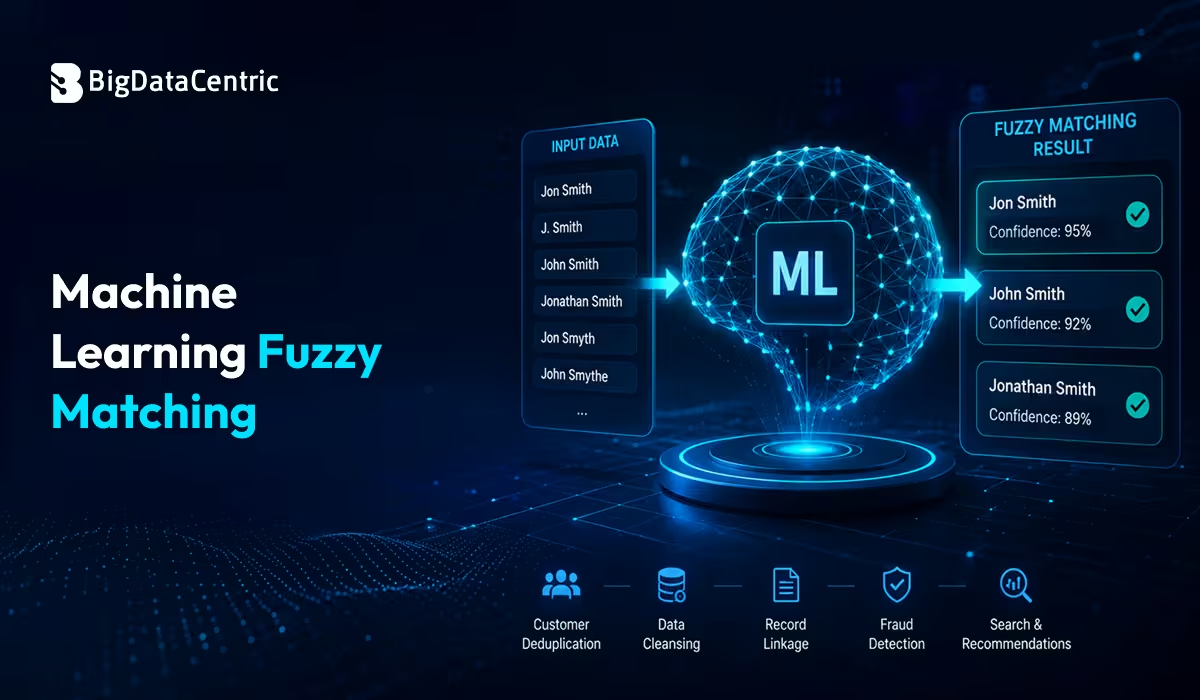
Machine Learning Fuzzy Matching solves this problem by identifying records that are similar rather than identical. It combines text similarity techniques, statistical methods, and machine learning algorithms to determine whether two data points likely refer to the same entity.
Fuzzy matching is widely used in data cleansing, customer record deduplication, fraud detection, recommendation systems, and enterprise search. By reducing duplicate records and improving search accuracy, organizations can enhance data quality and make better business decisions.
In this guide, you’ll learn how machine learning fuzzy matching works, common algorithms, Python implementation examples, practical use cases, and best practices.
What is Fuzzy Matching?
Fuzzy matching is the process of comparing two strings or records and measuring their similarity rather than checking for an exact match.
For example:
| Value 1 | Value 2 | Exact Match | Fuzzy Match |
|---|---|---|---|
| John Smith | Jon Smith | No | High Similarity |
| Machine Learning | Machine Learning | Yes | Yes |
| Artificial Intelligence | Artificial Intelligence | No | High Similarity |
Unlike exact matching, fuzzy matching can recognize spelling errors, abbreviations, missing characters, and formatting differences.
How Machine Learning Improves Fuzzy Matching?
Traditional fuzzy matching relies on predefined similarity algorithms. Machine learning enhances this process by learning patterns from historical data and predicting whether two records represent the same entity.
A typical workflow includes:
- Collect data records.
- Extract similarity features.
- Train a machine learning model.
- Predict whether records match.
- Continuously improve accuracy using new data.
Machine learning enables fuzzy matching systems to adapt to domain-specific naming conventions and complex datasets.
Popular Fuzzy Matching Algorithms
Several algorithms are commonly used for measuring similarity.
Levenshtein Distance
Levenshtein Distance calculates the minimum number of edits required to transform one string into another.
Example:
Machine

Machin
Distance = 1 because only one character is missing.
Jaro-Winkler Similarity
Jaro-Winkler assigns higher scores to strings that share matching prefixes.
It performs well for:
- Customer names
- Contact information
- Personal records
Cosine Similarity
Cosine Similarity compares text vectors instead of individual characters.
It is widely used in:
- Search engines
- Recommendation systems
- Natural Language Processing (NLP)
Token Sort Ratio
This technique rearranges words alphabetically before comparison.
Example:
New York University

University New York
Despite the different word order, the similarity score remains high.
Python Examples for Machine Learning Fuzzy Matching
Python Example Using RapidFuzz
One of the most popular Python libraries for fuzzy matching is RapidFuzz, which provides fast and efficient similarity calculations.
from rapidfuzz import fuzz
name1 = "John Smith"

name2 = "Jon Smith"

score = fuzz.ratio(name1, name2)

print(score)
Output
94.7
A higher score indicates greater similarity between the two strings.
Example Using FuzzyWuzzy
Another commonly used library is FuzzyWuzzy.
from fuzzywuzzy import fuzz
company1 = "Open AI Technologies"

company2 = "OpenAI Technologies"

similarity = fuzz.ratio(company1, company2)

print(similarity)
Output
98
Machine Learning Workflow for Fuzzy Matching
A machine learning-based fuzzy matching pipeline generally follows these steps:
Data Collection
Gather customer records, product catalogs, or other datasets that require matching.
Feature Engineering
Generate features such as:
- Levenshtein Distance
- Cosine Similarity
- Jaro-Winkler Score
- Token Similarity
- String Length Difference
Model Training
Common machine learning models include:
- Logistic Regression
- Random Forest
- XGBoost
- Gradient Boosting
- Neural Networks
Prediction
The model predicts whether two records are duplicates or represent different entities.
Real-World Applications
Customer Record Deduplication
Banks and CRM platforms merge duplicate customer profiles despite variations in spelling or formatting.
Product Matching
E-commerce platforms identify identical products listed by different sellers.
Example:
Apple iPhone 15 Pro

iPhone 15 Pro by Apple
A fuzzy matching model recognizes these as the same product.
Address Matching
Postal services compare addresses with abbreviations and spelling variations.
Example:
221B Baker Street

221 B Baker St.
Resume Screening
Recruitment platforms compare candidate skills with job descriptions despite wording differences.
Fraud Detection
Financial institutions identify duplicate identities and suspicious transactions using similarity matching.
Challenges in Machine Learning Fuzzy Matching
Although powerful, fuzzy matching presents several challenges.
False Positives
Different records may appear similar but represent different entities.
False Negatives
Records representing the same entity may receive low similarity scores due to significant formatting differences.
Large Dataset Performance
Comparing millions of records requires optimized indexing and blocking techniques.
Domain-Specific Variations
Healthcare, finance, and legal datasets often require customized similarity models.
Best Practices for Accurate Fuzzy Matching
Clean Data Before Matching
Normalize text by:
- Removing extra spaces
- Converting text to lowercase
- Removing punctuation
- Standardizing abbreviations
Use Multiple Similarity Metrics
Combining several similarity algorithms often produces better accuracy than relying on a single metric.
Train Domain-Specific Models
Machine learning models perform better when trained using data from the target industry.
Evaluate Model Performance
Measure results using:
- Precision
- Recall
- F1 Score
- Accuracy
Continuously Improve Models
Update models regularly as new data becomes available.
Common Mistakes to Avoid
Relying Only on Exact Matching
Incorrect approach:
John Smith

Jon Smith
An exact comparison treats these values as different.
Machine learning fuzzy matching recognizes their high similarity.
Ignoring Data Preprocessing
Comparing uncleaned text often reduces matching accuracy.
For example:
Machine Learning

machine learning
Normalizing text before comparison improves results significantly.
Build AI-Powered Data Matching Solutions
Our machine learning experts develop intelligent matching systems that improve data quality, search accuracy, and business decision-making.
Conclusion
Whether you’re building customer relationship management systems, e-commerce platforms, fraud detection solutions, or enterprise search applications, machine learning fuzzy matching provides a scalable and intelligent approach to comparing data beyond exact text matching.
By following best practices such as data preprocessing, feature engineering, machine learning model versioning, and continuous model evaluation, you can build accurate and efficient fuzzy matching solutions.


Jayanti Katariya is the CEO of BigDataCentric, a leading provider of AI, machine learning, data science, and business intelligence solutions. With 18+ years of industry experience, he has been at the forefront of helping businesses unlock growth through data-driven insights. Passionate about developing creative technology solutions from a young age, he pursued an engineering degree to further this interest. Under his leadership, BigDataCentric delivers tailored AI and analytics solutions to optimize business processes. His expertise drives innovation in data science, enabling organizations to make smarter, data-backed decisions.