
Machine Learning Model Versioning: Key Concepts Explained

Last Updated: June 23, 2026
 Total View: 212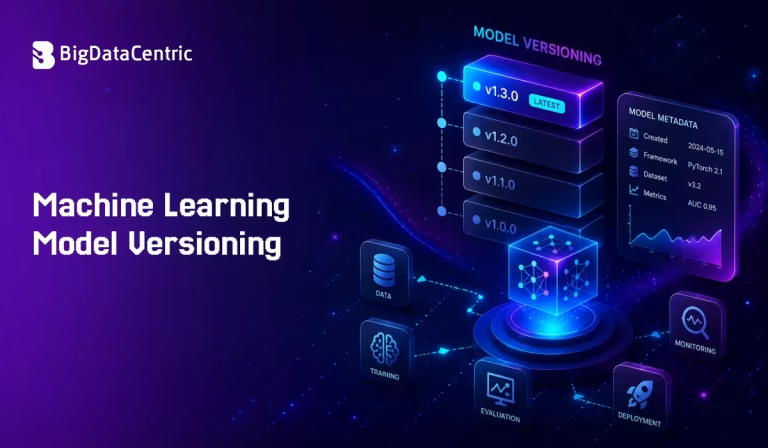
Submitting the form below will ensure a prompt response from us.
Machine learning projects rarely involve a single model. Data scientists continuously train, test, optimize, and deploy models using different datasets, algorithms, and hyperparameter configurations. As projects grow, keeping track of these changes becomes increasingly difficult.
This is where Machine Learning Model Versioning becomes essential. It enables organizations to manage multiple versions of machine learning models, ensuring reproducibility, collaboration, governance, and efficient deployment. Similar to how developers use Git to manage source code, machine learning teams use model versioning to track model evolution throughout the AI lifecycle.
In this article, we’ll explore machine learning model versioning, its importance, key components, popular tools, implementation strategies, and best practices.
What is Machine Learning Model Versioning?
Machine Learning Model Versioning is the process of systematically tracking and managing different versions of machine learning models, datasets, training configurations, and associated metadata.
Every time a model is retrained or modified, a new version can be created. These versions help teams:
- Track model changes
- Compare model performance
- Reproduce experiments
- Roll back to previous versions
- Maintain audit trails
- Support collaborative development
A versioned machine learning model typically includes:
- Model artifacts
- Training datasets
- Feature engineering steps
- Hyperparameters
- Source code references
- Evaluation metrics
- Deployment status
Why is Machine Learning Model Versioning Important?
Without versioning, organizations often struggle to identify which model is deployed, how it was trained, or why performance changed.
Better Collaboration
Teams working on the same project can easily share, compare, and manage model iterations.
Simplified Rollbacks
If a newly deployed model underperforms, organizations can quickly revert to a previous version.
Regulatory Compliance
Industries such as healthcare, banking, and insurance often require complete traceability of AI decisions and model changes.
Faster Deployment
Versioning enables automated deployment workflows within modern MLOps pipelines.
Key Components of Machine Learning Model Versioning
Successful versioning involves tracking more than just the model file itself.
Model Artifacts
Model artifacts are serialized files generated after training.
Example:
import joblib

joblib.dump(model, "customer_churn_v1.pkl")
These artifacts represent specific model versions and can be stored in repositories or model registries.
Dataset Versioning
Changes in training data often significantly affect model performance.
Example:
dataset_version = "customer_dataset_v3.2"
Tracking dataset versions ensures consistency and reproducibility across experiments.
Hyperparameter Tracking
Machine learning models are heavily influenced by hyperparameter settings.
Example:
params = {
    "learning_rate": 0.01,
    "max_depth": 10,
    "n_estimators": 200
}
Recording these settings helps teams understand performance differences between versions.
Performance Metrics
Each model version should store evaluation metrics.
metrics = {
    "accuracy": 0.95,
    "precision": 0.93,
    "recall": 0.91
}
This enables objective comparison among multiple model versions.
Source Code References
Versioning should link models to the code used during training.
Example:
Git Commit: a7d9f3e
Branch: model-optimization
This creates a complete audit trail.
How Machine Learning Model Versioning Works?
A standard versioning workflow follows several stages.
Step 1: Train the Model
from sklearn.ensemble import RandomForestClassifier

model = RandomForestClassifier(
    n_estimators=100,
    random_state=42
)

model.fit(X_train, y_train)
Step 2: Save the Model Artifact
import joblib

joblib.dump(model, "fraud_detection_v1.pkl")
Step 3: Store Metadata
Model metadata should include information such as:
{
  "model_version": "v1.0",
  "dataset_version": "dataset_v5",
  "algorithm": "RandomForest",
  "accuracy": 0.95
}
Step 4: Register the Model
The model is added to a centralized model registry for tracking and governance.
Step 5: Deploy the Model
The approved model version is deployed to production while preserving access to previous versions.
Popular Tools for Machine Learning Model Versioning
Several platforms support model versioning and experiment management.
MLflow
MLflow is one of the most widely used machine learning lifecycle management platforms.
Example:
import mlflow

mlflow.log_param("max_depth", 8)
mlflow.log_metric("accuracy", 0.95)
Features:
- Experiment tracking
- Model registry
- Deployment management
DVC (Data Version Control)
DVC extends Git capabilities to support datasets and machine learning artifacts.
Example:
dvc add model.pkl
git add model.pkl.dvc
git commit -m "Version 1 model"
Benefits include:
- Dataset versioning
- Pipeline reproducibility
- Git integration
Weights & Biases
Weights & Biases provides experiment tracking and model management capabilities.
Example:
import wandb

wandb.init(project="fraud-detection")

wandb.log({"accuracy": 0.96})
Features:
- Performance visualization
- Collaboration tools
- Automated experiment tracking
Amazon SageMaker Model Registry
AWS users can manage machine learning models through SageMaker’s built-in registry.
Capabilities include:
- Model approvals
- Version management
- Automated deployment workflows
Azure Machine Learning
Azure ML provides enterprise-grade model lifecycle management and governance.
Benefits:
- Centralized model registry
- Automated MLOps pipelines
- Version tracking and monitoring
Best Practices for Machine Learning Model Versioning
Use Semantic Versioning
Adopt version naming conventions such as:
v1.0.0
v1.1.0
v2.0.0
This helps teams understand the significance of updates.
Version Both Models and Data
Always track dataset versions alongside model artifacts.
Automate Metadata Collection
Automatically store:
- Training date
- Algorithm type
- Hyperparameters
- Evaluation metrics
- Deployment status
Maintain a Centralized Model Registry
A model registry ensures that all versions are discoverable and manageable.
Integrate Versioning into MLOps
Versioning should be embedded within CI/CD and deployment pipelines.
Example workflow:
stages:
  - train
  - validate
  - register
  - deploy
This enables automated model promotion and deployment.
Common Challenges in Model Versioning
Organizations implementing model versioning may encounter several challenges.
Large Storage Requirements
Machine learning artifacts and datasets often consume substantial storage resources.
Dependency Management
Different library versions can affect model reproducibility.
Example:
scikit-learn==1.5.0
numpy==2.1.0
pandas==2.2.2
Tracking dependencies is essential for consistent results.
Streamline Your ML Model Management
Implement robust model versioning and MLOps practices to accelerate AI development and deployment.
Conclusion
Machine Learning Model Versioning is a foundational practice for managing the lifecycle of AI models. As organizations develop increasingly sophisticated machine learning systems, maintaining control over model artifacts, datasets, code, and performance metrics becomes essential.
By implementing robust versioning strategies, businesses can improve reproducibility, strengthen governance, enhance collaboration, and accelerate deployment. Whether using MLflow, DVC, Weights & Biases, Azure ML, or Amazon SageMaker, effective model versioning ensures that machine learning initiatives remain scalable, transparent, and production-ready.


Jayanti Katariya is the CEO of BigDataCentric, a leading provider of AI, machine learning, data science, and business intelligence solutions. With 18+ years of industry experience, he has been at the forefront of helping businesses unlock growth through data-driven insights. Passionate about developing creative technology solutions from a young age, he pursued an engineering degree to further this interest. Under his leadership, BigDataCentric delivers tailored AI and analytics solutions to optimize business processes. His expertise drives innovation in data science, enabling organizations to make smarter, data-backed decisions.
Latest From Our Q&A
Stay updated with technical insights, industry trends, and the latest technology developments.