DevOps Maturity Model and Its Key Implementation Stages

 Total View: 227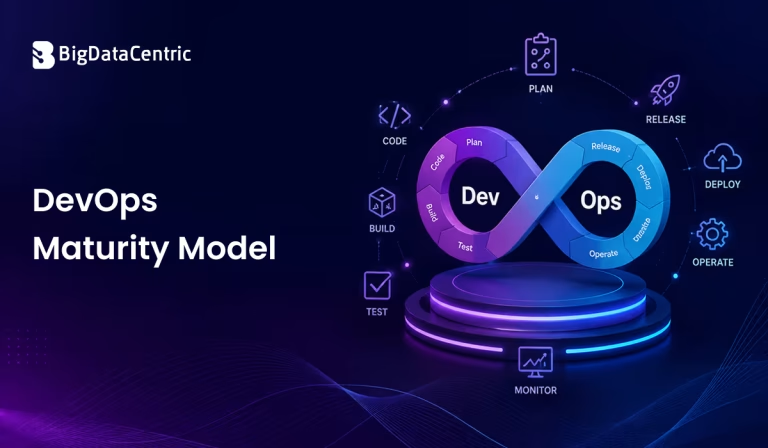
Submitting the form below will ensure a prompt response from us.
As organizations adopt DevOps practices, they often progress through different levels of automation, collaboration, and operational efficiency. Some teams are just beginning with manual deployments, while others have fully automated CI/CD pipelines and cloud-native workflows.
This progression is commonly measured using a DevOps Maturity Model.
So, what exactly is a DevOps maturity model, and why is it important?
What is a DevOps Maturity Model?
A DevOps Maturity Model is a framework for assessing how effectively an organization has adopted DevOps practices, culture, automation, and processes.
It helps organizations evaluate:
- Development workflows
- Deployment automation
- Collaboration between teams
- Monitoring and feedback systems
- Infrastructure management
The model provides a roadmap for continuous improvement.
Why is the DevOps Maturity Model Important?
Without a structured approach, organizations may struggle with:
- Slow software releases
- Manual deployments
- Poor collaboration
- Frequent production issues
- Lack of scalability
A DevOps maturity model helps businesses:
- Identify gaps
- Improve operational efficiency
- Standardize processes
- Accelerate software delivery
- Enhance system reliability
Common Stages of the DevOps Maturity Model
Most maturity models include multiple levels or stages.
Level 1: Initial Stage
At this stage:
- Processes are mostly manual
- Teams work in silos
- Deployments are slow and error-prone
- Monitoring is limited
Characteristics:
- Manual testing
- Manual deployments
- Limited automation
Organizations at this stage often face frequent downtime and inconsistent releases.
Level 2: Managed Stage
Organizations begin adopting basic DevOps practices.
Improvements:
- Source control systems implemented
- Basic CI pipelines introduced
- Improved collaboration between development and operations
Tools Often Used:
- Git
- Jenkins
- Basic scripting automation
Level 3: Defined Stage
Processes become standardized across teams.
Characteristics:
- CI/CD pipelines implemented
- Infrastructure automation introduced
- Automated testing adopted
- Monitoring tools integrated
Organizations gain:
- Faster deployments
- Better release consistency
- Improved reliability
Level 4: Measured Stage
At this level, organizations use metrics and analytics extensively.
Key Practices:
- Continuous monitoring
- Performance tracking
- Automated rollback mechanisms
- Security integration (DevSecOps)
Metrics Commonly Monitored:
- Deployment frequency
- Mean time to recovery (MTTR)
- Failure rates
- Lead time for changes
Level 5: Optimized Stage
This is the highest level of DevOps maturity.
Characteristics:
- Fully automated pipelines
- Self-healing infrastructure
- AI-driven monitoring
- Continuous optimization
Organizations achieve:
- Rapid software delivery
- High scalability
- Minimal downtime
- Strong operational resilience
DevOps Maturity Model Overview
| Level | Stage | Characteristics |
|---|---|---|
| 1 | Initial | Manual processes |
| 2 | Managed | Basic automation |
| 3 | Defined | Standardized CI/CD |
| 4 | Measured | Metrics-driven optimization |
| 5 | Optimized | Intelligent automation |
Python Example: Simple Deployment Automation
import os

print("Starting deployment pipeline")

# Simulate deployment task
os.system("echo Deploying application")

print("Deployment successful")
This simple example reflects early automation practices in DevOps maturity progression.
Key Areas Evaluated in DevOps Maturity
Automation
Measures:
- CI/CD adoption
- Infrastructure as Code (IaC)
- Automated testing
Collaboration
Evaluates communication between:
- Development teams
- Operations teams
- Security teams
Monitoring and Feedback
Includes:
- Application monitoring
- Incident management
- Logging systems
Security Integration
Modern maturity models assess:
- DevSecOps implementation
- Compliance automation
- Vulnerability scanning
Cloud and DevOps Maturity
Cloud-native technologies significantly accelerate DevOps maturity.
Common technologies include:
- Docker
- Kubernetes
- Terraform
- Serverless computing
Cloud environments enable scalable automation and continuous deployment.
Benefits of High DevOps Maturity
Organizations with advanced DevOps maturity experience:
- Faster Release Cycles – Deliver updates with improved deployment speed
- Improved Software Quality – Reduce bugs through automated testing
- Reduced Downtime – Ensure stable and reliable system performance
- Better Customer Experience – Provide seamless and faster digital services
- Increased Innovation Speed – Accelerate product development and experimentation
Real-World Use Cases
Industries using DevOps maturity models include:
Banking
Improve secure and reliable financial operations
E-commerce
Enable faster and smoother online experiences
SaaS Platforms
Support continuous product delivery and updates
Healthcare
Enhance system reliability and data accessibility
Telecommunications
Streamline network management and monitoring
Large Enterprises
Accelerate enterprise digital transformation initiatives
Large enterprises often use maturity assessments during digital transformation initiatives.
Common Challenges
Organizations may face challenges such as:
- Resistance to cultural change
- Legacy infrastructure limitations
- Skill gaps
- Tool integration complexity
- Security concerns
Successful DevOps adoption requires both technical and organizational transformation.
Best Practices for Improving DevOps Maturity
- Automate Repetitive Tasks – Reduce manual efforts and human errors
- Adopt CI/CD Pipelines – Enable faster and continuous software delivery
- Implement Infrastructure as Code – Simplify infrastructure provisioning and management
- Use Monitoring and Observability Tools – Improve system visibility and issue detection
- Foster Collaboration Across Teams – Strengthen communication between development and operations
- Continuously Measure Performance – Track efficiency using operational metrics
Future Trends in DevOps Maturity
Emerging trends include:
- AI-driven DevOps (AIOps)
- GitOps workflows
- Platform engineering
- Autonomous infrastructure management
- Intelligent incident remediation
DevOps maturity models are evolving to support cloud-native and AI-powered operations.
Build High-Performance DevOps Teams
Implement modern DevOps practices for scalable software delivery.
Conclusion
So, what is a DevOps Maturity Model?
It is a structured framework for measuring and improving an organization’s DevOps capabilities across automation, collaboration, monitoring, and deployment.
By progressing through maturity stages, organizations can:
- Deliver software faster
- Improve operational reliability
- Enhance collaboration
- Scale efficiently
The DevOps maturity model provides a roadmap for building high-performing software delivery systems in modern digital enterprises.


Jayanti Katariya is the CEO of BigDataCentric, a leading provider of AI, machine learning, data science, and business intelligence solutions. With 18+ years of industry experience, he has been at the forefront of helping businesses unlock growth through data-driven insights. Passionate about developing creative technology solutions from a young age, he pursued an engineering degree to further this interest. Under his leadership, BigDataCentric delivers tailored AI and analytics solutions to optimize business processes. His expertise drives innovation in data science, enabling organizations to make smarter, data-backed decisions.