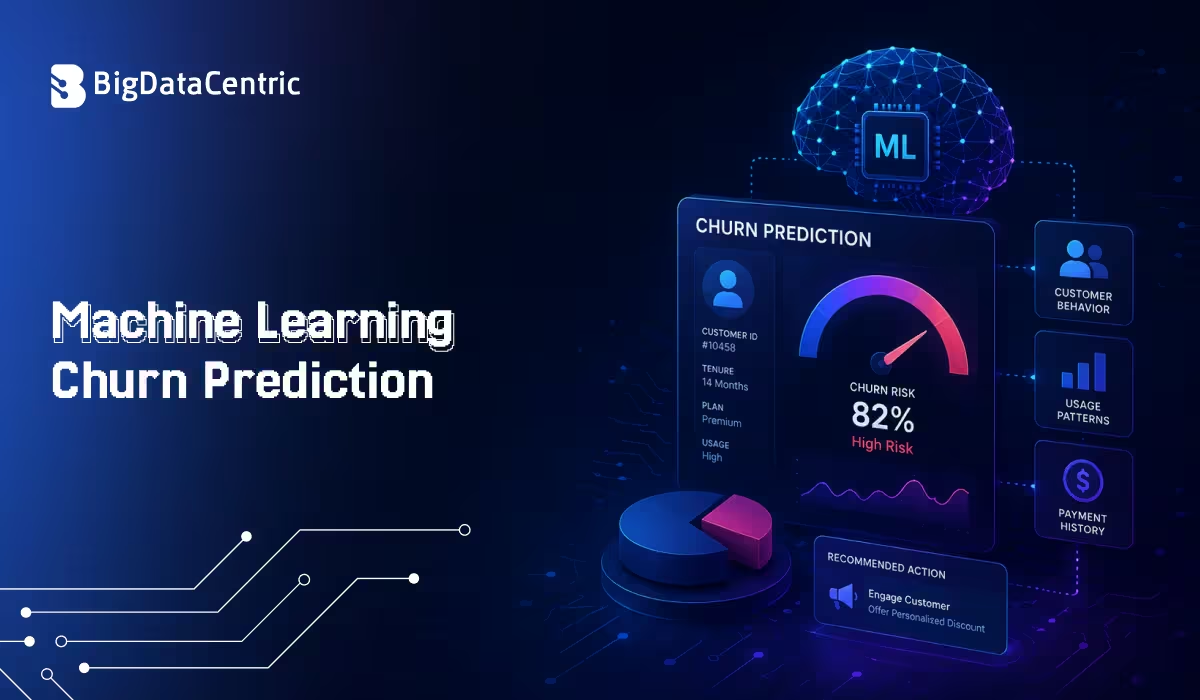
What is Machine Learning Churn Prediction?

 Total View: 62
Submitting the form below will ensure a prompt response from us.
Customer retention is one of the most important factors influencing business growth and profitability. Acquiring a new customer often costs significantly more than retaining an existing one, making customer loyalty a critical business objective. However, identifying which customers are likely to leave can be challenging without advanced analytics.
This is where Machine Learning Churn Prediction becomes valuable. By analyzing customer behavior, transaction history, engagement patterns, and demographic information, machine learning models can predict which customers are at risk of leaving a product, service, or subscription.
In this guide, we’ll explore machine learning churn prediction, how it works, popular algorithms, implementation steps, benefits, challenges, and best practices.
What is Machine Learning Churn Prediction?
Machine Learning Churn Prediction is the process of using machine learning algorithms to identify customers who are likely to stop using a company’s products or services.
Customer churn occurs when:
- A subscriber cancels a service.
- A customer stops making purchases.
- A user becomes inactive for a prolonged period.
- A client switches to a competitor.
By analyzing historical customer data, machine learning models can uncover patterns that indicate future churn and enable businesses to take proactive retention measures.
Why is Churn Prediction Important?
Losing customers directly impacts revenue, customer lifetime value, and overall business performance.
Improved Customer Retention
Predictive models help businesses identify at-risk customers before they leave.
Increased Revenue
Retaining existing customers often generates higher profitability than acquiring new ones.
Better Marketing Strategies
Businesses can launch personalized campaigns targeted at customers likely to churn.
Enhanced Customer Experience
Organizations can address customer concerns proactively and improve satisfaction.
Data-Driven Decision Making
Machine learning provides actionable insights based on customer behavior rather than assumptions.
How Machine Learning Churn Prediction Works?
A churn prediction system follows several stages, from data collection to deployment.
Step 1: Data Collection
Businesses gather customer-related information such as:
- Customer demographics
- Subscription history
- Purchase frequency
- Customer support interactions
- Product usage data
- Payment behavior
Example dataset:
customer_data = {
    "customer_id": 1001,
    "monthly_spend": 120,
    "support_tickets": 5,
    "subscription_length": 24,
    "churn": 0
}
The target variable is usually labeled as:
- 0 = Retained Customer
- 1 = Churned Customer
Step 2: Data Preprocessing
Raw data often contains inconsistencies that must be cleaned before training.
Example:
import pandas as pd

df = pd.read_csv("customer_data.csv")

df.dropna(inplace=True)
df["monthly_spend"] = df["monthly_spend"].astype(float)
Common preprocessing tasks include:
- Handling missing values
- Removing duplicates
- Feature scaling
- Encoding categorical variables
Step 3: Feature Engineering
Feature engineering improves model performance by creating meaningful variables.
Examples include:
- Average monthly spending
- Number of support tickets
- Login frequency
- Subscription duration
- Customer satisfaction scores
Example:
df["spend_per_month"] = (
    df["total_spend"] / df["subscription_length"]
)
These features often reveal hidden churn patterns.
Popular Machine Learning Algorithms for Churn Prediction
Several supervised learning algorithms are commonly used for churn prediction.
Logistic Regression
Logistic Regression is one of the simplest and most interpretable churn prediction models.
Example:
from sklearn.linear_model import LogisticRegression

model = LogisticRegression()

model.fit(X_train, y_train)
Benefits:
- Easy to implement
- Fast training
- High interpretability
Decision Trees
Decision Trees classify customers based on multiple behavioral factors.
Example:
from sklearn.tree import DecisionTreeClassifier

model = DecisionTreeClassifier()

model.fit(X_train, y_train)
Benefits:
- Easy visualization
- Handles nonlinear relationships
Random Forest
Random Forest combines multiple decision trees to improve accuracy.
from sklearn.ensemble import RandomForestClassifier

model = RandomForestClassifier(
    n_estimators=100
)

model.fit(X_train, y_train)
Benefits:
- High predictive performance
- Reduced overfitting
Gradient Boosting Models
Algorithms such as XGBoost and LightGBM are widely used for churn prediction.
Example:
from xgboost import XGBClassifier

model = XGBClassifier()

model.fit(X_train, y_train)
Benefits:
- Excellent accuracy
- Handles complex datasets effectively
Neural Networks
Deep learning models can capture highly complex customer behavior patterns.
from tensorflow.keras.models import Sequential
from tensorflow.keras.layers import Dense

model = Sequential([
    Dense(64, activation="relu"),
    Dense(1, activation="sigmoid")
])
Neural networks are often used when large volumes of customer data are available.
Evaluating Churn Prediction Models
A churn prediction model should be evaluated using multiple performance metrics.
Accuracy
Measures the percentage of correct predictions.
from sklearn.metrics import accuracy_score

accuracy = accuracy_score(
    y_test,
    predictions
)
Precision
Precision measures how many predicted churners actually churned.
Recall
Recall measures how many actual churners were successfully identified.
F1 Score
The F1 score balances precision and recall.
from sklearn.metrics import f1_score

score = f1_score(
    y_test,
    predictions
)
For churn prediction, recall is often prioritized because missing potential churners can be costly.
Real-World Applications of Machine Learning Churn Prediction
Telecommunications
Telecom companies predict customer cancellations and offer retention incentives.
SaaS Platforms
Software companies identify subscribers likely to cancel their plans.
Banking and Financial Services
Banks predict account closures and customer migration to competitors.
E-commerce
Online retailers identify customers with declining purchase activity.
Streaming Services
Platforms use churn prediction to improve engagement and reduce subscription cancellations.
Best Practices for Churn Prediction
Collect High-Quality Data
Accurate predictions depend on reliable and complete customer information.
Continuously Retrain Models
Customer behavior changes over time, requiring regular model updates.
Focus on Explainability
Businesses should understand why customers are predicted to churn.
Monitor Model Performance
Track accuracy, recall, and business outcomes after deployment.
Integrate Predictions into Business Processes
Use churn predictions to trigger automated marketing campaigns and retention strategies.
Reduce Customer Churn with AI-Powered Solutions
Leverage machine learning and predictive analytics to identify at-risk customers and improve retention rates.
Conclusion
Machine Learning Churn Prediction enables businesses to proactively identify customers at risk of leaving and take corrective action before revenue is lost. By leveraging historical customer data, machine learning algorithms can uncover patterns that are difficult to detect through traditional analysis.
From telecommunications and banking to SaaS and e-commerce, churn prediction has become a powerful tool for improving customer retention, increasing profitability, and enhancing customer experiences.
When combined with high-quality data, robust algorithms, and ongoing monitoring, machine learning churn prediction can provide a significant competitive advantage in today’s data-driven business landscape.


Jayanti Katariya is the CEO of BigDataCentric, a leading provider of AI, machine learning, data science, and business intelligence solutions. With 18+ years of industry experience, he has been at the forefront of helping businesses unlock growth through data-driven insights. Passionate about developing creative technology solutions from a young age, he pursued an engineering degree to further this interest. Under his leadership, BigDataCentric delivers tailored AI and analytics solutions to optimize business processes. His expertise drives innovation in data science, enabling organizations to make smarter, data-backed decisions.