




Data Mesh VS Data Fabric: Which Data Approach Fits Best?
Blog Summary:
Data Mesh and Data Fabric are two modern approaches designed to improve how organizations manage and use data. While Data Mesh focuses on decentralized ownership and domain-driven data management, Data Fabric creates a unified layer for seamless data integration and access. The choice between them depends on business needs, structure, and data complexity. In many cases, combining both approaches can deliver better scalability, flexibility, and control.
Modern businesses are generating data at a pace that traditional architectures struggle to manage. As organizations scale, they often face challenges like fragmented data sources, inconsistent governance, and slow access to insights. This is where modern approaches like Data Mesh VS Data Fabric come into the picture, offering new ways to manage and utilize data efficiently.
While both concepts aim to solve similar problems, they take very different paths. One focuses on decentralizing ownership and treating data as a product, while the other emphasizes a unified architecture powered by automation and intelligent integration. Understanding the difference between data fabric and data mesh is essential for organizations looking to build scalable and future-ready data ecosystems.
A clear understanding of Data Mesh VS Data Fabric helps organizations choose the right approach based on their data strategy and business goals.
In recent years, businesses have started moving away from monolithic data systems toward more flexible models. Approaches like modern data platforms are becoming increasingly important as companies seek faster insights and better control over their data assets.
This blog explores Data Mesh VS Data Fabric in detail, breaking down their core principles, benefits, and key differences. By the end, you’ll have a clear understanding of which approach fits your business needs—and whether a combination of both could be the right strategy.
What is Data Mesh?
To better understand Data Mesh VS Data Fabric, it’s important to first explore each approach individually.
Data Mesh is a modern data architecture approach that shifts the way organizations handle and manage data. Instead of relying on a centralized data team or platform, it distributes data ownership across different business domains. Each domain—such as marketing, sales, or operations—takes responsibility for its own data, treating it as a product that can be easily accessed and used by others.
This approach was introduced to address the limitations of traditional, centralized data systems, which often become bottlenecks as data volume and complexity grow. In a Data Mesh model, teams closest to the data are empowered to manage, maintain, and share it, leading to better context, improved accuracy, and faster decision-making.
When discussing Data Mesh VS Data Fabric, Data Mesh stands out for its strong focus on decentralization and domain-driven ownership. Rather than building a single, unified layer over all data sources, it creates a distributed ecosystem where each domain operates independently but follows shared standards.
A key concept within Data Mesh is “data as a product.” This means data is not just stored—it is curated, documented, and made discoverable for other teams. Organizations adopting data mesh solutions often see improvements in data accessibility, collaboration, and scalability.
To support this decentralized model, companies often rely on modern practices like data science, which help teams extract meaningful insights from domain-specific datasets without depending on a centralized data team.
In simple terms, Data Mesh is not just a technology shift—it’s an organizational and cultural change that redefines how data is owned, shared, and used across the enterprise.
This makes Data Mesh a strong contender in the Data Mesh VS Data Fabric comparison for organizations seeking decentralized data ownership.
What are the Key Benefits of Data Mesh?
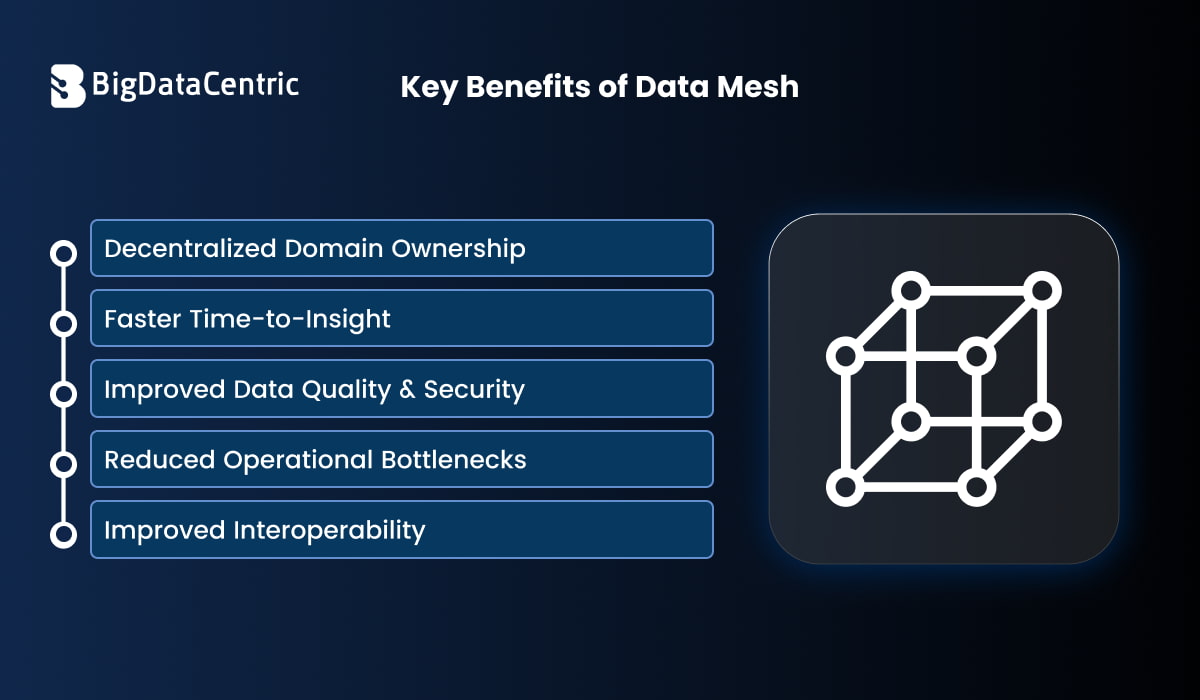
Adopting a Data Mesh approach brings a fundamental shift in how organizations interact with their data. By distributing ownership and promoting domain-driven practices, it solves many of the bottlenecks seen in traditional architectures. Below are the key benefits that make Data Mesh a compelling choice in the Data Mesh VS Data Fabric discussion.
Decentralized Domain Ownership
One of the most significant advantages of Data Mesh is that it assigns data ownership to domain-specific teams. Instead of relying on a central data team, each business unit manages its own datasets.
This leads to better accountability, as the teams closest to the data understand its context and usage more clearly. It also reduces dependency, enabling faster decision-making across the organization.
Faster Time-to-Insight
With domain teams handling their own data pipelines and access, delays caused by centralized approvals or processing are minimized. Teams can quickly access, analyze, and act on their data without waiting in queues. This accelerates the overall time-to-insight and helps businesses respond more effectively to changing conditions.
Improved Data Quality & Security
Since data is owned and maintained by domain experts, the quality naturally improves. These teams are more aware of data nuances, ensuring better accuracy and consistency. Additionally, security becomes more robust, as each domain implements controls tailored to its specific data requirements while still aligning with organizational standards.
Reduced Operational Bottlenecks
Centralized systems often struggle with scale, creating operational bottlenecks as more data and users are added. Data Mesh removes this limitation by distributing responsibilities. Each domain operates independently, which prevents overload on a single system and ensures smoother operations across the data ecosystem.
Improved Interoperability
Even though Data Mesh promotes decentralization, it doesn’t lead to chaos. Standardized protocols and shared governance models ensure that data across domains remains interoperable. This means teams can easily discover and use data from other domains without friction, improving collaboration and cross-functional insights.
4 Core Principles of Data Mesh
Data Mesh is built on a set of foundational principles that guide how data is owned, managed, and shared across an organization. These principles ensure that decentralization does not lead to inconsistency, but instead creates a scalable and well-governed data ecosystem. Understanding these principles is essential when evaluating Data Mesh VS Data Fabric, as they highlight the philosophical shift behind Data Mesh.
Domain-oriented Decentralized Data Ownership
At the heart of Data Mesh is the idea that data ownership should align with business domains. Each domain—such as finance, marketing, or operations—takes full responsibility for its data. This includes data quality, availability, and lifecycle management. By doing so, organizations reduce reliance on centralized teams and enable faster, more context-driven decision-making.
Data as a Product
In the context of Data Mesh VS Data Fabric, Data Mesh treats data as a product rather than just a byproduct of operations. This means each dataset is designed, maintained, and delivered with end users in mind. It includes proper documentation, clear ownership, defined quality standards, and easy discoverability.
This approach ensures that data is reliable, usable, and valuable across different teams.
Organizations that focus on productizing data often complement this approach with AI services advanced analytics solutions to make data more actionable and accessible for decision-makers.
Self-serve Data Infrastructure as a Platform
To support decentralized ownership, Data Mesh requires a self-service infrastructure that allows teams to manage their data independently. This platform provides tools, frameworks, and standards that simplify data ingestion, processing, and sharing.
It removes the need for deep technical dependencies, enabling teams to operate efficiently without constant support from centralized IT teams.
Federated Computational Governance
While Data Mesh promotes decentralization, governance remains a critical component. Federated computational governance ensures that all domains follow shared rules and standards, while still maintaining autonomy. Policies related to security, compliance, and data access are enforced programmatically, striking a balance between flexibility and control.
What is Data Fabric?
After understanding Data Mesh, let’s explore the other side of the Data Mesh VS Data Fabric comparison.
Data Fabric is a modern architectural approach designed to unify and integrate data across an organization, regardless of where it resides. Instead of distributing ownership like Data Mesh, it focuses on creating a connected data layer that brings together data from multiple sources—on-premises, cloud, or hybrid environments—into a single, cohesive framework.
At its core, Data Fabric uses automation, metadata, and intelligent integration to make data easily discoverable, accessible, and usable. It continuously analyzes data across systems and applies governance, security, and integration policies in a centralized yet flexible manner. This makes it easier for organizations to manage complex data environments without physically moving all their data into one place.
In the context of Data Mesh VS Data Fabric, Data Fabric stands out for its technology-driven approach. It relies heavily on automation and metadata to streamline data management processes, reducing manual effort and improving efficiency. Unlike Data Mesh, which emphasizes organizational change, Data Fabric focuses more on architectural and technological transformation.
A key component of data fabric architecture is its ability to connect disparate systems and eliminate silos. By creating a unified data layer, businesses can gain a holistic view of their data landscape and enable seamless data sharing across departments.
Organizations often combine this approach with capabilities like business intelligence solutions to transform integrated data into actionable insights, supporting faster and more informed decision-making.
In simple terms, Data Fabric acts as a smart, interconnected layer that simplifies data access and management across the entire enterprise, making it a strong counterpart in the Data Mesh VS Data Fabric comparison.
What are the Key Benefits of Data Fabric?
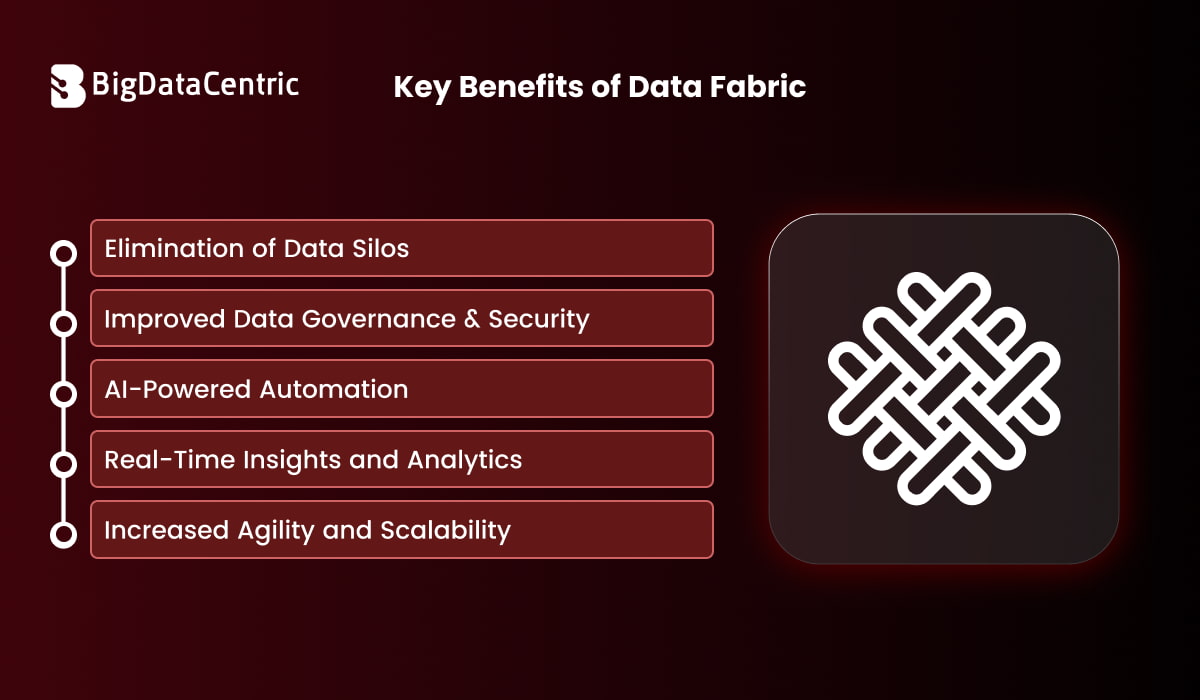
Data Fabric brings a unified and intelligent approach to managing complex data environments. By connecting disparate systems and automating data processes, it helps organizations overcome many of the limitations of traditional architectures. In the context of Data Mesh VS Data Fabric, this model stands out for its strong focus on integration, automation, and centralized visibility.
Elimination of Data Silos
One of the biggest challenges organizations face is fragmented data spread across multiple systems. Data Fabric addresses this by creating a connected layer that integrates data from various sources without requiring full migration. This eliminates silos and ensures that data can be accessed seamlessly across departments, improving collaboration and consistency.
Improved Data Governance & Security
With Data Fabric, governance is embedded directly into the architecture. It uses metadata and automated policies to enforce security, compliance, and access controls across all data sources. This ensures that sensitive data is protected while still being accessible to authorized users, making governance both efficient and scalable, in the Data Mesh VS Data Fabric comparison.
AI-powered Automation
A key strength of Data Fabric is its ability to automate data management processes. From data discovery to integration and transformation, automation reduces manual effort and minimizes errors. This intelligent handling of data helps organizations maintain consistency and efficiency, especially in large-scale environments.
Real-time Insights and Analytics
In the context of Data Mesh VS Data Fabric, Data Fabric enables faster access to real-time data by connecting systems and streamlining data flow. This allows businesses to analyze data as it is generated, leading to quicker insights and more responsive decision-making. It is particularly valuable for organizations that rely on timely data to stay competitive.
Increased Agility and Scalability
As businesses grow, their data environments become more complex. Data Fabric is designed to scale with this growth, supporting new data sources and technologies without major disruptions. Its flexible architecture allows organizations to adapt quickly to changing needs, making it a reliable choice for long-term data strategy.
4 Core Principles of Data fabric
Data Fabric is built on a set of principles that enable seamless data integration, intelligent automation, and unified access across complex environments. These principles define how a data fabric architecture operates and help organizations manage data efficiently at scale. In the broader context of Data Mesh VS Data Fabric, these principles highlight the technology-first approach of Data Fabric.
Continuous Analysis of All Types of Metadata
Metadata plays a central role in Data Fabric. The system continuously analyzes different types of metadata—such as technical, operational, and business metadata—to understand data relationships, usage patterns, and dependencies. This ongoing analysis allows the architecture to optimize data integration, improve discoverability, and support smarter decision-making.
Conversion of Passive to Active Metadata
Traditional systems treat metadata as static information, but Data Fabric transforms it into an active component. Active metadata can trigger automated actions, such as data classification, policy enforcement, or pipeline optimization. This shift reduces manual intervention and ensures that data processes remain efficient and consistent across the ecosystem.
Creation and Curation of Knowledge Graphs
In the Data Mesh VS Data Fabric comparison, Data Fabric leverages knowledge graphs to map relationships between different data assets. These graphs provide a contextual view of how data is connected, making it easier for users to discover relevant datasets and understand their meaning.
This enhances data accessibility and supports more informed analytics by providing deeper insights into relationships within the data.
Robust Data Integration Backbone
At its core, Data Fabric relies on a strong integration layer that connects data from various sources, including cloud platforms, on-premises systems, and third-party applications. This backbone ensures smooth data flow and consistency across the organization, enabling unified access without complex data movement or duplication.
Need a Scalable Data Solution for Your Business?
Our team builds robust data architectures that support growth, improve access, and ensure better data governance.
Data Mesh vs Data Fabric: Quick Comparison Table
To better understand Data Mesh VS Data Fabric, a side-by-side comparison helps highlight how these two approaches differ across key aspects. While both aim to improve data accessibility and scalability, their methods and focus areas are quite distinct.
| Aspect | Data Mesh | Data Fabric |
|---|---|---|
| Definition | A decentralized data architecture that assigns ownership to domain teams and treats data as a product | A unified architecture that integrates and connects data across systems using automation and metadata |
| Architecture Type | Distributed and domain-oriented | Centralized, with a unified data layer across sources |
| Data Ownership | Owned by individual business domains | Managed centrally through automated systems and governance policies |
| Focus Area | Organizational change and domain-driven data management | Technological integration and seamless data connectivity |
| Data Management Style | Decentralized and product-focused | Automated and metadata-driven |
| Use Case Suitability | Best for large organizations with multiple independent teams | Ideal for organizations dealing with complex, multi-source data environments |
| Best For | Companies aiming to scale data ownership and improve domain accountability | Businesses looking to eliminate silos and enable real-time data access |
| Technology Dependency | Less dependent on specific tools, more on organizational alignment | Highly dependent on tools, automation, and advanced integration technologies |
This comparison makes it clear that the difference between Data Mesh VS Data Fabric lies not just in architecture, but also in how organizations approach data ownership, governance, and scalability. While Data Mesh emphasizes decentralization and cultural change, Data Fabric focuses on building a unified and intelligent data layer.
Data Mesh vs Data Fabric: Key Differences
While both approaches aim to modernize data management, the real distinction becomes clearer when you look at how they operate in practice. The difference between data fabric and data mesh goes beyond structure—it reflects how organizations think about ownership, governance, and scalability. Below are the key areas where they differ.
Understanding these differences is crucial when evaluating Data Mesh VS Data Fabric for your organization.
Data Ownership Model
In a Data Mesh approach, data ownership is decentralized and aligned with business domains. Each domain team is responsible for producing, maintaining, and sharing its own data, which improves accountability and ensures that data is handled by those who understand it best. This reduces dependency on central teams and speeds up data-related processes.
On the other hand, Data Fabric follows a more centralized ownership model, where data is managed through a unified layer supported by automation and governance frameworks. Instead of assigning ownership to domains, it focuses on integrating data from various sources into a connected system.
This makes it easier to control and standardize data but can limit domain-level flexibility compared to Data Mesh.
Philosophy
In the Data Mesh VS Data Fabric comparison, the philosophy behind Data Mesh is centered around organizational transformation. It promotes the idea of treating data as a product and encourages teams to take full ownership of their data assets. This approach requires a shift in mindset, where collaboration and accountability are distributed across the organization rather than concentrated in a single team.
In contrast, Data Fabric is driven by a technology-first mindset. It focuses on simplifying data management through automation, metadata, and intelligent integration. Instead of changing how teams operate, it enhances existing systems by adding a layer that connects and manages data more efficiently. This makes it easier for organizations to adopt without major structural changes.
Scalability and Flexibility
Data Mesh achieves scalability by distributing responsibilities across multiple domains. As new teams or data sources are added, they can operate independently without overloading a central system. This makes it highly flexible for large organizations with diverse data needs, as each domain can evolve at its own pace.
Data Fabric, however, scales through its unified architecture. By creating a connected data layer, it can handle increasing volumes and sources without requiring significant changes to the overall structure. While this ensures consistency and control, flexibility may be somewhat limited compared to the domain-driven nature of Data Mesh.
Implementation Complexity
In the Data Mesh VS Data Fabric comparison, implementing Data Mesh often involves significant organizational change. It requires aligning teams, redefining roles, and establishing new processes for data ownership and governance. This cultural shift can take time and effort, especially in organizations that are used to centralized systems. However, once implemented, it can lead to long-term efficiency and scalability.
Data Fabric may be easier to adopt from an organizational perspective, as it does not require major changes in team structure. However, it can involve complex technology implementation, including integration tools, metadata management systems, and automation frameworks. The challenge here lies more in technical execution than in cultural transformation.
Governance Strategy
Governance in Data Mesh is federated, meaning that while each domain has autonomy, it still follows a set of shared standards and policies. This balance allows organizations to maintain consistency in areas like security and compliance while enabling teams to operate independently. Governance is often embedded into workflows to ensure it scales effectively.
In Data Fabric, governance is more centralized and automated. Policies are enforced across the entire data ecosystem using metadata and intelligent systems. This ensures consistency and reduces the risk of errors, as rules are applied uniformly across all data sources. It is particularly useful for organizations that require strict compliance and control.
Architecture Approach
Data Mesh uses a distributed architecture where data is managed within individual domains. Each domain builds and maintains its own data pipelines and products, which are then made available to other teams. This approach supports scalability and domain expertise but requires strong coordination to ensure interoperability.
In contrast, data fabric architecture focuses on creating a unified layer that connects data across systems. Instead of distributing responsibility, it integrates data into a cohesive framework that allows seamless access. This reduces complexity from a user perspective, as they can interact with data without worrying about its underlying location or structure.
Use Case Suitability
Data Mesh is best suited for organizations that have multiple independent teams and want to scale data ownership across domains. It works well in environments where domain expertise is critical and where teams need autonomy to manage and use their data effectively. It is especially valuable for large, complex organizations undergoing digital transformation.
Data Fabric is ideal for businesses dealing with fragmented data environments and multiple data sources. It is particularly useful when the goal is to eliminate silos, improve integration, and enable real-time data access. Organizations that prioritize centralized visibility and automation often benefit more from this approach.
When to Choose Data Mesh?
Data Mesh is a strong fit for organizations that operate across multiple domains where each team generates and relies on its own data. In such cases, centralized data systems often create delays and bottlenecks, limiting scalability and slowing decision-making. By shifting ownership to domain teams, businesses can improve accountability, reduce dependency on central teams, and enable faster access to insights.
This approach works especially well when domain expertise is critical to maintaining data quality and context.
It is also ideal for organizations looking to build scalable data mesh solutions and improve agility in data operations. By enabling self-service capabilities, teams can independently manage and share their data as well-defined products.
However, this model requires strong governance and alignment across teams to ensure consistency and smooth collaboration across the data ecosystem in the Data Mesh VS Data Fabric discussion.
When to Choose Data Fabric?
In Data Mesh VS Data Fabric discussion, Data Fabric is the right choice for organizations dealing with fragmented data spread across multiple systems, such as cloud platforms, on-premises infrastructure, and third-party applications. When businesses struggle with data silos and lack a unified view, a data fabric architecture helps by creating a connected layer that integrates data without requiring full migration.
This makes it easier to access, manage, and analyze data across the organization from a single interface.
It is also well-suited for companies that prioritize automation, real-time insights, and strong governance. Data Fabric uses metadata and intelligent systems to automate data integration, enforce policies, and improve data accessibility.
This approach is particularly beneficial for organizations that need consistent control over their data environment while scaling operations efficiently, making it a strong option in the Data Mesh VS Data Fabric decision.
Can Data Mesh and Data Fabric Work Together?
Yes, Data Mesh and Data Fabric can work together, and in many cases, combining both approaches creates a more balanced and effective data strategy. While they are often compared in the Data Mesh VS Data Fabric discussion, they are not mutually exclusive. Instead, they address different aspects of data management—one focuses on organizational structure, and the other on technological integration.
In the Data Mesh VS Data Fabric comparison, Data Mesh brings decentralization by assigning ownership to domain teams and encouraging them to treat data as a product. On the other hand, Data Fabric provides the underlying layer that connects data across systems, enabling seamless access and integration.
When used together, Data Fabric can support Data Mesh by offering the infrastructure needed for data discovery, integration, and governance across domains.
This combination allows organizations to maintain domain-level ownership while still benefiting from a unified data environment. Domain teams can manage their own data independently, while Data Fabric ensures that data remains accessible, interoperable, and governed across the organization. This helps reduce silos without sacrificing flexibility.
In practice, many organizations adopt a hybrid approach where Data Mesh defines how data is owned and managed, and Data Fabric ensures how data is connected and delivered. This approach is particularly useful for large enterprises that need both scalability and centralized visibility in their data ecosystem.
How BigDataCentric Can Help with Data Mesh and Data Fabric?
Adopting modern data architectures like Data Mesh VS Data Fabric requires more than just technology—it involves the right strategy, tools, and implementation approach. BigDataCentric helps organizations design and implement scalable data ecosystems that align with their business goals while ensuring efficiency and long-term value.
With deep expertise in data engineering, analytics, and modern architectures, BigDataCentric supports businesses in building both decentralized and unified data environments. Whether it’s implementing domain-driven data mesh solutions or designing a robust data fabric architecture, the focus remains on improving data accessibility, governance, and performance.
This ensures that organizations can extract meaningful insights without dealing with operational bottlenecks.
The team also helps in setting up strong governance frameworks, integrating data from multiple sources, and enabling real-time analytics capabilities. By combining the strengths of both approaches, BigDataCentric ensures that businesses can scale their data operations while maintaining control, security, and flexibility across the entire ecosystem.
Looking to Build a Scalable Data Strategy?
Share your data challenges with us and get tailored solutions using modern architectures like Data Mesh and Data Fabric.
Conclusion
Choosing between Data Mesh VS Data Fabric ultimately depends on how your organization wants to manage, scale, and utilize its data. Both approaches aim to solve modern data challenges, but they do so in fundamentally different ways.
Data Mesh focuses on decentralization, empowering domain teams to take ownership and treat data as a product, while Data Fabric emphasizes integration, automation, and a unified data layer across systems.
The difference between Data Mesh VS Data Fabric lies in their core philosophy—one is driven by organizational change, and the other by technological innovation. Businesses that require flexibility, domain-level control, and faster decision-making may lean toward Data Mesh, whereas those dealing with complex, distributed data environments may benefit more from Data Fabric’s integrated approach.
In many cases, organizations are not limited to choosing just one. A hybrid model that combines decentralized ownership with a unified integration layer can offer the best of both worlds. By aligning the right approach with business goals, companies can build a scalable, efficient, and future-ready data ecosystem.
FAQs
Is mesh better than fabric?
Neither is universally better—it depends on your needs. Data Mesh suits organizations that want decentralized ownership and domain-driven data management, while Data Fabric is ideal for unified integration and centralized control. The right choice depends on your structure and data complexity.
Is fabric replacing ADF?
No, Data Fabric is not replacing Azure Data Factory (ADF). ADF is a data integration tool, while Data Fabric is a broader architectural approach that can actually include tools like ADF as part of its ecosystem.
Is Kafka a data fabric?
No, Apache Kafka is not a data fabric. It is a distributed event streaming platform used for real-time data pipelines, which can be a component within a Data Fabric architecture but not the architecture itself.
What are the 4 pillars of data mesh?
The four pillars of Data Mesh are domain-oriented ownership, data as a product, self-serve data infrastructure, and federated computational governance. These principles enable decentralized and scalable data management.
Is fabric a PaaS or SaaS?
Data Fabric is neither strictly PaaS nor SaaS—it is an architectural approach. However, it can be implemented using both PaaS and SaaS tools depending on the technology stack and business requirements.


Jayanti Katariya is the CEO of BigDataCentric, a leading provider of AI, machine learning, data science, and business intelligence solutions. With 18+ years of industry experience, he has been at the forefront of helping businesses unlock growth through data-driven insights. Passionate about developing creative technology solutions from a young age, he pursued an engineering degree to further this interest. Under his leadership, BigDataCentric delivers tailored AI and analytics solutions to optimize business processes. His expertise drives innovation in data science, enabling organizations to make smarter, data-backed decisions.


