




Enterprise AI Architecture: Proven Strategies for Scalable AI
Blog Summary:
Enterprise AI Architecture connects data, AI models, applications, infrastructure, security, and governance into a scalable framework. This blog covers its key layers, business use cases, best practices, implementation strategy, adoption challenges, and essential security, governance, and compliance standards for building reliable enterprise AI solutions.
Enterprise AI Architecture provides the foundation for organizations to integrate artificial intelligence into modern business operations. AI helps enterprises automate processes, analyse large volumes of data, improve customer experiences, and speed decision-making.
However, moving AI from isolated experiments to reliable business applications requires more than selecting a powerful model. Enterprises need an architecture that connects data, AI models, applications, infrastructure, security, and governance into a scalable ecosystem.
An effective enterprise ai architecture provides the foundation for developing, deploying, and managing AI solutions across different business functions. It enables organizations to integrate AI with existing enterprise systems while maintaining performance, security, compliance, and operational control.
A well-designed architecture can also support AI agents, generative AI applications, predictive analytics, and intelligent automation as enterprise requirements evolve.
As organizations expand their AI initiatives, having a structured Enterprise AI platform becomes increasingly important. It helps teams standardise AI development, manage models and data, integrate business applications, monitor performance, and scale successful solutions across departments.
This article explores the key layers of enterprise AI architecture, business use cases, best practices, and implementation strategies. It also covers adoption challenges and important security, governance, and compliance standards for building a scalable AI foundation.
What Is Enterprise AI Architecture?
Enterprise AI Architecture refers to the structured framework that enables an organization to design, integrate, deploy, and manage artificial intelligence capabilities across its business environment. It brings together enterprise data, AI models, retrieval systems, applications, computing infrastructure, security controls, and governance mechanisms so that AI can operate reliably at scale.
AI adoption is increasing rapidly, with 44% of firms now rolling out AI across their organizations, up from 38% last year. Among firms earning more than $1 billion, 54% are rolling out AI, compared with roughly one-third of smaller firms.
Unlike a standalone AI application, an enterprise AI environment needs to work with existing business systems and large volumes of organizational data. This makes ai architecture more complex, as it must support different models, applications, users, workloads, and data sources while maintaining consistent security and performance.
A well-designed architecture provides a common foundation for enterprise ai initiatives. It allows organizations to develop AI-powered assistants, intelligent automation, predictive analytics, and AI agents. This approach avoids creating separate technology environments for every use case.
The architecture also establishes how data moves through the AI ecosystem and how models access relevant information. It defines how applications interact with models and enterprise systems while applying security and governance throughout the process. This integrated approach helps enterprises create AI capabilities that can evolve with changing business requirements while supporting scalability, reliability, and responsible AI adoption.
Enterprise AI Architecture: 6 Layers
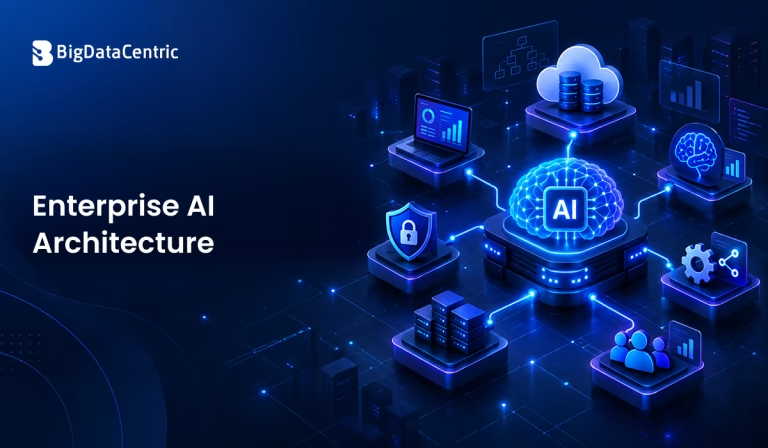
A scalable AI environment is built from interconnected layers, with each layer handling a specific part of the AI lifecycle. These layers help organizations connect enterprise data with models, applications, infrastructure, and governance while creating a foundation for reliable enterprise ai solutions.
Data Foundation & Integration Layer
The data foundation provides the information required for AI systems to generate insights, automate tasks, and support business decisions.
- Data Sources: Connects databases, documents, APIs, enterprise applications, and other structured and unstructured data sources across the organization’s technology ecosystem.
- Data Ingestion: Collects and transfers data through ETL, ELT, streaming, and batch processing pipelines for efficient and timely AI processing.
- Data Management: Maintains data quality, consistency, accessibility, metadata, and lifecycle management to support accurate and reliable AI outcomes.
- System Integration: Connects AI capabilities with CRM, ERP, HR, finance, and other enterprise systems for seamless data exchange and business workflows.
Model Layer
The model layer contains AI and machine learning capabilities that process enterprise data and perform specific tasks. Organizations can use enterprise ai architecture frameworks to define how models are selected, developed, deployed, and managed.
- Foundation & AI Models: Includes foundation models, LLMs, machine learning models, and domain-specific models for diverse enterprise applications and workloads.
- Model Selection: Evaluates models based on accuracy, performance, cost, capabilities, and business requirements to identify the most suitable option.
- Model Training & Fine-Tuning: Adapts models using relevant enterprise data and task-specific requirements to improve accuracy and contextual performance.
- Model Management: Handles model versioning, evaluation, deployment, monitoring, and lifecycle management throughout the AI development and production process.
Retrieval & Grounding Layer
The retrieval and grounding layer helps AI systems access relevant enterprise knowledge before generating responses or completing tasks. It is particularly important for applications that need accurate, context-specific information.
- Knowledge Base: Organizes enterprise documents, records, policies, and proprietary information for centralized and efficient knowledge access.
- Vector Search: Uses embeddings and vector databases to identify semantically relevant information from large enterprise datasets.
- RAG: Retrieves relevant information from enterprise sources and provides it as context to AI models for more accurate responses.
- Knowledge Grounding: Helps connect AI outputs to trusted enterprise information and reduces unsupported responses during business interactions.
Orchestration & Application Layer
This layer coordinates AI models, data, tools, APIs, and workflows to deliver business-facing applications. An enterprise ai agent architecture can also be established here to enable AI agents to reason through tasks, use tools, and interact with enterprise systems.
- AI Orchestration: Coordinates models, prompts, tools, data sources, and AI workflows for seamless task execution across enterprise environments.
- AI Agents: Enables autonomous or semi-autonomous systems to perform multi-step business tasks with minimal human intervention.
- Business Applications: Supports AI assistants, copilots, recommendation systems, and intelligent applications across different business functions.
- Workflow Integration: Connects AI capabilities with existing business processes and enterprise applications for streamlined operations and improved productivity.
Infrastructure & Compute Layer
The infrastructure layer provides the computing, storage, networking, and deployment environment for AI workloads. A flexible ai architecture supports different workloads while managing performance and resource requirements.
- Cloud & Hybrid Infrastructure: Supports cloud, on-premises, and hybrid deployment environments for flexible and scalable enterprise AI workloads.
- Compute Resources: Provides CPUs, GPUs, and specialized accelerators for AI training and inference across various workloads.
- Scalability: Enables computing resources to adapt to changing workloads, users, and data volumes without compromising system performance.
- Performance & Cost Management: Balances processing speed, availability, resource utilization, and AI operating costs for efficient enterprise operations.
Security & Governance Layer
Security and governance span all architecture layers to protect enterprise data, models, applications, and users. A well-defined enterprise ai security architecture establishes controls for secure AI adoption, privacy, risk, and compliance.
- Identity & Access Control: Manages authentication, authorization, roles, and permissions for AI resources.
- Data Security & Privacy: Protects sensitive enterprise information through encryption, access controls, and privacy measures.
- AI Governance: Establishes policies for responsible AI use, risk management, compliance, and model oversight.
- Monitoring & Auditing: Tracks system activity, model behavior, access events, and governance requirements.
Build a Scalable AI Foundation With BigDataCentric
Build a scalable AI environment tailored to your business with BigDataCentric. Explore the right solution for your needs.
Business Use Cases of Enterprise AI
Enterprise AI is being used across business functions to improve efficiency, decision-making, customer interactions, and automation. With the right enterprise ai solutions, organizations can connect AI with existing processes and systems to meet business needs.
AI-powered Customer Service
AI-powered customer service enables organizations to provide faster and more personalized support. Virtual assistants and AI chatbots can handle routine queries, recommend relevant information, summarize customer interactions, and route complex issues to human agents. By integrating enterprise knowledge with conversational AI, businesses can improve response times while maintaining consistent customer experiences.
Intelligent Process Automation
Intelligent process automation combines AI with business workflows to reduce manual effort and streamline repetitive operations. Organizations can use AI to process documents, extract information, classify requests, and trigger actions across connected systems. AI Automation for Business Processes can help employees focus on higher-value activities while improving process consistency and operational efficiency.
Sales & Marketing Intelligence
AI can help sales and marketing teams understand customer behavior, identify opportunities, and personalize engagement. Businesses can apply AI to lead scoring, customer segmentation, campaign analysis, recommendation systems, and sales forecasting. These capabilities allow teams to work with large datasets and generate insights that support more informed commercial decisions.
Fraud Detection & Risk Management
AI models can analyze transactions, user behavior, and historical patterns to identify unusual activity and potential risks. Financial institutions, insurers, and other organizations can use these capabilities for fraud detection, anomaly identification, credit assessment, and risk analysis. Continuous analysis can also help organizations respond to emerging threats more efficiently.
Predictive Analytics & Forecasting
Predictive AI helps enterprises identify patterns in historical and real-time data to anticipate potential outcomes. Organizations can apply forecasting to demand planning, inventory management, equipment performance, revenue projections, and resource allocation. For asset-intensive businesses, Predictive Maintenance can help identify potential equipment issues before failures disrupt operations.
AI-powered Software Development
AI is transforming software development by assisting teams throughout the development lifecycle. Developers can use AI for code generation, code completion, debugging, documentation, testing, and code review. When integrated into existing development workflows, these capabilities can accelerate delivery while helping development teams manage increasingly complex software environments.
Enterprise AI Best Practices
Building a reliable AI environment requires more than implementing individual models or applications. Enterprises need consistent practices for managing data, models, security, governance, and collaboration across AI initiatives. The following practices can help organizations establish a strong foundation for sustainable AI adoption.
Clear AI Governance Policies
Organizations should establish clear policies covering AI development, deployment, usage, risk management, and accountability. Governance frameworks should define roles, responsibilities, approval processes, data access requirements, and acceptable AI usage. Regular reviews can help organizations identify governance gaps as technologies and regulatory requirements evolve, creating greater consistency and accountability across enterprise AI initiatives.
High-quality & Accessible Data
AI performance depends heavily on the quality, relevance, and accessibility of enterprise data. Organizations should establish processes for data validation, cleaning, classification, and lifecycle management to ensure information remains accurate and usable. Providing authorized teams with reliable and well-structured data can improve model performance while supporting consistent outcomes across different AI applications and business functions.
Strong Security & Privacy Controls
Security should be incorporated throughout the AI lifecycle rather than added after deployment. Enterprises should protect sensitive data, models, APIs, and applications through access management, encryption, identity protection, and privacy controls. A well-defined enterprise ai security architecture can help manage security risks across interconnected AI workloads while continuous assessments strengthen protection against evolving threats.
Reliable Model Evaluation
Models should be evaluated continuously against clearly defined technical and business requirements. Enterprises can assess factors such as accuracy, relevance, latency, reliability, safety, and cost before and after deployment. Standardized testing and ongoing evaluation can identify performance changes, unexpected behavior, and improvement opportunities, helping organizations maintain dependable AI capabilities as business requirements evolve.
Cross-functional Team Collaboration
Successful enterprise AI initiatives require collaboration between data scientists, developers, IT teams, security specialists, business stakeholders, and compliance professionals. Each team contributes different technical or business expertise that can help define practical requirements, identify risks, and address implementation challenges. Strong collaboration also improves coordination throughout AI development, deployment, monitoring, and ongoing optimization.
Enterprise AI Platform Implementation Strategy
Implementing an enterprise ai platform requires a structured approach connecting business goals with data, AI capabilities, infrastructure, and operations. Organizations should assess readiness, prioritize use cases, build the platform, and improve AI capabilities based on business outcomes.
Define AI Goals & Strategy
Organizations should identify clear business objectives that AI can support, such as improving efficiency, reducing costs, enhancing customer experiences, and strengthening decision-making. These objectives should align with business priorities and define measurable outcomes. Developing AI Adoption Strategies can help establish priorities, identify stakeholders, and create a clear direction for implementation.
Assess AI Readiness
Before implementation, enterprises should assess their data, technology infrastructure, workforce capabilities, security requirements, and governance processes. This helps identify gaps that could affect AI development and deployment. Evaluating data quality, integration capabilities, computing resources, and technical expertise helps determine whether the existing environment can support planned AI workloads.
Prioritize AI Use Cases
Organizations should prioritize AI use cases based on business value, technical feasibility, data availability, complexity, risk, and expected return. High-value opportunities with measurable outcomes can be selected for initial development and testing. Lower-priority initiatives can be addressed as platform capabilities mature, helping enterprise ai initiatives progress through manageable stages.
Build the AI Platform
The platform should bring together data, models, applications, infrastructure, integrations, and governance mechanisms required for AI workloads. Organizations can use enterprise ai architecture frameworks to structure platform components and establish consistent development practices. It should also support monitoring, lifecycle management, and AI Workflow Automation across existing business processes.
Deploy AI Solutions
Selected use cases can be developed, tested, and deployed in controlled business environments once the platform foundation is established. Organizations should validate model performance, security, integration, user experience, and operational requirements before wider deployment. For agent-based applications, enterprise ai agent architecture can define interactions between agents, models, tools, and enterprise data.
Monitor & Scale
Continuous monitoring helps track model performance, reliability, usage, costs, security, and business outcomes after deployment. Organizations can apply AI Cost Optimization practices to manage infrastructure and model expenses as workloads grow. The enterprise ai platform should evolve with changing requirements, while an Artificial Intelligence Development service can support further integration and optimization.
Enterprise AI Adoption Challenges
Adopting AI can involve technical, operational, financial, and organizational challenges. Enterprises must address reliability, governance, scalability, employee adoption, and technology dependencies for long-term AI adoption.
Model Accuracy & Reliability
AI models may produce inaccurate or inconsistent results when training data is insufficient, outdated, biased, or poorly structured. Model performance can also change as business conditions or data patterns evolve over time. Continuous testing, validation, monitoring, and human oversight can help maintain reliable results across business applications.
AI Governance & Compliance
Organizations must manage governance and compliance requirements throughout the AI lifecycle and across different applications. Sensitive information, automated decisions, regulatory obligations, and business risks can create additional compliance challenges. Clear governance policies and accountability help align AI initiatives with internal requirements and applicable regulations.
Scalability & Performance Issues
AI workloads can require significant computing resources, storage capacity, network connectivity, and processing capabilities. Growing users, applications, models, and data volumes can increase performance and infrastructure requirements over time. Capacity planning and continuous monitoring help maintain response times, availability, and resource efficiency.
Employee Adoption & Change Management
Employees may require training and support to understand how AI tools fit into existing roles, processes, and workflows. Resistance can occur when teams are uncertain about new technologies, changing responsibilities, or automation. Training, communication, employee involvement, and practical guidance can support smoother AI adoption.
Vendor & Model Dependency
Organizations may become dependent on specific AI model providers, cloud platforms, APIs, or technology vendors for critical business capabilities. Changes in pricing, availability, licensing, or technical capabilities can affect long-term operations. Evaluating portability, integration dependencies, and contingency options can help maintain greater technology flexibility.
Key Enterprise AI Security, Governance & Compliance Standards
Enterprises need security, governance, and compliance standards to manage AI risks and protect organizational data. These standards support responsible AI development, privacy, security, and regulatory compliance.
- ISO/IEC 42001 – AI Management System: Provides requirements for establishing and managing an AI management system. It helps organizations address AI risks, responsibilities, and continual improvement.
- NIST AI Risk Management Framework: Guides organizations in identifying, assessing, and managing AI risks. It supports trustworthy and responsible AI throughout the lifecycle.
- ISO/IEC 27001 – Information Security Management: Provides requirements for managing information security risks. It helps protect business information through appropriate security controls.
- ISO/IEC 27701 – Privacy Information Management: Provides guidance for managing privacy information and personal data. It helps strengthen privacy controls alongside information security.
- NIST Generative AI Profile: Provides guidance for managing risks related to generative AI systems. It covers concerns including inaccurate outputs, privacy, and security.
- GDPR & AI Data Privacy Requirements: Sets requirements for processing and protecting personal data. AI systems should address privacy, transparency, data minimization, and security.
- EU AI Act: Establishes a risk-based regulatory framework for AI in the European Union. Organizations should assess applicable requirements and maintain appropriate compliance processes.
Secure Your Enterprise AI Journey
Strengthen AI security, privacy, and governance with solutions designed around your business requirements.
How BigDataCentric Can Help Build a Scalable Enterprise AI Platform?
BigDataCentric is an Artificial Intelligence Development Company that helps organizations design and develop scalable AI solutions aligned with their business requirements and technology environment. Its expertise can support data integration, AI development, model deployment, workflow integration, and scalable infrastructure. By combining technical capabilities with business-focused implementation, BigDataCentric can help organizations move AI initiatives from planning to production.
BigDataCentric can also help businesses integrate AI capabilities with existing enterprise systems while maintaining security, performance, and scalability. Its approach can support customized AI implementations that adapt to evolving business needs and workloads. This enables organizations to build a flexible AI foundation that can support new use cases and long-term growth.
Conclusion
A well-structured AI foundation helps enterprises connect data, models, applications, infrastructure, and governance to support scalable AI initiatives. Organizations that combine clear strategies, strong security, reliable data, and continuous monitoring can build AI capabilities that evolve with business needs. With the right approach, enterprises can turn AI investments into practical solutions that improve efficiency, decision-making, and long-term business growth.
FAQs
Why do enterprises need AI platform architecture?
AI platform architecture provides a structured foundation for integrating data, AI models, applications, infrastructure, security, and governance. It helps enterprises manage AI workloads and scale solutions across business functions.
What business outcomes does a strong enterprise AI architecture enable?
It can help enterprises automate processes, improve efficiency, enhance customer experiences, and support faster, data-driven decision-making. It also enables AI initiatives to scale as business needs grow.
How is enterprise AI architecture different from traditional IT architecture?
Traditional IT architecture focuses on applications, systems, networks, and infrastructure, while enterprise AI architecture also manages AI models, data pipelines, AI agents, model monitoring, and AI-specific governance.
What factors should enterprises consider when choosing AI models?
Enterprises should consider accuracy, performance, scalability, cost, capabilities, security, data requirements, and specific business needs when selecting AI models.
How can enterprises measure the success of AI initiatives?
They can track model accuracy, system performance, user adoption, process efficiency, cost savings, and business outcomes to evaluate AI performance and value.


Jayanti Katariya is the CEO of BigDataCentric, a leading provider of AI, machine learning, data science, and business intelligence solutions. With 18+ years of industry experience, he has been at the forefront of helping businesses unlock growth through data-driven insights. Passionate about developing creative technology solutions from a young age, he pursued an engineering degree to further this interest. Under his leadership, BigDataCentric delivers tailored AI and analytics solutions to optimize business processes. His expertise drives innovation in data science, enabling organizations to make smarter, data-backed decisions.


