

How to Integrate Generative AI Into Existing Business Systems
Blog Summary:
Generative AI Integration helps businesses automate workflows, improve productivity, reduce operational costs, and deliver personalized customer experiences. This blog covers its key benefits, 10 implementation steps, best practices, common challenges, and real-world use cases across industries. It also explains how businesses can build scalable AI-powered solutions aligned with their goals.
Businesses increasingly adopt artificial intelligence to boost productivity, automate repetitive tasks, and improve the customer experience. Generative AI enables organizations to create content, summarize information, generate code, and simplify complex workflows.
When connected to existing business applications and data, it helps teams work more efficiently and use available information better.
Generative AI Integration allows businesses to incorporate AI capabilities into customer support systems, enterprise applications, and daily operations.
From automating customer queries to helping employees analyze data, a well-planned generative AI solution can reduce manual effort, speed decision-making, and create new opportunities for innovation. However, successful implementation requires the right models, reliable data, security measures, and clear business objectives.
In this blog, we’ll cover the key benefits, implementation steps, best practices, common challenges, and real-world use cases to help businesses adopt generative AI effectively.
Understanding Generative AI Integration
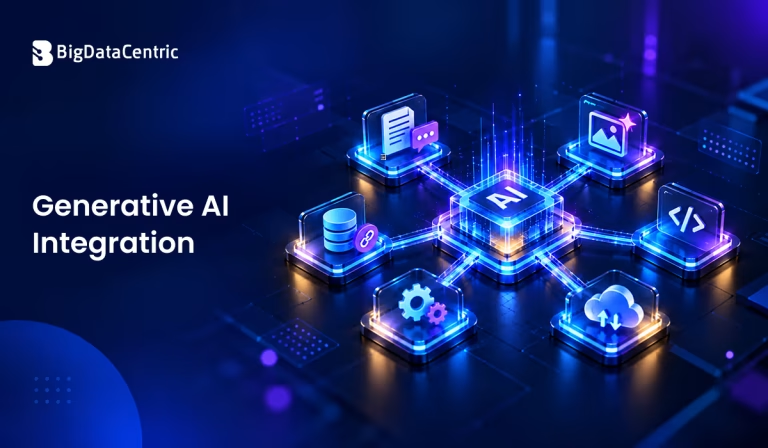
Generative AI integration connects AI models with existing business applications, databases, APIs, and workflows to perform specific tasks. Instead of using AI as a separate tool, businesses embed its capabilities into their systems to generate content, summarize documents, answer questions, and automate routine activities.
For example, integrating an AI assistant with a company’s knowledge base allows employees to retrieve relevant information without manually searching multiple documents.
The process typically involves selecting suitable generative AI models, preparing business data, and connecting the model to applications through APIs or an integration layer.
Depending on the use case, organizations may use a ready-made model, customize an existing model, or connect it to internal information using retrieval-augmented generation (RAG). The goal is to produce relevant outputs while maintaining data security, accuracy, and compatibility with existing systems.
For example, a business can connect a generative AI model to its customer relationship management (CRM) system to summarize customer interactions and draft follow-up emails.
Similarly, an internal assistant can help employees find company policies or prepare reports using approved business information. These applications show how integrating generative AI can make existing software more useful while helping teams reduce manual effort and work more efficiently.
Key Benefits of Generative AI Integration for Businesses
Businesses can use generative AI to improve operational efficiency, enhance customer experiences, and accelerate innovation. When connected with existing applications and business data, it helps teams automate repetitive tasks, access relevant insights, and manage growing workloads more effectively.
The following benefits highlight how organizations can apply this technology to achieve practical business outcomes.
Productivity & Workflow Efficiency
Generative AI can automate routine activities such as drafting emails, summarizing documents, preparing reports, and answering internal queries. Integrating these capabilities into existing workflows helps employees spend less time on repetitive work and focus more on strategic tasks.
For example, sales teams can generate follow-up emails, while support teams can prepare responses using approved knowledge resources.
Cost Reduction
Automating manual processes can reduce the time and resources required for everyday business operations. AI can assist with document processing, customer support, content creation, and administrative tasks, helping teams manage workloads more efficiently.
Businesses should also consider implementation, maintenance, and model-usage costs to ensure automation delivers measurable financial benefits.
Hyper-Personalized Customer Engagement
Generative AI can help businesses deliver more relevant customer experiences by using available customer preferences, interaction history, and behavioral data.
For example, an e-commerce platform can generate personalized product recommendations, while a customer support assistant can tailor responses to a user’s specific question. Organizations must handle customer information responsibly and follow applicable privacy requirements.
Faster Data Synthesis & Decision-Making
Businesses often need to analyze information scattered across reports, databases, documents, and communication platforms. Generative AI can summarize large volumes of information, identify relevant patterns, and present key findings in an accessible format.
This helps managers review information faster and make informed decisions. However, managers should verify important insights against reliable data before using them for critical business decisions.
Content & Product Innovation
Generative AI can support creative work by producing initial drafts, brainstorming product ideas, generating code, and helping teams develop prototypes.
Marketing teams can create campaign variations, while product teams can explore concepts and test ideas faster. Human review remains essential to maintain originality, brand consistency, factual accuracy, and quality.
Scalable Operations
As businesses grow, their operational demands and customer inquiries often increase. AI-powered applications can handle higher request volumes, support employees across departments, and automate repeatable workflows without requiring manual handling of every task.
With appropriate monitoring, infrastructure, and access controls, organizations can expand successful AI applications across teams while maintaining performance and reliability.
Bring AI Innovation to Your Business
Integrate generative AI into your existing applications to simplify processes, boost productivity, and improve customer experiences.
10 Steps to Integrate Generative AI Into Your Business
Successfully implementing AI requires more than selecting a model or adding a chatbot to an application. Businesses need a clear strategy, reliable data, suitable technology, and ongoing evaluation.
The following ten steps provide a practical approach to introducing AI into business workflows while managing costs, security, and performance.
Identify Business Problems
Start by identifying the challenges that AI could realistically address. These may include repetitive administrative tasks, slow customer support, manual document processing, or difficulty accessing business information.
Discuss these challenges with the teams involved to understand their daily workflows and existing limitations. Focusing on a genuine business problem helps ensure that the implementation solves a real need rather than introducing technology without a clear purpose.
Define Clear Objectives
Once the problem is identified, establish measurable objectives for the implementation. For example, a business may aim to reduce response times, speed up document processing, or decrease the time employees spend preparing reports.
Define key performance indicators (KPIs) to measure progress and establish a baseline for comparison. Clear objectives help teams evaluate results, manage expectations, and determine whether the investment is delivering value.
Assess Data Readiness
AI applications depend on relevant, reliable, and accessible data. Review the quality, accuracy, completeness, and structure of the information the model will use. Identify outdated records, duplicate entries, missing information, and sensitive data that requires protection.
Businesses should also establish appropriate access controls and data governance practices before connecting AI systems to internal databases or documents.
Select Use Cases
Choose use cases based on business impact, technical feasibility, implementation cost, and potential risks. Reviewing relevant generative ai use cases can help identify opportunities such as drafting customer responses, summarizing documents, and assisting employees with internal searches.
Prioritizing a few high-value use cases makes it easier to test the technology and demonstrate its usefulness before expanding to more complex processes.
Choose the Right Models
Select a model based on the task, required accuracy, data sensitivity, response speed, and budget. Some applications may work well with hosted commercial models, while others may require open-source models or domain-specific customization.
Evaluate model capabilities, integration options, scalability, and data-handling policies before deciding. The most advanced model isn’t always the best choice; the right option is the one that reliably meets business requirements.
Build an Integration Layer
Create a secure connection between the AI model and the applications, databases, and services it needs to access. This can involve APIs, middleware, authentication mechanisms, and retrieval systems that provide the model with relevant business information.
An integration layer also helps manage data flow, permissions, error handling, and communication between systems. A well-designed architecture makes the solution easier to maintain and expand as requirements change.
Establish Ethical Guidelines
Define rules for responsible AI usage before deploying the solution. Address data privacy, access permissions, potential bias, transparency, intellectual property, and accountability.
Determine which tasks require human approval and which outputs must be verified before use. Clear guidelines help employees understand appropriate AI use and reduce the risk of exposing sensitive information or relying on misleading outputs.
Run a Small Pilot
Test the solution in a controlled environment with a limited group of users or a specific workflow. Measure performance against the objectives established earlier, including accuracy, response time, user satisfaction, and operational cost.
Collect employee feedback and identify issues such as incorrect responses, integration failures, or usability problems. Use these findings to refine the solution before introducing it across the organization.
Train and Upskill Staff
Prepare employees to work effectively with AI-powered tools. Provide practical training on writing effective prompts, reviewing generated outputs, protecting confidential information, and recognizing inaccurate responses.
Training should also explain how AI changes existing workflows and where human judgment remains necessary. Involving employees early can improve adoption and help teams use the technology confidently and responsibly.
Scale and Monitor
After the pilot shows measurable value, gradually expand the solution to additional teams, applications, or workflows. Monitor accuracy, latency, usage costs, security, user feedback, and business outcomes to ensure consistent performance.
Set up alerts and regular reviews to detect failures, shifting data patterns, or declining output quality. Continuous evaluation helps businesses maintain reliability and improve the solution as their needs evolve.
Best Practices for Effective Generative AI Integration
Businesses need a structured approach to get consistent results from AI-powered applications. Choosing the right technology matters, but success also depends on business alignment, data quality, human oversight, and compatibility with existing systems.
Following these best practices helps organizations build reliable solutions that can adapt to changing business requirements.
Strategic Alignment
Align AI initiatives with specific business goals, such as improving customer satisfaction, reducing manual effort, or accelerating internal processes. Identify the departments and workflows that are most likely to benefit, and define measurable performance indicators before implementation.
Regularly review outcomes against these objectives to ensure the solution delivers practical value rather than adding unnecessary complexity.
Ensure Human Oversight
AI-generated outputs may contain inaccurate information, biased recommendations, or inappropriate responses. Establish review procedures for sensitive tasks, including financial decisions, legal documentation, and customer communications that could have significant consequences.
Employees should be able to verify outputs, correct errors, and escalate uncertain cases. Human oversight maintains accountability while letting teams benefit from automation.
Data Foundations & Architecture
Build a strong data foundation by keeping information accurate, organized, and accessible. Remove outdated records, standardize data formats, and implement appropriate governance policies.
Use secure data pipelines and retrieval mechanisms to provide AI models with relevant business context when required. Strong architecture and access controls help protect confidential information while improving the relevance and reliability of generated outputs.
Design for Enterprise Integration
Plan AI applications to work seamlessly with existing business systems, such as CRM platforms, ERP software, databases, and customer support tools. Use secure APIs, appropriate authentication, and clear permission boundaries to control how information moves between systems. Reviewing relevant generative AI tools can also help businesses identify suitable technologies for their integration requirements.
Design the architecture to support scalability, monitoring, error handling, and future model changes. This approach helps businesses expand AI capabilities without disrupting established workflows or compromising system security.
Common Challenges in Generative AI Integration
Businesses may face technical, operational, and financial challenges when implementing AI into existing workflows. Addressing these issues early improves reliability, manages risk, and delivers better results.
Legacy System Integration
Older business systems may lack the APIs, infrastructure, or data formats modern AI applications need. Integrating them may require custom connectors, middleware, or system upgrades. Assessing existing infrastructure helps identify compatibility issues and plan a smoother implementation.
Hallucinations and Accuracy
Generative AI can produce convincing but incorrect or misleading information. Businesses can reduce these risks by connecting models to trusted data, testing outputs, and having humans review critical tasks. Regular evaluations help maintain accuracy and reliability.
Observability and Drift
AI performance may change as business data, user behavior, or models evolve. Monitoring response quality, latency, error rates, and usage costs helps identify issues early. Regular testing and performance reviews ensure the solution continues to meet business requirements.
Unclear ROI
Businesses may struggle to measure AI’s value without clear objectives and performance benchmarks. Implementation, integration, training, and maintenance costs can also affect returns. Defining KPIs and testing a small pilot helps determine whether the solution delivers measurable business benefits.
Real-World Use Cases of Generative AI Integration
Businesses across industries are using generative AI to automate routine tasks, improve service delivery, and support innovation. Integrating AI into existing applications helps organizations address industry-specific challenges and make workflows more efficient.
Customer Service & Operations
Generative AI can power virtual assistants that answer customer queries, summarize support tickets, and recommend relevant solutions using company knowledge bases. It can also help employees draft responses, process documents, and retrieve internal information, reducing manual effort and improving response times.
Healthcare & Life Sciences
Healthcare organizations can use generative AI to summarize medical documentation, help manage clinical records, and support research by synthesizing scientific literature. Pharmaceutical teams can also use it to organize research findings and accelerate early-stage drug discovery. Human expertise, privacy safeguards, and clinical validation remain essential.
Software Engineering
Development teams can integrate AI into coding environments to generate code snippets, explain existing code, identify potential bugs, and create test cases. AI assistants can also help developers document software and troubleshoot technical issues, supporting faster development cycles while keeping code review and security testing part of the process.
Manufacturing & Supply Chain
Manufacturers can use generative AI to summarize maintenance records, retrieve equipment documentation, and help technicians troubleshoot. Supply chain teams can generate reports from operational data, summarize supplier communications, and support planning activities. Combining AI with reliable inventory and production data helps teams respond more effectively to operational changes.
Retail & Marketing
Retail businesses can use generative AI to create product descriptions, develop campaign content, and personalize customer interactions. When connected to suitable customer and product data, AI can support tailored recommendations, customer service, and marketing communications. Human review helps maintain brand consistency, factual accuracy, and appropriate use of customer information.
How BigDataCentric Supports Generative AI Integration?
BigDataCentric helps businesses incorporate AI capabilities into their applications and workflows to improve efficiency, automate tasks, and deliver better user experiences. Its expertise in artificial intelligence, machine learning, data science, and chatbot development supports solutions tailored to specific business requirements.
From identifying suitable use cases to connecting AI models with existing systems, businesses can build solutions that align with their operational goals. BigDataCentric also develops AI-powered applications that support data-driven decision-making, streamline business processes, and adapt to evolving organizational needs.
Whether a business wants to develop an intelligent chatbot, automate workflows, or incorporate generative AI into an existing application, BigDataCentric can help plan and develop a solution suited to its requirements.
Looking to Build a Smarter AI-Powered Application?
Integrate intelligent capabilities into your applications with tailored AI solutions that improve efficiency and the user experience.
Conclusion
Generative AI helps businesses boost productivity, automate repetitive tasks, personalize customer experiences, and accelerate innovation. Successful implementation requires clear objectives, reliable data, suitable models, secure integration, and continuous performance monitoring. By starting with focused use cases and measuring results, organizations can adopt AI while managing costs and operational risks.
With the right gen AI strategy and technical expertise, businesses can integrate AI capabilities into existing applications and workflows to support long-term growth. BigDataCentric helps organizations develop AI-powered solutions tailored to their business needs, enabling them to streamline operations and make better use of their data.
FAQs
What are the top 5 Generative AI tools?
Popular generative AI tools include ChatGPT, Google Gemini, Microsoft Copilot, Anthropic Claude, and Adobe Firefly. The best choice depends on business needs, such as content creation, coding, research, productivity, or image generation.
How much does it cost to implement Generative AI?
The cost depends on model selection, integration complexity, data preparation, infrastructure, security, and ongoing maintenance. Basic implementations may cost a few thousand dollars, while complex enterprise solutions can cost tens of thousands of dollars or more.
How Can AI Integration Support Business Scalability?
AI integration helps businesses automate repetitive tasks, handle increasing workloads, and improve operational efficiency without proportionally increasing manual effort. It also supports faster data processing and more consistent customer service as the business grows.
What Is Needed to Deploy AI in Enterprise Applications?
Deploying AI requires a clearly defined use case, quality data, a suitable AI model, secure APIs, compatible infrastructure, and appropriate access controls. Testing, human oversight, performance monitoring, and ongoing maintenance are also essential.
Is Open-Source AI Suitable for Enterprise Applications?
Yes, open-source AI models can suit enterprise applications when they meet requirements for accuracy, security, scalability, and compliance. Businesses should also evaluate hosting costs, technical expertise, licensing terms, and ongoing maintenance before choosing a model.

About Author
Jayanti Katariya is the CEO of BigDataCentric, a leading provider of AI, machine learning, data science, and business intelligence solutions. With 18+ years of industry experience, he has been at the forefront of helping businesses unlock growth through data-driven insights. Passionate about developing creative technology solutions from a young age, he pursued an engineering degree to further this interest. Under his leadership, BigDataCentric delivers tailored AI and analytics solutions to optimize business processes. His expertise drives innovation in data science, enabling organizations to make smarter, data-backed decisions.
Latest From Our Blog
Stay updated with technical insights, industry trends, and the latest technology developments.