


Machine Learning vs Deep Learning: A Comprehensive Guide
Blog Summary:
Machine Learning and Deep Learning are two important branches of AI that help businesses automate tasks, analyze data, and make smarter decisions. While Machine Learning uses algorithms to identify patterns, Deep Learning relies on multi-layered neural networks to handle complex data. This guide covers their key differences, models, applications, and benefits to help you choose the right approach for your business.
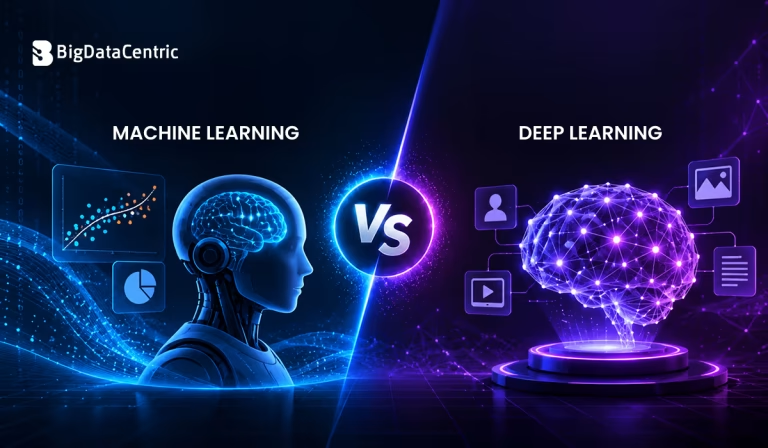
Machine Learning vs Deep Learning is an important consideration for businesses planning to adopt artificial intelligence (AI). Although both technologies enable computers to learn from data, they differ in how they process information, identify patterns, and generate results. Understanding these differences helps businesses select the right approach for their technical requirements and long-term goals.
Machine learning enables systems to learn from historical data and make predictions without requiring explicit programming for every scenario. Deep learning takes this further by using multi-layered neural networks to identify complex patterns, particularly in large and unstructured datasets such as images, audio, and text.
Both approaches offer valuable opportunities across industries, from detecting fraudulent transactions to powering intelligent virtual assistants. However, their suitability depends on factors such as data availability, computational resources, model complexity, and the problem being solved.
This guide explores the fundamentals of both technologies, their real-world applications, key differences, and practical selection criteria. Understanding deep learning vs machine learning helps businesses make informed decisions when planning their next AI initiative.
Machine Learning Fundamentals and Core Concepts
Machine learning is a branch of artificial intelligence that enables computers to learn from historical data, identify patterns, and make predictions without explicit programming for every task. Businesses use this technology to automate processes, improve decision-making, and uncover valuable insights from data.
The global machine learning market is projected to grow from USD 126.91 billion in 2026 to approximately USD 1,709.98 billion by 2035, expanding at a CAGR of 33.66% during the forecast period. This growth highlights the increasing adoption of machine learning across industries.
Machine learning models learn from data through different approaches. Supervised learning uses labeled data to predict outcomes, while unsupervised learning identifies hidden patterns in unlabeled datasets. Semi-supervised learning combines labeled and unlabeled data to improve learning when fully labeled datasets are limited. Reinforcement learning trains systems to make decisions using rewards and penalties.
The effectiveness of machine learning depends on data quality, algorithm selection, and problem complexity. By applying the right machine learning models, businesses can improve predictive analytics, detect fraud, and understand customer behavior. Machine Learning Development Companies can further help organizations turn these capabilities into practical solutions that meet their specific business needs.
You Might Also Like:
Real-world Applications of Machine Learning
Machine learning helps businesses analyze historical data, identify patterns, and make informed predictions. Its applications span multiple industries, enabling organizations to reduce risks, improve customer experiences, and streamline operations. Here are some common use cases.
Fraud Detection
Machine learning analyzes transaction patterns to identify suspicious activities and potential fraud. Financial institutions use these systems to flag unusual transactions, detect anomalies, and reduce fraudulent activities while minimizing disruptions to legitimate customers.
Customer Churn Prediction
Businesses use machine learning to identify customers who may discontinue their services. By analyzing purchasing behavior, engagement levels, and customer feedback, organizations can develop targeted retention strategies and improve customer loyalty.
Sales and Demand Forecasting
Machine learning examines historical sales, seasonal trends, and market conditions to predict future demand. These insights help businesses manage inventory, allocate resources, and plan sales strategies more effectively. Businesses can also use machine learning for pricing optimization to analyze demand fluctuations, customer purchasing patterns, and market trends.
Customer Segmentation
Machine learning identifies customer groups based on purchasing habits, preferences, demographics, and engagement patterns. Businesses can use these insights to personalize marketing campaigns, improve customer targeting, and develop relevant product offerings.
Credit Risk Assessment
Financial institutions apply machine learning to evaluate borrowers using credit histories, financial records, and other relevant data. These assessments help lenders estimate default risks and make more informed lending decisions.
Recommendation Systems
Machine learning powers recommendation systems by analyzing user preferences, browsing behavior, and purchase history. E-commerce platforms and streaming services use these insights to suggest relevant products or content, improving engagement and customer satisfaction.
Build Smarter Solutions With Machine Learning
We help businesses translate data-driven insights into practical applications that address real operational challenges.
Deep Learning Fundamentals and Core Concepts
Deep learning is a subset of machine learning that uses multilayered artificial neural networks to identify complex patterns in large datasets. Understanding what is deep learning involves recognizing its ability to automatically extract relevant features from raw data, reducing the need for manual feature engineering. It is particularly effective for processing images, audio, video, and natural language.
The global deep learning market is projected to grow from USD 178.3 billion in 2026 to USD 1,125.7 billion by 2033, at a CAGR of 30.1% [2026-2033]. This growth highlights the increasing adoption of deep learning across industries.
Unlike traditional machine learning approaches, deep learning typically requires larger datasets and greater computational power. However, it can deliver strong results in applications such as image recognition, speech processing, and generative AI.
Businesses can use a deep learning platform to develop, train, evaluate, and deploy neural network models for complex tasks. The choice between these technologies depends on data availability, problem complexity, performance requirements, and computing resources.
Real-world Applications of Deep Learning
Deep learning enables businesses to process complex, unstructured data and automate tasks that require advanced pattern recognition. From analyzing medical scans to generating human-like text, it is transforming how organizations operate across industries.
Image and Video Recognition
Deep learning models analyze images and videos to identify objects, detect patterns, and classify visual information. Businesses use this technology for facial recognition, quality inspection, security monitoring, and automated defect detection in manufacturing.
Speech Recognition
Deep learning converts spoken language into text and helps systems understand voice commands. It powers virtual assistants, voice-controlled applications, automated transcription, and customer support solutions.
Natural Language Processing (NLP)
Deep learning helps computers understand, interpret, and generate human language. Its applications include sentiment analysis, language translation, document summarization, and intelligent conversational systems.
Generative AI and Large Language Models
Deep learning supports generative AI systems that create text, images, audio, and other content. Large language models (LLMs) can answer questions, summarize documents, assist with coding, and support business workflows.
Medical Image Analysis
Healthcare providers use deep learning to analyze medical images, identify abnormalities, and support clinical assessments. These systems can help professionals examine X-rays, MRI scans, and CT scans, but clinical decisions still require appropriate medical oversight.
Autonomous Driving Systems
Deep learning helps autonomous vehicles interpret camera feeds and sensor data to recognize pedestrians, road signs, vehicles, and obstacles. This information supports navigation and driving decisions in changing road conditions.
Build Deep Learning Solutions for Complex Business Challenges
Develop deep learning solutions that improve image recognition, language processing, and complex data analysis.
Machine Learning vs Deep Learning: Snapshot Comparison
Machine Learning vs Deep Learning involves comparing how the two approaches learn from data, process information, and handle complex tasks. Understanding what is machine learning and deep learning helps businesses evaluate their different requirements, capabilities, and suitability for specific applications.
| Comparison Factor | Machine Learning | Deep Learning |
|---|---|---|
| Learning Approach | Learns patterns using algorithms and training data | Learns complex patterns through multi-layered neural networks |
| Feature Engineering | Often requires manual feature selection | Can automatically extract features from raw data |
| Data Requirements | Can perform well with smaller datasets | Generally benefits from large datasets |
| Model Architecture | Includes decision trees, regression, and clustering algorithms | Uses deep neural network architectures |
| Training Time | Often requires less training time | Can require longer training periods |
| Computational Requirements | Usually needs fewer computing resources | Often requires powerful GPUs or specialized hardware |
| Handling Unstructured Data | May require substantial preprocessing | Well suited to images, audio, and text |
| Interpretability | Many models are easier to interpret | Complex models can be difficult to explain |
| Transfer Learning | Available for selected algorithms and pretrained models | Widely used with pretrained neural networks |
| Output Generation | Commonly produces predictions, classifications, or clusters | Can produce predictions, classifications, and generated content |
This comparison highlights each approach’s strengths. The appropriate choice depends on the business problem, data availability, infrastructure, and expected outcomes.
A Detailed Comparison of Machine Learning and Deep Learning
Although both technologies help systems learn from data, Machine Learning vs Deep Learning involves different methods, computational requirements, and levels of complexity. Understanding these differences can help businesses choose the right approach for their project goals.
Learning Approach
Machine learning algorithms identify patterns in historical data to make predictions or support decision-making. Deep learning uses multiple layers of artificial neural networks to learn increasingly complex patterns automatically. This makes it particularly useful for tasks involving intricate relationships in large datasets, such as image recognition and language processing.
Feature Engineering
Traditional machine learning often requires domain experts to select, extract, and prepare relevant features before training a model. The quality of these features can significantly influence prediction accuracy. Deep learning can automatically learn useful features from raw data, reducing manual preprocessing for applications involving images, audio, video, and text.
Data Requirements
Machine learning can deliver reliable results with relatively small, structured datasets when the information is relevant and well prepared. Deep learning generally benefits from larger datasets to recognize complex patterns and improve performance. However, pretrained models and transfer learning can reduce data requirements for certain applications.
Model Architecture
Machine learning uses algorithms such as decision trees, linear regression, and support vector machines to solve classification and prediction problems. Deep learning relies on multi-layered neural network architectures, including convolutional neural networks, recurrent neural networks, and transformers. These architectures enable systems to process complex information and learn detailed representations from data.
Training Time
Many machine learning algorithms can train relatively quickly, depending on dataset size, algorithm choice, and model complexity. Deep learning models often require longer training periods because they process large volumes of data through multiple layers and repeatedly adjust their parameters. Training time can also increase when models have more parameters or require extensive optimization.
Computational Requirements
Machine learning algorithms often run efficiently on standard computing systems, making them suitable for projects with limited infrastructure budgets. Deep learning may require graphics processing units (GPUs) or other specialized hardware to handle intensive calculations. These requirements can increase infrastructure costs, energy consumption, and ongoing operational expenses.
Handling Unstructured Data
Machine learning typically requires preprocessing or feature extraction to make unstructured information suitable for analysis. Deep learning can learn useful representations directly from images, audio, and text, making it effective for speech recognition, visual classification, and language understanding. Its performance still depends on suitable training data and model design.
Interpretability
Many machine learning models, including decision trees and linear regression, offer relatively transparent decision-making processes. This helps users understand how certain predictions are generated. Deep learning models are often harder to interpret because their predictions depend on numerous interconnected layers and parameters, making individual outcomes more challenging to explain.
Transfer Learning
Transfer learning adapts pretrained models to related tasks, reducing development time and data requirements. It is widely used in deep learning for image recognition and language processing. Fine-tuning supports specific business needs, while machine learning model deployment and management involve monitoring performance and updating models as requirements change.
You Might Also Like:
What Is Machine Learning Model Management and Why Does It Matter?
Output Generation
Machine learning commonly produces predictions, classifications, numerical estimates, or customer clusters based on input data. Deep learning supports these outputs as well as generative tasks, including creating text, images, audio, and other content. These capabilities depend on the architecture, training process, and data used to develop the model.
Machine Learning vs Deep Learning: Which Should You Choose?
Choosing between machine learning and deep learning depends on your project goals, data availability, budget, and technical requirements. A practical Machine Learning vs Deep Learning assessment should consider the complexity of the task, the size of the dataset, infrastructure costs, and expected results. This comparison helps businesses select an approach that balances performance, complexity, and cost.
Choose Machine Learning When
Machine learning is suitable for projects involving structured data, limited datasets, and tasks such as sales forecasting, fraud detection, and customer segmentation. It generally requires fewer computational resources and can be easier to interpret and maintain. Businesses can use machine learning when they need reliable predictions without the complexity of large neural networks.
Choose Deep Learning When
Deep learning is a strong option for complex tasks involving large datasets and unstructured information, such as images, audio, video, and text. It is particularly useful for speech recognition, computer vision, and generative AI applications. However, businesses should consider its higher computing requirements, longer training times, and potential need for specialized expertise before choosing this approach.
Why Choose BigDataCentric for ML and Deep Learning Solutions?
BigDataCentric is a development company that helps businesses build AI-driven solutions through Artificial Intelligence Development Services tailored to their technical requirements and business goals. Its development and consultancy capabilities support technology selection, implementation planning, and scalable application development.
Businesses looking for predictive solutions can explore experienced Machine Learning Development Company to understand their options for building and implementing suitable models. BigDataCentric helps organizations evaluate project requirements, choose appropriate technologies, and develop solutions that support forecasting, automation, and data-driven decision-making.
By assessing project requirements, data availability, and infrastructure needs, BigDataCentric helps businesses determine whether machine learning or deep learning is the better fit. This approach supports practical technology decisions while keeping performance, scalability, and long-term maintenance in mind.
Turn Your AI Ideas Into Business Solutions
BigDataCentric helps businesses develop machine learning and deep learning applications that address real-world challenges and support smarter decision-making.
Conclusion
Machine Learning vs Deep Learning depends on your business goals, data availability, project complexity, and budget. Machine learning suits structured data and predictive analytics, while deep learning is effective for complex tasks involving images, audio, and text. Understanding what is machine learning and deep learning helps businesses choose the right approach for their requirements.
BigDataCentric helps businesses evaluate their needs, select suitable technologies, and develop scalable AI solutions through its development and consultancy capabilities. With the right strategy, businesses can use machine learning and deep learning to improve efficiency, strengthen decision-making, and support long-term growth.
FAQs
What are the four types of AI?
The four commonly described types of AI are reactive machines, limited memory, theory of mind, and self-aware AI. The last two remain theoretical.
Is AI possible without ML?
Yes, AI is possible without machine learning. Rule-based expert systems and symbolic AI can perform intelligent tasks using predefined rules and logic.
Can machine learning and deep learning be used together?
Yes, they can be combined in a single solution. For example, deep learning can extract features from images, while a machine learning model uses those features to classify or predict outcomes.
What is AI vs. ML vs. DL?
Artificial intelligence (AI) is the broad field of creating intelligent systems. Machine learning (ML) is a subset of AI that learns from data, while deep learning (DL) is a subset of ML that uses multi-layered neural networks.
Which programming languages are used for ML and deep learning?
Python is widely used for both machine learning and deep learning. Other options include R, Java, and C++, depending on the project requirements and development environment.

About Author
Jayanti Katariya is the CEO of BigDataCentric, a leading provider of AI, machine learning, data science, and business intelligence solutions. With 18+ years of industry experience, he has been at the forefront of helping businesses unlock growth through data-driven insights. Passionate about developing creative technology solutions from a young age, he pursued an engineering degree to further this interest. Under his leadership, BigDataCentric delivers tailored AI and analytics solutions to optimize business processes. His expertise drives innovation in data science, enabling organizations to make smarter, data-backed decisions.
Latest From Our Blog
Stay updated with technical insights, industry trends, and the latest technology developments.