What is Data Leakage in Machine Learning? Causes, Examples, and Prevention

 Total View: 283
Submitting the form below will ensure a prompt response from us.
In machine learning, building a model that performs well during training is not enough. The real goal is to ensure that the model generalises well to unseen data. However, one common issue that leads to misleadingly high performance is data leakage, often confused with overfitting in machine learning.
Data leakage occurs when information that should not be available during training is used by the model, leading to overly optimistic results. This can make a model appear highly accurate during evaluation but fail in real-world scenarios.
What is Data Leakage in Machine Learning?
Data leakage happens when a model has access to information outside the training dataset that would not be available in real-world predictions. This information can unintentionally influence the model’s learning process.
As a result, the model learns patterns that do not actually exist in real data. This leads to poor performance in deployment, even though it seemed highly accurate during testing.
Why is Data Leakage a Serious Problem?
Data leakage can invalidate the entire machine learning pipeline orchestration. It creates a false sense of confidence in the model’s performance and can lead to incorrect business decisions.
Since leakage is often subtle, it can go unnoticed until the model fails in production. Preventing leakage is therefore critical for building reliable and trustworthy models.
Misleading Model Accuracy
When leakage occurs, the model learns from information it should not have access to. This artificially increases accuracy during training and validation.
However, when the model encounters real-world data, its performance drops significantly.
Poor Generalization
Models affected by leakage fail to generalize to new data. They rely on patterns that only exist due to leaked information.
This makes them unreliable for real-world applications, in the context of Data Leakage in Machine Learning.
Risk in Critical Applications
In domains like healthcare or finance, Data Leakage in Machine Learning can lead to incorrect predictions and serious consequences.
Ensuring clean and unbiased data is essential in such scenarios.
Types of Data Leakage
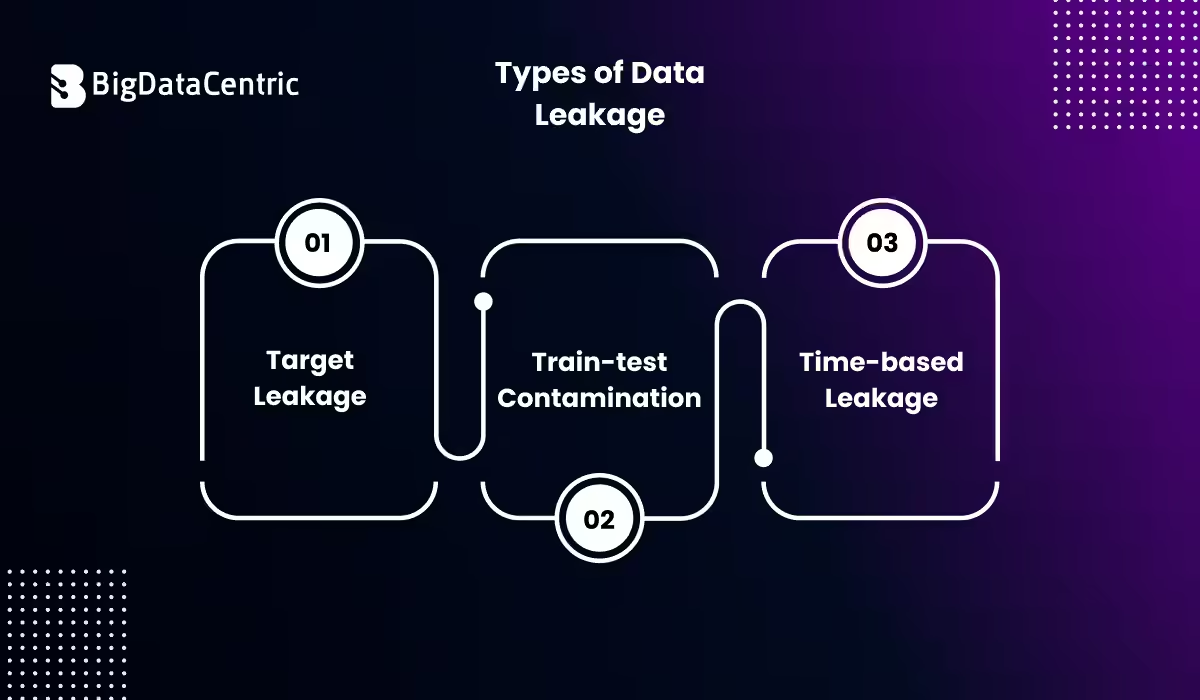
Data Leakage in Machine Learning can occur in different forms depending on how data is handled during the machine learning process, especially when there is a lack of clarity around feature in machine learning. Understanding these types helps in identifying and preventing them effectively.
Target Leakage
Target leakage occurs when the model has access to the target variable or related information during training. This often happens when features are created using future data.
For example, including a “final outcome” field while predicting the same outcome can lead to leakage. This makes the model unrealistically accurate.
Train-test Contamination
This type of leakage happens when information from the test dataset is used during training. It can occur due to improper data splitting or preprocessing.
For instance, scaling the entire dataset before splitting can introduce leakage, as the model indirectly learns from test data.
Time-based Leakage
Time-based Data Leakage in Machine Learning occurs in time-series data when future information is used to predict past events. This violates the natural sequence of data.
For example, using future sales data to predict past trends can lead to inaccurate models.
Example of Data Leakage in Machine Learning
Let’s consider a simple example to understand how data leakage occurs in practice.
Incorrect Approach (With Leakage)
from sklearn.preprocessing import StandardScaler

from sklearn.model_selection import train_test_split

X_scaled = StandardScaler().fit_transform(X)  # Leakage here

X_train, X_test, y_train, y_test = train_test_split(X_scaled, y)
In this example, the scaler is applied to the entire dataset before splitting, causing leakage.
Correct Approach (Without Leakage)
from sklearn.preprocessing import StandardScaler

from sklearn.model_selection import train_test_split

X_train, X_test, y_train, y_test = train_test_split(X, y)

scaler = StandardScaler()

X_train = scaler.fit_transform(X_train)

X_test = scaler.transform(X_test)
Here, the scaler is fitted only on the training data, preventing leakage.
How to Detect Data Leakage?
Data leakage can be difficult to identify because it often leads to overly optimistic model performance during testing. It occurs when information from outside the training dataset unintentionally influences the model. Detecting it early is important to ensure reliable and generalizable machine learning results. Careful evaluation and validation practices are key to spotting these issues.
Unusually High Accuracy
If a model shows unexpectedly high accuracy, it may be a sign of data leakage. This often happens when the model has access to information it should not have during training. Such performance usually drops when tested on real-world data.
Feature Correlation with Target
When certain features are too strongly correlated with the target variable, they may be leaking information. These features might indirectly include future or hidden data. Proper feature analysis helps ensure only valid inputs are used.
Inconsistent Validation Results
Significant differences between validation and production performance can indicate leakage. The model may perform well during testing but fail in real scenarios. Cross-validation and careful dataset splitting help detect these inconsistencies.
How to Prevent Data Leakage in Machine Learning?
Preventing Data Leakage in Machine Learning requires careful handling of data and proper workflow design. Following best practices ensures that models remain reliable.
Split Data Before Processing
Always split the dataset into training and testing sets before applying preprocessing steps.
This ensures that the model does not learn from test data.
Use Pipelines
Pipelines help manage preprocessing and model training steps consistently.
from sklearn.pipeline import Pipeline

pipeline = Pipeline([

    ('scaler', StandardScaler()),

    ('model', LogisticRegression())

])
This reduces the risk of leakage during preprocessing.
Avoid Using Future Data
Ensure that features do not include information from the future.
This is especially important for time-series models.
Validate Feature Selection
Carefully review features to ensure they do not indirectly include target information, in Data Leakage in Machine Learning.
This helps maintain data integrity.
Best Practices to Avoid Data Leakage
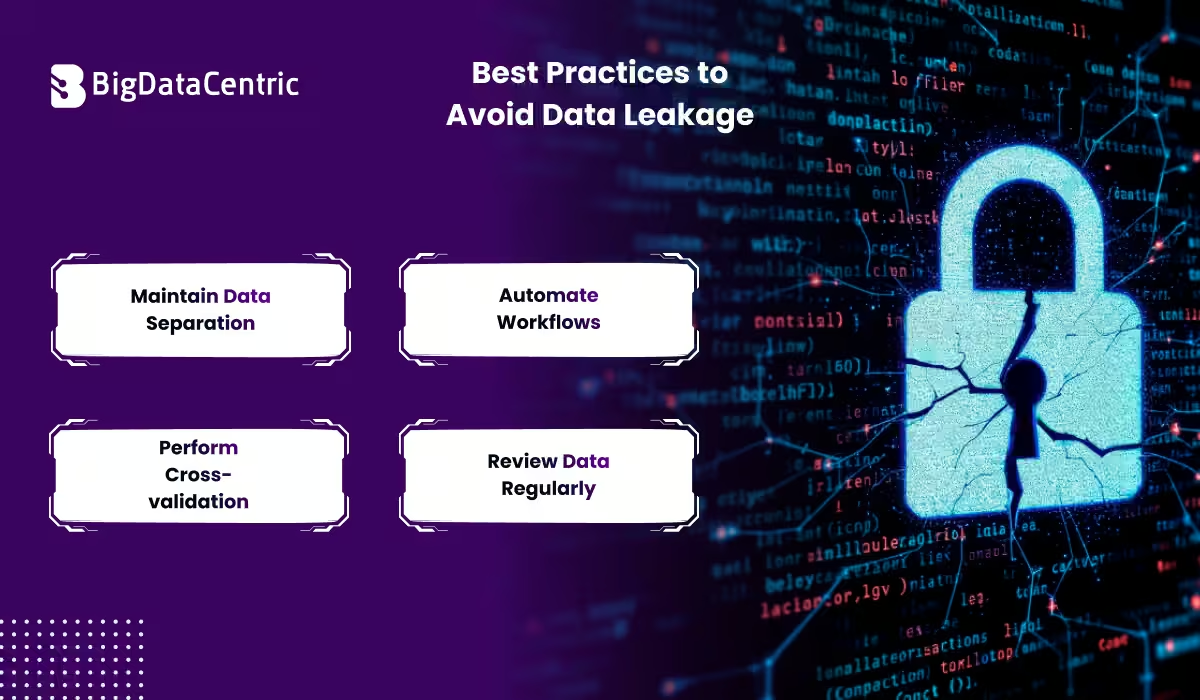
Preventing Data Leakage in Machine Learning is essential for building trustworthy and accurate models, especially in sensitive systems using privacy preserving machine learning. It ensures that the model learns only from valid training data without unintentionally accessing future or hidden information. Applying structured practices helps maintain model integrity and improves real-world performance.
Consistent monitoring and validation further reduce the risk of leakage.
Maintain Data Separation
Training, validation, and test datasets should always be kept strictly separate. Mixing data can lead to overly optimistic results and unreliable models. Proper separation ensures fair evaluation of model performance.
Automate Workflows
Automating data processing and model training pipelines reduces the chances of human error. It ensures consistent handling of data across all stages. This improves reproducibility and reliability of results.
Perform Cross-validation
Cross-validation helps evaluate model performance across different subsets of data. It highlights inconsistencies that may indicate leakage or overfitting. This leads to more robust and generalizable models.
Review Data Regularly
Regular audits of datasets and features help identify hidden leakage risks. Over time, data sources and features may change, introducing new issues. Continuous review ensures the model remains accurate and trustworthy.
How BigDataCentric Helps with Machine Learning Solutions?
Bigdatacentric helps businesses develop reliable and production-ready machine learning models with a strong focus on proper data handling, validation, and pipeline design. The emphasis is on building accurate and scalable AI solutions that perform consistently in real-world environments.
By applying best practices to prevent data leakage and improve data quality, Bigdatacentric enables organizations to build more robust models with better performance and trustworthiness.
Conclusion
Data Leakage in Machine Learning is a serious problem that can result in overly optimistic evaluation and poor real-world performance. It happens when a model unintentionally gains access to information that would not be available at the time of prediction. This leads to misleading results and reduces the trustworthiness of the model.
By recognizing its causes, spotting early warning signs, and applying strong validation practices, developers can prevent leakage effectively. Bigdatacentric helps organizations implement these safeguards to build reliable, accurate, and production-ready machine learning solutions.


Jayanti Katariya is the CEO of BigDataCentric, a leading provider of AI, machine learning, data science, and business intelligence solutions. With 18+ years of industry experience, he has been at the forefront of helping businesses unlock growth through data-driven insights. Passionate about developing creative technology solutions from a young age, he pursued an engineering degree to further this interest. Under his leadership, BigDataCentric delivers tailored AI and analytics solutions to optimize business processes. His expertise drives innovation in data science, enabling organizations to make smarter, data-backed decisions.