




AI in Oil and Gas: How AI is Reshaping the Energy Sector
Blog Summary:
AI is helping oil and gas companies improve exploration, drilling, production, maintenance, and operational efficiency through data-driven insights. This blog explores key AI applications across the industry, along with their benefits and implementation challenges. It also highlights how AI supports better decision-making, predictive maintenance, and resource optimization. Finally, it examines future trends that are expected to shape the next generation of oil and gas operations.
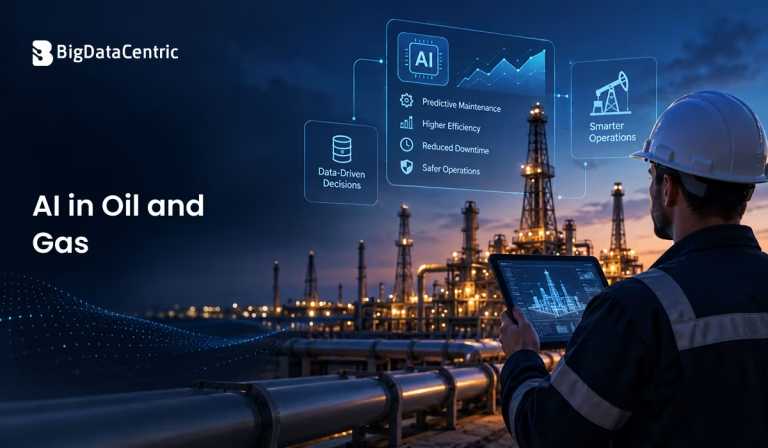
The oil and gas industry is undergoing a significant digital transformation as companies seek faster, more accurate, and more efficient ways to manage complex operations. From analyzing geological data and optimizing drilling to monitoring equipment and forecasting demand, artificial intelligence is becoming increasingly important across the energy value chain.
The global AI market in oil and gas is valued at USD 4.28 billion in 2026, up from USD 3.79 billion in 2025, and is projected to reach approximately USD 7.91 billion by 2031, growing at a CAGR of 13.03%.
Adoption is expanding across both upstream and downstream operations. 44% of upstream organizations currently use AI for exploration, while another 45% plan to adopt it within three years. In downstream operations, 41% are applying AI to refining processes, with 52% expecting to deploy it within the same period.
These developments demonstrate how AI in Oil and Gas is moving beyond experimentation and being applied to practical areas such as exploration, production, refining, maintenance, and operational planning.
The growing adoption is also driven by the potential to improve operational performance. AI-powered predictive maintenance can help identify equipment issues before they result in costly failures, while data-driven systems can support better asset utilization and production planning.
Industry reports have cited reductions of 30% to 50% in unplanned downtime and maintenance cost reductions of up to 25% in targeted applications, although results vary depending on the operation and implementation. As companies continue generating vast amounts of operational and geological data, AI provides new ways to turn that information into actionable insights and support more informed decisions across the oil and gas value chain.
Understanding the Role of AI in Oil and Gas
Artificial intelligence helps oil and gas companies analyze large, complex datasets generated across exploration, drilling, production, refining, transportation, and distribution.
AI models can identify patterns in seismic surveys, equipment readings, production data, and market information that may be difficult to detect through conventional analysis. This allows engineers and operators to gain deeper operational insights and make data-driven decisions faster.
In the upstream segment, AI can support geological interpretation, reservoir analysis, drilling planning, and production optimization. In midstream and downstream operations, it can help optimize transportation routes, refinery processes, equipment performance, inventory planning, and demand forecasting.
These AI applications in oil and gas industry can connect data from different stages of the value chain and help companies identify opportunities to improve efficiency, reduce operational disruptions, and use resources more effectively.
AI also extends beyond individual processes. By combining historical information with real-time operational data, AI systems can help companies anticipate equipment failures, identify potential safety risks, optimize production conditions, and respond more quickly to changing market or operational conditions.
As a result, AI is increasingly being viewed as a decision-support technology that works alongside domain experts rather than simply replacing manual processes.
Key AI Use Cases in Oil and Gas
AI is being applied across different stages of the oil and gas value chain, from identifying potential reserves to optimizing production, refining, transportation, and maintenance. These applications combine operational data, historical records, sensor inputs, and advanced analytics to support faster and more informed decisions.
Seismic and Geological Analysis
Seismic and geological analysis involves processing large volumes of subsurface data to identify potential hydrocarbon reserves and understand geological formations. AI models can analyze seismic images, geological records, and historical exploration data to identify patterns and anomalies that may be difficult to detect through conventional analysis. This can help geoscientists interpret subsurface conditions more efficiently.
AI can also support prospect evaluation by combining information from multiple geological datasets and highlighting areas that require further investigation. By improving the speed and consistency of geological interpretation, these systems can help exploration teams prioritize promising prospects while reducing the time required for manual data analysis.
Drilling Optimization
Drilling operations involve multiple variables, including formation characteristics, pressure, temperature, drilling speed, and equipment performance. AI can analyze these variables in real time to help drilling teams identify suitable operating conditions, optimize drilling parameters, and detect unusual patterns during operations. This can support more consistent drilling performance and reduce avoidable operational delays.
AI-based models can also use historical drilling data to predict potential issues such as equipment problems, abnormal pressure conditions, or changes in formation behavior. By providing timely insights, AI can help operators respond to changing conditions and improve well planning, drilling efficiency, and overall resource utilization.
Reservoir Modeling
Reservoir modeling requires companies to understand how hydrocarbons are distributed and how they may behave under different production conditions. AI can process geological, production, pressure, and well data to identify relationships within complex reservoirs. Machine learning models can then support more detailed reservoir characterization and help teams evaluate different production scenarios.
AI-driven reservoir models can also be updated as new operational data becomes available, allowing teams to refine their understanding of reservoir behavior over time. This can support production planning, improve recovery strategies, and help engineers make more informed decisions about well placement, production rates, and field development.
Route and Throughput Optimization
Oil and gas companies manage extensive transportation networks involving pipelines, storage facilities, terminals, and distribution routes. AI can analyze demand, capacity, operating conditions, equipment status, and transportation constraints to identify more efficient routing and throughput strategies. This helps operators coordinate movement across complex networks while responding to changing conditions.
AI can also help identify bottlenecks and potential disruptions before they significantly affect operations. By continuously analyzing network data, companies can adjust transportation schedules, optimize pipeline utilization, and improve resource movement between facilities. This makes route and throughput optimization an important AI application for improving midstream operational efficiency.
Refinery Process Optimization
Refineries operate through interconnected processes where changes in temperature, pressure, feedstock quality, and equipment conditions can influence overall output.
AI can analyze these variables simultaneously and identify operating patterns associated with improved process performance. This allows refinery teams to optimize production parameters while maintaining required quality and safety conditions.
AI models can also support real-time process monitoring by identifying deviations from expected operating conditions. Operators can use these insights to adjust processes, improve energy efficiency, reduce waste, and maintain more consistent production.
In this way, oil and gas industry AI solutions can support both operational performance and better utilization of refinery resources.
Predictive Maintenance
Oil and gas facilities depend on critical assets such as pumps, compressors, turbines, drilling equipment, pipelines, and processing systems. AI can analyze sensor readings, historical maintenance records, operating conditions, and equipment behavior to identify signs of potential failure.
Instead of relying only on fixed maintenance schedules, companies can use these insights to plan maintenance around actual equipment conditions.
Predictive maintenance can help reduce unexpected equipment failures and minimize unplanned downtime. It can also help maintenance teams prioritize assets that require attention, improve spare-parts planning, and reduce unnecessary maintenance activities.
The result is a more condition-based approach that can improve asset reliability while supporting more efficient maintenance operations.
Demand Forecasting
Demand for oil, gas, and refined products can change because of factors such as economic activity, seasonal consumption, market conditions, weather, and changes in industrial demand.
AI can process historical sales data, market information, consumption patterns, and external variables to identify trends and generate demand forecasts. These forecasts can help companies plan production and distribution more effectively.
More accurate forecasting can also support inventory management and supply planning across the value chain. Companies can adjust production schedules, storage levels, and distribution plans based on expected demand rather than relying only on historical averages. This can help reduce supply imbalances, improve resource allocation, and make operations more responsive to changing market conditions through supply chain automation.
Safety and Risk Management
Safety is a critical concern across exploration, drilling, production, transportation, and refining operations. AI can analyze data from sensors, surveillance systems, equipment monitoring platforms, and historical incident records to identify conditions associated with potential safety risks.
Computer vision systems, for example, can help detect unsafe conditions or determine whether required safety procedures are being followed.
AI can also support risk assessment by identifying unusual equipment behavior, environmental changes, or operational patterns that may require attention. When integrated with existing safety systems, these capabilities can provide earlier warnings and help teams respond to potential hazards.
AI therefore adds an extra layer of monitoring and decision support, while human expertise remains essential for safety-critical decisions.
Turn Oil and Gas Data Into Action
Transform complex operational data into actionable insights with AI solutions that support predictive maintenance, optimization, forecasting, and more.
How Can AI Transform the Oil and Gas Industry?
AI can influence oil and gas operations by connecting large volumes of operational data with advanced analytics and decision-support capabilities. Instead of using AI for isolated tasks, companies can integrate it across functions to improve how they analyze information, manage resources, and make operational decisions.
Advanced Data Analysis and Decision-Making
AI can process geological, production, equipment, and market data at a scale that would be difficult to manage manually. By identifying patterns, correlations, and anomalies, it can provide teams with timely insights for exploration, production planning, and operational decisions. This enables engineers and managers to evaluate more information and respond faster to changing conditions.
Improved Operational Efficiency
AI can identify process inefficiencies, optimize operating parameters, and automate repetitive analytical tasks across oil and gas facilities. Real-time monitoring helps operators detect deviations and adjust before they affect production.
These capabilities can reduce operational delays, improve asset utilization, and support more consistent performance across facilities.
Enhanced Exploration and Production
AI can improve exploration and production by analyzing seismic data, geological information, well performance, and reservoir conditions.
Machine learning models can help identify promising exploration targets and evaluate production scenarios more efficiently. This allows teams to make better-informed decisions about drilling, well placement, reservoir management, and production strategies.
Predictive Maintenance and Asset Optimization
AI can monitor equipment conditions and identify patterns that may indicate developing failures or declining performance. Predictive insights let maintenance teams prioritize critical assets, schedule interventions at the right time, and reduce unnecessary maintenance work.
This can improve equipment reliability while helping companies minimize unplanned downtime and use maintenance resources more effectively.
Improved Workplace Safety
AI can strengthen workplace safety by continuously analyzing sensor data, equipment conditions, surveillance footage, and operational patterns. Systems can help identify potential hazards, unusual equipment behavior, or unsafe conditions and provide alerts for further assessment.
When combined with established safety procedures and human oversight, these capabilities can support faster identification and management of operational risks.
Optimized Resource Utilization
AI can help companies optimize equipment, energy, raw materials, workforce capacity, and transportation resources. By analyzing operational requirements and current conditions, AI systems can identify opportunities to reduce waste and improve allocation. This can support more efficient production planning while helping organizations balance operational performance with resource and cost considerations.
Challenges of Implementing AI in Oil and Gas
Although AI can support exploration, production, maintenance, and decision-making, implementing it across oil and gas operations involves several practical challenges.
Companies often work with large amounts of data generated by different systems, facilities, and equipment, while many operations still depend on older technologies. Addressing these issues is essential to building reliable, scalable AI solutions.
Data Fragmentation and Quality
Oil and gas companies generate data from seismic surveys, sensors, control systems, maintenance platforms, production databases, and other sources. This information may exist in different formats, with inconsistent structures, missing values, or varying levels of accuracy. Poor-quality or fragmented data can hurt model performance and make it hard to build a reliable foundation for AI-driven analysis.
Legacy System Integration
Many oil and gas facilities rely on legacy operational systems that were not designed to work with modern AI platforms or cloud-based technologies. Connecting these systems with new data and AI infrastructure can require significant integration work while maintaining operational continuity.
Companies also need to consider compatibility, cybersecurity, data access, and the reliability of existing equipment when introducing AI into established environments.
Interpretability and Black-Box Risks
Some advanced AI models can produce highly accurate predictions while offering limited visibility into how they generated individual results. This lack of interpretability can create challenges in safety-critical and high-value oil and gas operations, where engineers need to understand the reasoning behind recommendations.
Using explainable models, appropriate validation processes, and human oversight can help organizations build greater confidence in AI-supported decisions.
What is the Future of AI in Oil and Gas?
The future of AI in oil and gas is expected to move beyond individual use cases toward connected systems that can support operations across the entire value chain. Advances in machine learning, generative AI, real-time analytics, and industrial automation can enable companies to combine operational data with domain expertise and respond more quickly to changing conditions.
Autonomous Operations
AI is expected to play a larger role in autonomous and semi-autonomous operations across drilling, production, inspection, and facility management. AI-powered systems can continuously monitor operating conditions, identify deviations, and recommend or execute predefined responses with appropriate human oversight. Over time, this can reduce the need for manual intervention in repetitive or predictable operational tasks.
Hybrid Modeling
Hybrid modeling combines machine learning with established engineering principles, physical models, and domain knowledge. This approach can be particularly useful in oil and gas because many processes are governed by well-understood physical relationships alongside complex real-world variables. Combining both approaches can improve model reliability and provide more useful predictions when operational data is limited or conditions change.
Full-Process Intelligence
AI is likely to become more interconnected across exploration, drilling, production, transportation, refining, and distribution rather than being deployed as isolated solutions. A connected intelligence approach can allow insights from one stage of the value chain to inform decisions in another. This can help companies optimize processes collectively instead of improving individual operations without considering their wider impact.
Generative AI Integration
Generative AI can provide new ways for oil and gas professionals to interact with technical information, operational records, engineering documents, and enterprise data. It can support tasks such as summarizing reports, retrieving relevant information, assisting with technical analysis, and generating operational documentation. With appropriate data governance and human validation, generative AI can become an additional productivity and decision-support layer.
Upstream Exploration
In upstream exploration, AI is expected to support increasingly sophisticated analysis of seismic, geological, well, and reservoir data. Advanced models can help identify patterns, evaluate prospects, improve subsurface interpretation, and support exploration decisions. As more high-quality data becomes available, AI could help exploration teams evaluate complex geological environments more efficiently while complementing the expertise of geoscientists and engineers.
How Can BigDataCentric Help Implement AI in Oil and Gas?
BigDataCentric can help oil and gas organizations develop AI solutions tailored to their operational and business requirements. Implementation can begin by identifying suitable use cases, assessing available data, and selecting the right AI and machine learning approaches for areas such as predictive maintenance, operational analytics, demand forecasting, and process optimization.
The company can also support developing and integrating AI solutions with existing data platforms, business applications, and operational systems. By combining data engineering, machine learning, artificial intelligence, and analytics capabilities, BigDataCentric can help organizations build scalable solutions that turn operational data into actionable insights while aligning AI implementation with their specific processes and objectives.
Looking to Build an AI Solution for the Energy Sector?
Develop scalable AI solutions tailored to your processes, data, and business goals, from predictive maintenance to production optimization.
Conclusion
AI is becoming an important technology for improving how oil and gas companies explore resources, manage production, maintain assets, optimize processes, and respond to operational risks. From seismic analysis and drilling optimization to predictive maintenance and demand forecasting, its applications can help organizations make better use of complex operational data and improve decision-making.
As the industry moves toward autonomous operations, hybrid models, full-process intelligence, and generative AI, successful implementation will depend on more than adopting new technology. Companies will need reliable data, integration with existing systems, appropriate governance, and strong collaboration between AI specialists and industry experts. With the right foundation, AI can support more efficient, data-driven, and responsive oil and gas operations.
FAQs
Can AI improve leak detection and pipeline inspection?
Yes. AI can analyze sensor readings, pressure changes, inspection data, and images to detect potential leaks or pipeline abnormalities more quickly. This helps operators identify issues earlier, prioritize inspections, and reduce the risk of costly failures and environmental incidents.
How does AI improve oil and gas exploration?
AI can analyze large volumes of seismic, geological, and historical exploration data to identify patterns and potential drilling locations more quickly. It can also accelerate subsurface interpretation and help teams evaluate exploration prospects more efficiently.
How does AI help identify potential safety risks?
AI can analyze sensor data, equipment conditions, surveillance information, and operational patterns to detect anomalies or conditions associated with potential hazards. This can provide earlier warnings and support proactive intervention before equipment failures or unsafe situations escalate.
How can AI reduce equipment maintenance costs?
AI-powered predictive maintenance analyzes real-time sensor data and equipment history to identify early signs of failure, allowing teams to schedule maintenance before costly breakdowns occur. This can reduce unnecessary maintenance, unplanned downtime, and emergency repair costs.


Jayanti Katariya is the CEO of BigDataCentric, a leading provider of AI, machine learning, data science, and business intelligence solutions. With 18+ years of industry experience, he has been at the forefront of helping businesses unlock growth through data-driven insights. Passionate about developing creative technology solutions from a young age, he pursued an engineering degree to further this interest. Under his leadership, BigDataCentric delivers tailored AI and analytics solutions to optimize business processes. His expertise drives innovation in data science, enabling organizations to make smarter, data-backed decisions.


