

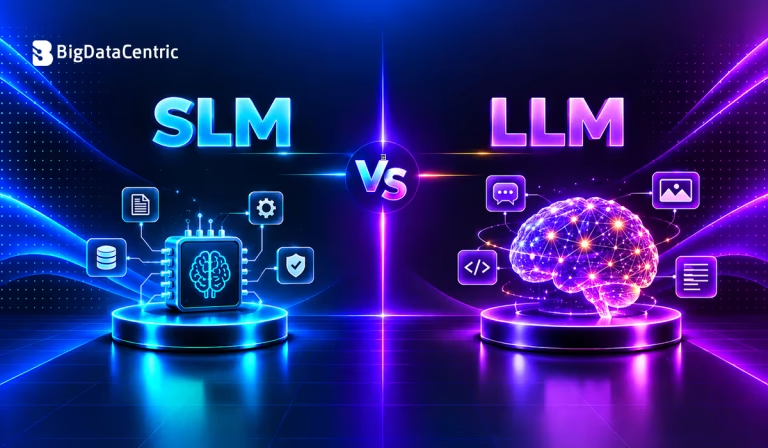
SLM vs LLM: Powerful Guide to Choosing the Best AI Model
Blog Summary:
Choosing the right AI model can improve efficiency, performance, and application outcomes. This guide explains SLM vs LLM, covering their key differences, practical use cases, and real-world applications. It also provides a situation-based checklist to help businesses determine which model best fits their project requirements and goals.
SLM vs LLM is an important comparison for businesses choosing the right artificial intelligence (AI) model for their applications. Both model types help automate tasks, process information, and improve user experiences, but they differ in capabilities, computing requirements, speed, and cost.
Small models are designed to handle focused tasks with fewer computing resources, while larger models can manage complex instructions, generate detailed content, and support advanced reasoning.
Understanding these differences helps businesses select an AI solution that meets their technical and operational requirements.
For example, a business developing an offline mobile assistant may benefit from a lightweight model that runs directly on a device. In contrast, an organization building an AI solution for complex document analysis may need a more capable model with broader language understanding.
Choosing the right model depends on factors such as application complexity, available infrastructure, data privacy, and budget. This guide explores how both model types work, their real-world applications, key differences between slm vs llm, and the factors to consider when selecting the most suitable AI solution.
What is a Small Language Model (SLM)?
Small language models (SLMs) can have up to 10 billion parameters, depending on their design and intended use. These AI models understand and generate human language while requiring fewer computing resources than many larger models.
Small language model can be optimized for specific tasks, such as text classification, information extraction, and short-form response generation. Their smaller size can make deployment easier on mobile devices, local servers, and edge hardware.
A key advantage of an SLM is its potential to reduce inference costs and response latency. Local deployment can also help businesses process sensitive information without sending every request to an external AI service, although proper security controls remain essential.
However, SLMs may struggle with complex reasoning and detailed analysis. Their performance depends on model design, training data, and fine-tuning. For businesses with clearly defined requirements, a small language model can offer a practical balance between performance, efficiency, and deployment flexibility.
For businesses with clearly defined requirements, a small language model can provide a practical balance between performance, efficiency, and deployment flexibility.
Real-world Use Cases of SLMs
Small language models suit applications that need quick responses, focused capabilities, and efficient computing. Their smaller footprint makes them suitable for several everyday business and consumer applications.
On-device AI
SLMs can run directly on smartphones, laptops, and other compatible devices. They can power features such as text suggestions, voice commands, and personal assistants without relying on cloud processing for every request.
This can improve responsiveness and reduce data transmission, provided the device has sufficient computing resources.
Text Classification
Businesses can use SLMs to categorize large volumes of text automatically. For example, an organization can classify emails by topic, label customer feedback by sentiment, or sort support tickets by priority.
These focused tasks can often be handled efficiently with a properly fine-tuned model.
Smart Replies
SLMs can suggest short, relevant responses to messages and emails. Messaging applications and workplace communication tools can use them to generate contextual replies, helping users respond faster without composing every message from scratch.
Data Extraction
SLMs can identify and extract specific information from invoices, forms, emails, and other documents. For instance, a business can use them to retrieve invoice numbers, dates, and payment amounts, reducing manual data entry.
Accuracy checks remain important when handling business-critical information.
Offline AI Processing
When deployed on compatible local hardware, SLMs can perform selected language tasks without a continuous internet connection. This is valuable for field workers, remote locations, and environments with unreliable connectivity.
Local processing can also support data privacy, although organizations must still secure stored information and device access.
What is a Large Language Model (LLM)?
A large language model (LLM) is an AI model trained on extensive text datasets to understand language, interpret instructions, and generate human-like responses.
These models can have billions or even trillions of parameters and perform tasks such as answering questions, summarizing documents, and solving complex problems.
Large language models support diverse applications through their broad language understanding. Depending on their capabilities, they can generate content, analyze lengthy text, write code, and support multiple languages.
According to the Pew Research Center Report on AI 2026, 49% of American adults use AI chatbots, while 96% have at least heard of chatbots such as ChatGPT, Gemini, and Copilot.
Businesses use optimized llm to automate content creation, assist with research, analyze customer feedback, and develop conversational AI applications. They can also be adapted using techniques such as fine-tuning and retrieval-augmented generation (RAG) to meet specific business requirements.
However, LLMs can require substantial computing resources, particularly during training and large-scale deployment. Businesses must also consider operating costs, response latency, data privacy, and inaccurate outputs. The right model depends on the task, available infrastructure, and required performance.
Real-world Use Cases of LLMs
Large language models support applications that require broad language understanding, content creation, and handling complex instructions. These LLM use cases highlight five common ways businesses apply this technology to improve workflows and productivity.
AI Chatbots
LLMs power conversational AI assistants that understand user questions and generate relevant responses. Unlike rule-based chatbots, they can handle varied questions and follow conversational context.
Businesses use them to answer queries, guide users through processes, and provide personalized assistance.
You Might Also Like:
How does an LLM chatbot architecture work, and what are its main components?
Content Generation
LLMs can generate blog drafts, marketing copy, product descriptions, email campaigns, and social media posts. They also help summarize information and adapt content for different audiences. Human review remains essential to verify facts, maintain brand consistency, and improve originality.
Code Generation
Developers use LLM-powered tools to generate code snippets, explain programming concepts, identify potential bugs, and suggest improvements. +
These capabilities can speed up development workflows, but teams should test and review generated code for security, accuracy, and maintainability.
Document Analysis
LLMs can analyze lengthy documents, summarize reports, extract key insights, and answer questions about business records. For example, legal teams can review contracts, while analysts can summarize research reports.
Connecting models to reliable source documents can help ground responses in relevant information.
Customer Support
Businesses can use LLMs to assist support teams with customer queries, draft responses, summarize conversations, and retrieve relevant information from knowledge bases.
These applications can improve response efficiency, but sensitive issues and complex requests may still require human intervention.
Together, these use cases demonstrate how language models can support different business workflows, from software development to customer interactions. The best application depends on the complexity of the task, the accuracy required, and the available resources.
SLM vs LLM: Key Differences
The main difference between small and large language models lies in their capabilities, resource requirements, and intended applications. While smaller models are often suitable for focused tasks, larger models are generally better equipped to handle diverse and complex requests.
The right choice depends on the application’s goals, budget, and infrastructure.
| Factor | Small Language Model (SLM) | Large Language Model (LLM) |
|---|---|---|
| Model Size | Typically has fewer parameters and a smaller footprint. | Generally has more parameters and a larger footprint. |
| Training Data | Can use focused datasets for specific tasks. | Often trained on broader and larger datasets. |
| Accuracy and Complexity | Can perform well on narrow, well-defined tasks. | Often better suited to complex tasks requiring broad knowledge. |
| Speed and Latency | Usually offers faster responses with suitable hardware. | May have higher latency, depending on model size and deployment. |
| Computing Requirements | Can run on less powerful hardware, depending on the model. | Often requires more memory and computing power. |
| Cost | Can reduce inference and deployment costs for targeted workloads. | Can cost more to operate, especially at high usage volumes. |
| Customization | Can be fine-tuned efficiently for specific tasks in some cases. | Can be adapted for diverse tasks, but customization may require more resources. |
| Deployment and Privacy | Can run locally, helping keep data on-device or within private infrastructure. | Often deployed through cloud services, though local and private deployments are also possible. |
| Scalability and Maintenance | Efficient for focused applications, but you may need separate models for different tasks. | Can support multiple workflows, though serving and maintenance may be more demanding. |
Overall, slm vs llm is not simply a comparison of model size. It is about matching a model’s capabilities and operating requirements to the task. A smaller model may be better for repetitive, narrowly defined workflows, while a larger model may suit applications that need broader knowledge and more complex reasoning.
Choose the Right AI Model for Your Business
From lightweight SLMs to powerful LLMs, BigDataCentric helps you develop AI solutions that meet your performance, scalability, and business requirements.
LLMs vs SLMs: A Side-by-Side Comparison
The SLM vs LLM comparison becomes clearer when you understand how each model fits different business requirements. SLMs focus on efficiency and specific tasks, while LLMs offer broader capabilities for applications requiring complex language understanding.
Best Suited for Different Tasks
SLMs work well for focused tasks such as text classification, data extraction, and automated replies. They are useful when a business needs a model for a clearly defined workflow.
LLMs, on the other hand, can handle a wider range of requests, making them suitable for applications involving diverse topics and more complex instructions.
Response Speed and Latency
SLMs generally deliver faster responses for lightweight tasks because they require fewer computing resources. This makes them useful for applications where users expect immediate results, such as smart replies or on-device assistants.
LLMs may take longer to process complex requests, depending on their size, hardware, and deployment setup.
Computing Resources and Costs
SLMs typically need less memory and processing power, which can lower deployment and operating costs. Businesses can use them for targeted workloads without investing in extensive infrastructure.
LLMs often require more powerful hardware or cloud resources, especially for complex requests or high traffic volumes.
Deployment and Data Privacy
SLMs can run on compatible mobile devices, edge hardware, or local servers, reducing dependence on external services. This can help businesses limit data transfers when processing sensitive information.
LLMs can also run on private infrastructure, but cloud-based deployments require careful consideration of data handling, access controls, and security policies.
Customization and Maintenance
SLMs can be fine-tuned for specific business workflows, making them useful for specialized applications such as document classification or information extraction. LLMs can support a wider range of tasks and may reduce the need for separate models across different workflows.
However, customization and maintenance costs depend on the model and deployment approach.
Accuracy and Complex Reasoning
SLMs can achieve strong results on narrowly defined tasks when properly trained or fine-tuned. However, they may struggle with requests requiring extensive background knowledge or multi-step reasoning.
LLMs often perform better on complex instructions and broader contextual tasks, though accuracy still depends on the model, input quality, and the task being evaluated.
Scalability and Business Applications
SLMs can help businesses scale repetitive tasks efficiently, particularly when response speed and operating costs are priorities. LLMs can support multiple workflows across departments, including research, content creation, and complex customer interactions.
Some businesses may benefit from combining both approaches, using an SLM for routine requests and an LLM for more demanding tasks.
Ultimately, choosing between SLM and LLM is a decision about balancing capability, efficiency, cost, and flexibility. Businesses should evaluate both options using real-world tasks and measure accuracy, latency, resource usage, and maintenance requirements before selecting a model.
SLM vs LLM: A Checklist for Choosing the Right AI Model
Choosing between a small language model (SLM) and a large language model (LLM) depends on your application’s complexity, computing resources, privacy requirements, and budget. Use this checklist to identify which model better aligns with your technical needs and business goals.
| Situation | What to Choose |
|---|---|
| Building an AI assistant for complex, multi-step tasks | LLM |
| Developing a lightweight chatbot for basic queries | SLM |
| Processing large amounts of complex or unstructured text | LLM |
| Running AI applications on mobile devices or edge hardware | SLM |
| Working with limited computing resources | SLM |
| Generating detailed content, reports, and summaries | LLM |
| Handling simple classification and data extraction tasks | SLM |
| Supporting advanced reasoning and complex problem-solving | LLM |
| Prioritizing lower operating costs and faster responses for narrow tasks | SLM |
| Building an AI system that needs broad knowledge across multiple domains | LLM |
| Keeping sensitive data on local devices or private infrastructure | SLM |
| Creating an enterprise AI application with diverse, demanding use cases | LLM |
| Automating repetitive tasks with clearly defined workflows | SLM |
| Supporting multiple languages and nuanced conversations | LLM, depending on the model |
| Deploying AI in environments with strict latency or connectivity limits | SLM |
Before making a final decision, evaluate candidate models using representative tasks from your business. Compare accuracy, response time, resource consumption, and operating costs. For some applications, combining an SLM for routine tasks with an LLM for complex requests can balance efficiency and capability.
How Can BigDataCentric Help You Build the Right AI Solution?
BigDataCentric is a Large Language Model Development Company that helps businesses build AI solutions tailored to their specific requirements. From developing AI assistants to implementing document analysis systems, the company aligns model capabilities with business goals, computing resources, and data privacy needs.
If your project requires a custom language model, BigDataCentric can guide you through the process to build & train llm solutions, from defining use cases and preparing data to model selection, training, evaluation, and deployment.
Whether your organization needs an efficient model for a focused task or a more capable system for demanding applications, the development approach should reflect your actual requirements. Model evaluation, testing, security, and ongoing monitoring are essential for building a reliable AI solution.
Need the Right AI Model for Your Business?
Turn your AI ideas into solutions with BigDataCentric, balancing performance, scalability, and cost.
Conclusion
Small language models are ideal for focused tasks that prioritize speed, efficiency, and lower deployment costs. In contrast, large language models are better suited for applications requiring broader knowledge, flexible content generation, and complex reasoning.
Before making a decision, evaluate both options based on accuracy, latency, scalability, data privacy, and long-term maintenance. In some cases, combining both model types can help balance performance and cost.
Ultimately, the right SLM vs LLM approach is the one that meets your application’s requirements while delivering reliable results and sustainable operating costs.
FAQs
Is DeepSeek SLM or LLM?
DeepSeek is primarily known for its large language models (LLMs). Its models support tasks such as reasoning, coding, and text generation.
What are the top 5 AI language models?
Popular options include GPT, Claude, Gemini, DeepSeek, and Llama. The best choice depends on performance, cost, and use case.
What's the difference between LLM and VLM?
LLMs primarily process and generate text, while VLMs (Vision Language Models) handle both visual inputs and language. VLMs can interpret images and answer questions about them.
What are the four types of LLM?
Four common categories are encoder-only, decoder-only, encoder-decoder, and instruction-tuned models. These categories describe model architecture or training approach, so they are not all mutually exclusive.

About Author
Jayanti Katariya is the CEO of BigDataCentric, a leading provider of AI, machine learning, data science, and business intelligence solutions. With 18+ years of industry experience, he has been at the forefront of helping businesses unlock growth through data-driven insights. Passionate about developing creative technology solutions from a young age, he pursued an engineering degree to further this interest. Under his leadership, BigDataCentric delivers tailored AI and analytics solutions to optimize business processes. His expertise drives innovation in data science, enabling organizations to make smarter, data-backed decisions.
Latest From Our Blog
Stay updated with technical insights, industry trends, and the latest technology developments.