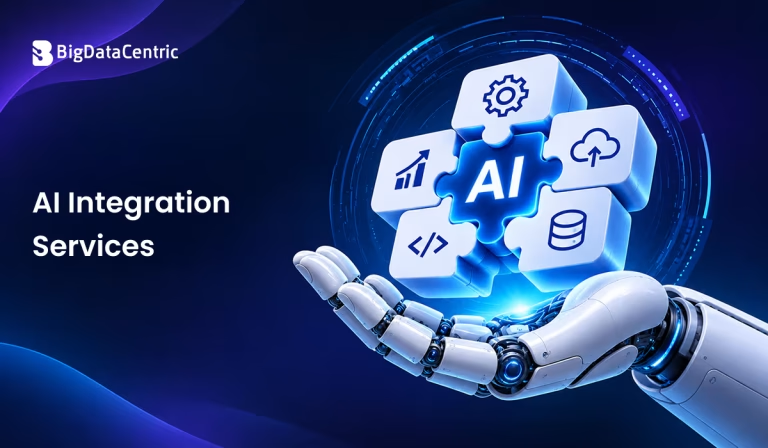


AI Integration Services: Types, Benefits, Use Cases, and Implementation Guide
Blog Summary:
AI integration helps businesses connect intelligent technologies with existing systems to automate workflows, improve decision-making, and enhance operational efficiency. This guide covers different types of AI integration, key business benefits, real-world industry applications, implementation challenges, and associated costs. It also explains how to choose the right integration partner and build scalable AI-powered business solutions.
Artificial Intelligence (AI) is becoming essential to modern business operations, helping organizations automate repetitive tasks, improve decision-making, and deliver better customer experiences.
However, adopting AI tools alone is not enough to achieve meaningful business outcomes. Businesses need to connect these technologies with their existing applications, databases, and workflows to make AI capabilities accessible across different departments. AI Integration Services play an important role here.
From integrating machine learning models into business applications to deploying generative AI, intelligent chatbots, and automated workflows, AI integration enables organizations to make better use of their existing technology infrastructure.
It helps eliminate disconnected processes, improve data accessibility, and turn business information into actionable insights. Organizations can also use these capabilities to streamline operations, personalize customer interactions, and respond more effectively to changing business requirements.
As AI technologies continue to evolve, businesses are moving beyond standalone AI applications toward connected, intelligent systems that support their broader operational goals.
Understanding the different integration approaches, business benefits, implementation challenges, and associated costs can help organizations make informed decisions about AI adoption.
What are AI Integration Services?
AI integration services involve connecting artificial intelligence technologies, such as machine learning models, generative AI applications, natural language processing (NLP), and computer vision, with an organization’s existing software, databases, and business workflows.
This integration lets businesses add intelligent capabilities to their operations without replacing their entire technology infrastructure. It also enables different systems to exchange data, automate processes, and generate useful insights from business information.
These services typically include AI model selection, data integration, API development, workflow automation, system configuration, and ongoing performance monitoring.
Depending on business requirements, organizations can integrate AI into CRM platforms, ERP systems, customer support applications, analytics platforms, and other enterprise solutions. The goal is to make AI capabilities work seamlessly with existing systems while improving operational efficiency, accuracy, and business performance.
Different Types of AI Integration Services
Businesses can integrate different AI technologies depending on their operational requirements, existing infrastructure, and long-term objectives. Each type serves a specific purpose, from analyzing historical data and generating content to understanding customer queries and automating complex workflows.
The following are some common types of AI integration used across business environments.
Machine Learning Integration
Machine learning integration involves embedding ML models into existing business applications to analyze historical data, identify patterns, and make predictions. Businesses can use these models for demand forecasting, customer segmentation, fraud detection, sales predictions, and predictive maintenance.
By connecting machine learning capabilities with CRM, ERP, and business intelligence platforms, organizations can generate data-driven insights and improve operational decisions without relying entirely on manual analysis.
Generative AI and LLM Integration
Generative AI and Large Language Model (LLM) integration connects AI models with business applications to generate, summarize, and interpret information. Organizations can integrate these capabilities into internal knowledge platforms, document management systems, content management systems, and customer support applications.
For example, an enterprise knowledge assistant can retrieve relevant information from internal documents and provide contextual responses, while an AI-powered writing tool can help employees prepare reports, emails, and business documentation more efficiently.
AI Agent Integration
AI agent integration involves connecting intelligent agents with business applications, databases, and APIs so they can perform multi-step tasks with limited human intervention.
Unlike conventional automation tools that follow predefined instructions, AI agents can interpret information, determine appropriate actions, and interact with connected systems to complete specific objectives.
Businesses can use them for lead qualification, invoice processing, appointment scheduling, customer query resolution, and workflow management, with human approval for sensitive actions.
Natural Language Processing (NLP) Integration
Natural Language Processing (NLP) integration enables business systems to understand, interpret, and process human language in text or speech formats. It can be integrated into email management platforms, document processing systems, customer support applications, and enterprise search tools.
Common applications include sentiment analysis, language translation, document classification, keyword extraction, and automated text summarization. These capabilities help organizations process large volumes of unstructured information and extract relevant insights.
Computer Vision Integration
Computer vision integration connects AI-powered image and video recognition capabilities with business applications and connected devices. It lets systems analyze visual information, identify objects, detect anomalies, and recognize patterns in images or video feeds.
For example, manufacturing companies can integrate computer vision with production line cameras to identify product defects, while retail businesses can use visual recognition for inventory monitoring and product identification. This reduces dependence on manual inspections and improves accuracy in visual tasks.
Conversational AI Integration
Conversational AI integration connects intelligent chatbots and virtual assistants to business platforms, enabling automated, natural interactions with customers and employees.
These systems can understand user queries, retrieve relevant information, and provide responses through websites, mobile applications, messaging platforms, and contact center software.
When connected to CRM and customer support databases, conversational AI can also retrieve customer details, track service requests, and handle routine queries, improving response times and support availability.
Turn Your Business Ideas Into AI-Powered Solutions
Build customized AI solutions that connect your systems, simplify processes, and support your business goals.
Key Benefits of AI Integration Services for Businesses
Integrating AI into existing business systems helps organizations improve operational efficiency, use data more effectively, and respond to changing business needs. Instead of managing disconnected tools and manual processes, businesses can create connected workflows that support faster execution and more informed decisions.
Some key benefits include:
Higher Productivity and Automation
AI integration helps automate repetitive and time-consuming activities such as data entry, document processing, report generation, and customer query handling. By connecting AI capabilities with existing business applications, employees can complete routine tasks with less manual effort and focus on activities that require human judgment and expertise.
This improves workflow consistency, reduces operational delays, and allows teams to handle larger workloads without proportionally increasing their resources.
Smarter, Faster Decisions
AI-powered systems can analyze large volumes of structured and unstructured data to identify patterns, forecast trends, and generate actionable insights. When integrated with business intelligence platforms and enterprise databases, these capabilities help decision-makers access relevant information without depending entirely on manual reporting.
For example, sales teams can identify changing customer preferences, while finance teams can evaluate transaction patterns to support more informed business decisions.
Better Customer Experiences
Integrating AI into CRM platforms, websites, and customer support applications helps businesses deliver more relevant and responsive customer interactions. AI systems can analyze customer preferences, purchase history, and previous interactions to personalize product recommendations, support responses, and marketing communication.
Chatbots and virtual assistants can also handle common queries around the clock, reducing waiting times and providing consistent assistance across customer touchpoints.
Cost Reduction and Scalability
AI integration can reduce operational expenses by automating manual processes, minimizing repetitive work, and improving resource utilization. It also allows businesses to expand automated workflows as transaction volumes, customer demands, and operational requirements increase.
Instead of continuously adding resources for routine activities, organizations can use connected AI applications to manage growing workloads while maintaining operational efficiency. However, the actual cost savings depend on implementation expenses, infrastructure requirements, and ongoing maintenance.
Stronger Risk and Security Management
AI-powered systems can help organizations identify unusual activities, detect potential threats, and monitor operational risks by analyzing data from multiple sources. When connected with security platforms, financial systems, and enterprise databases, AI models can flag suspicious transactions, identify abnormal access patterns, and support real-time threat monitoring.
These capabilities help security teams investigate potential issues faster, although human oversight and established security controls remain important for critical decisions.
Real-world Use Cases of AI Integration Services Across Industries
AI is being adopted across industries to address operational challenges, improve service delivery, and support data-driven processes. By connecting AI capabilities with industry-specific applications and existing business systems, organizations can automate complex tasks and improve how they manage information.
Here are some practical examples of how different industries use AI integration.
Healthcare: Clinical Data Processing and Workflow Automation
Healthcare organizations can integrate AI with electronic health records (EHR), hospital management systems, and clinical databases to streamline administrative and clinical workflows.
AI-powered tools can extract relevant information from medical documents, summarize patient records, assist with clinical documentation, and automate appointment scheduling. These capabilities reduce administrative workloads and help healthcare professionals access relevant patient information more efficiently.
AI can also support medical image analysis and clinical decision-making, with qualified healthcare professionals making final medical judgments.
Finance: Fraud Detection and Risk Assessment
Financial institutions can integrate machine learning models with banking platforms, payment gateways, and transaction monitoring systems to identify suspicious activities. These models analyze transaction patterns, account behavior, and historical data to detect unusual activities that may indicate fraud.
AI integration can also support credit risk assessment, anti-money laundering monitoring, and automated financial reporting. By identifying potential risks earlier, financial organizations can strengthen security controls and improve the accuracy of financial operations.
Retail and E-commerce: Personalized Product Recommendations
Retailers and e-commerce businesses can connect AI recommendation engines with CRM platforms, inventory management systems, and online shopping applications. These systems analyze browsing behavior, purchase history, product preferences, and customer interactions to suggest relevant products.
AI can also support dynamic pricing, demand forecasting, and customer segmentation. This helps businesses deliver personalized shopping experiences, improve product discovery, and make more informed inventory and marketing decisions.
Manufacturing: Predictive Maintenance and Quality Control
Manufacturing companies can integrate AI models with industrial equipment, IoT sensors, production management software, and quality inspection systems. Machine learning algorithms analyze equipment performance data to identify unusual patterns that may indicate potential failures.
This enables maintenance teams to address equipment issues before they cause unexpected downtime. Similarly, computer vision systems can inspect products on production lines, detect defects, and identify quality inconsistencies, helping manufacturers improve production efficiency and maintain consistent product standards.
Logistics: Demand Forecasting and Route Optimization
Logistics companies can connect AI applications with transportation management systems (TMS), warehouse management systems (WMS), GPS devices, and supply chain databases. These integrations help analyze shipment volumes, traffic conditions, delivery schedules, and historical demand patterns.
AI models can forecast inventory requirements, recommend efficient delivery routes, and identify potential supply chain disruptions. As a result, logistics providers can improve fleet utilization, reduce delivery delays, and coordinate transportation and warehouse operations more effectively.
Education: Personalized Learning and Intelligent Assessment
Educational institutions can integrate AI with learning management systems (LMS), student information systems, and digital learning platforms to improve teaching and assessment processes. AI applications can analyze student performance, identify learning gaps, and recommend learning materials based on individual progress.
Intelligent assessment tools can also help grade objective assignments, generate practice questions, and provide feedback. These capabilities help educators monitor student development and create more adaptive learning experiences while retaining human oversight in academic evaluation.
Customer Service: AI Chatbots and Virtual Assistants
Businesses can integrate AI chatbots and virtual assistants with CRM systems, helpdesk software, knowledge bases, and communication channels to automate customer support activities. These applications can understand customer questions, retrieve relevant information, track service requests, and provide responses without requiring an agent for every interaction.
More advanced systems can also route complex queries to the appropriate support teams with relevant conversation history. This improves response times, reduces repetitive support workloads, and helps businesses deliver consistent assistance across multiple channels.
Across these industries, AI effectiveness depends on how well its capabilities connect with existing data sources, applications, and operational workflows. A well-planned integration approach lets organizations apply AI to specific business challenges rather than introducing technology without a clear purpose.
Make AI Integration Work for Your Business Goals
Get tailored AI solutions that fit your existing infrastructure, operational requirements, and long-term business plans.
Challenges of AI Integration and How to Overcome Them
Integrating AI into existing business environments involves more than selecting suitable models or applications.
Organizations may face technical, operational, financial, and data-related challenges that affect implementation and long-term performance. Understanding these obstacles early helps businesses plan their integration strategy and avoid unnecessary disruptions.
Poor Data Quality and Silos
AI systems depend on accurate, consistent, and accessible data to generate reliable results. However, businesses often store information across disconnected databases, applications, and departments, making it difficult to establish a unified data environment.
Organizations can overcome this challenge by implementing data governance practices, standardizing data formats, removing duplicate records, and connecting relevant data sources through APIs or centralized data platforms.
Legacy Systems and Integration Bottlenecks
Older enterprise applications may lack modern APIs, compatible data formats, or the infrastructure required to support AI integration. Connecting these systems with newer AI technologies can create compatibility issues, performance limitations, and additional development work.
Businesses can address these challenges with API gateways, middleware, custom connectors, and phased modernization strategies that let AI capabilities work with existing infrastructure without disrupting critical operations.
Lack of Skilled Talent
AI integration requires expertise in machine learning, data engineering, cloud infrastructure, software development, and system architecture. Organizations without the right technical capabilities may struggle to select suitable technologies, manage deployments, and maintain integrated solutions.
Businesses can overcome this limitation by training internal teams, hiring experienced AI professionals, or partnering with specialized technology providers who can support implementation and knowledge transfer.
High Costs and Unclear ROI
AI integration can involve costs for software development, infrastructure, data preparation, licensing, model deployment, and ongoing maintenance. Without clearly defined business objectives, organizations may invest in capabilities that fail to deliver measurable value.
To manage costs, businesses should begin with high-impact use cases, define measurable performance indicators, estimate total ownership costs, and evaluate results through pilot projects before expanding implementation.
You Might Also Like:
How Much Do AI Integration Services Cost?
AI integration costs depend on several factors, including project complexity, technology selection, existing infrastructure, data readiness, and the level of customization required.
A basic integration involving an existing AI API or chatbot may require less investment than a complex enterprise implementation involving custom machine learning models, multiple business applications, and large-scale data processing.
The pricing also varies based on whether the solution uses cloud-based AI platforms, open-source models, or proprietary technologies.
The following table provides an indicative cost breakdown based on project complexity:
| Integration Type | Estimated Cost (USD) | Complexity Level |
|---|---|---|
| Basic AI API Integration | 5,000–15,000 | Low |
| AI Chatbot Integration | 10,000–30,000 | Low to Medium |
| Generative AI and LLM Integration | 20,000–60,000 | Medium to High |
| Custom Machine Learning Integration | 25,000–80,000 | High |
| Enterprise-Level AI Integration | 50,000–150,000+ | Very High |
Several factors influence the overall investment:
- Project Complexity: Integrating an existing AI model into one application generally costs less than developing a customized solution connected to multiple enterprise systems.
- Data Preparation: Data cleaning, transformation, labeling, and migration can increase development costs, particularly when information is spread across disconnected systems.
- Technology and Infrastructure: Cloud computing, API usage, model hosting, storage, and third-party software licensing contribute to implementation and operational expenses.
- Customization Requirements:Custom AI models, business-specific workflows, advanced integrations, and specialized features require additional development and testing.
- Maintenance and Support: Model updates, security improvements, performance monitoring, and infrastructure management create recurring costs after deployment.
Businesses should evaluate the total cost of ownership rather than focusing only on initial development expenses. Starting with a smaller implementation, measuring its business impact, and gradually expanding successful use cases can help organizations manage investment while building a scalable AI environment.
How to Choose the Right AI Integration Service Provider
Selecting the right technology partner is important for implementing AI solutions that align with business requirements and existing infrastructure.
A suitable provider should understand your operational challenges, recommend appropriate AI technologies, and ensure seamless integration with current applications. Businesses should evaluate the following factors before choosing an integration partner.
Technical Expertise and Industry Experience
Evaluate the provider’s experience in AI development, machine learning, data engineering, cloud computing, and enterprise software integration. A provider with relevant industry experience can better understand business-specific requirements and recommend practical solutions.
Review previous projects, case studies, and technical capabilities to determine whether the team can handle your integration requirements and deliver reliable results.
AI Technology and Integration Capabilities
The provider should have experience working with different AI technologies, including machine learning, generative AI, large language models, NLP, and AI agents. They should also understand API development, middleware, cloud platforms, and third-party application connectivity.
This ensures they can select suitable technologies and connect AI capabilities with your existing business applications without introducing unnecessary complexity.
Security and Compliance Standards
AI integration often involves access to sensitive business information, customer records, and internal databases. Therefore, evaluate the provider’s approach to data encryption, access management, secure API communication, and information protection.
Depending on your industry and operating locations, they should also understand relevant regulatory requirements and compliance frameworks, such as GDPR, HIPAA, or SOC 2.
Scalability and Customization Options
Choose a provider that can develop solutions around your current business requirements while supporting future growth. The integration architecture should accommodate increasing data volumes, additional applications, and evolving AI capabilities without requiring major infrastructure changes.
Customization is equally important because different organizations have unique workflows, operational processes, and technology environments that may not be addressed by generic AI solutions.
Post-deployment Support and Maintenance
AI integration requires continuous monitoring and maintenance to ensure systems remain accurate, secure, and compatible with changing business requirements.
Before selecting a provider, understand the support services they offer after deployment, including performance monitoring, troubleshooting, model updates, security patches, and system optimization. A reliable support arrangement helps businesses maintain integration performance and address technical issues as they arise.
Ultimately, the right provider should offer more than technical implementation. Look for a partner that understands your business objectives, communicates transparently, and can support the complete integration lifecycle, from initial planning and development to deployment and ongoing optimization.
How BigDataCentric Helps Businesses With AI Integration Services?
BigDataCentric helps businesses connect artificial intelligence technologies with their existing applications, data sources, and operational workflows. Its capabilities include custom AI model integration, generative AI and LLM integration, chatbot development, workflow automation, and AI consulting.
By understanding business requirements and existing infrastructure, the team focuses on developing solutions that address specific operational challenges while supporting efficiency, accuracy, and scalability.
With expertise in AI development, data engineering, and enterprise application integration, BigDataCentric supports businesses throughout the implementation process, from initial planning and development to deployment and ongoing optimization.
Whether organizations want to automate business processes, integrate intelligent assistants, or incorporate predictive capabilities into existing platforms, BigDataCentric helps build customized solutions aligned with their objectives.
Ready to Integrate AI Into Your Existing Systems?
Connect your business applications with intelligent AI solutions to automate workflows and improve operational efficiency.
Conclusion
AI integration enables businesses to connect intelligent technologies with existing applications, data sources, and workflows to improve operational efficiency and decision-making.
From machine learning and generative AI to intelligent automation and conversational systems, different integration approaches help organizations address specific business challenges. However, successful implementation depends on data quality, suitable technology selection, system compatibility, and a clear understanding of business objectives.
As AI adoption continues to grow, businesses should focus on building scalable solutions that deliver measurable value rather than adopting technologies without a defined purpose.
Choosing an experienced integration partner, planning implementation carefully, and continuously monitoring performance can help organizations make better use of AI capabilities. With the right strategy and technical support, businesses can develop more connected, intelligent, and efficient operations.
FAQs
How can businesses integrate AI into existing software?
Businesses can integrate AI by connecting machine learning models, APIs, LLMs, or AI-powered tools with existing applications, databases, and workflows. The process typically involves assessing system compatibility, preparing data, selecting suitable AI technologies, and testing the integration.
What is the difference between AI development and AI integration?
AI development involves building custom AI models, algorithms, or applications to solve specific problems. AI integration focuses on connecting existing or newly developed AI capabilities with business software, databases, and workflows to make them usable within existing systems.
How long does it take to integrate AI into an existing system?
AI integration can take anywhere from a few weeks to several months, depending on project complexity, data readiness, system compatibility, and customization requirements. Basic API integrations may take less time, while enterprise-level implementations require more planning, development, and testing.
How much do AI integration services cost?
AI integration costs can range from approximately $5,000 to $150,000 or more, depending on the technology, project scope, customization, and infrastructure requirements. Simple API integrations generally cost less than complex enterprise implementations involving multiple systems and custom AI models.

About Author
Jayanti Katariya is the CEO of BigDataCentric, a leading provider of AI, machine learning, data science, and business intelligence solutions. With 18+ years of industry experience, he has been at the forefront of helping businesses unlock growth through data-driven insights. Passionate about developing creative technology solutions from a young age, he pursued an engineering degree to further this interest. Under his leadership, BigDataCentric delivers tailored AI and analytics solutions to optimize business processes. His expertise drives innovation in data science, enabling organizations to make smarter, data-backed decisions.
Latest From Our Blog
Stay updated with technical insights, industry trends, and the latest technology developments.