Deployment Automation Explained for Modern DevOps Teams

 Total View: 271
Submitting the form below will ensure a prompt response from us.
Modern software development requires fast, reliable, and repeatable deployments. Manually deploying applications can lead to delays, configuration issues, and production failures.
This is where Deployment Automation becomes essential.
So, what exactly is deployment automation, and how does it work?
What is Deployment Automation?
Deployment automation is the process of automatically deploying software applications, updates, and infrastructure changes using scripts, tools, and CI/CD pipelines.
Instead of manually copying files or configuring servers, automation tools handle deployment tasks consistently and efficiently.
Deployment automation helps organizations:
- Reduce human errors
- Accelerate software releases
- Improve deployment consistency
- Enhance system reliability
Why is Deployment Automation Important?
Manual deployments often lead to configuration mismatches, unexpected downtime, delayed software releases, and deployment failures, all of which impact application performance and user experience.
As applications grow more complex, manual deployment management also increases operational overhead and makes it difficult for teams to maintain consistency across multiple environments.
Deployment automation helps organizations overcome these challenges by streamlining and standardizing the entire release process. Automated workflows ensure that applications are deployed faster, more reliably, and with fewer human errors.
It also improves rollback capabilities, allowing teams to quickly recover from failed deployments while supporting scalable DevOps practices for modern software delivery.
How Deployment Automation Works?
Deployment automation typically follows a CI/CD pipeline workflow.
Code Commit
Developers push code to a repository such as:
- GitHub
- GitLab
- Bitbucket
Continuous Integration (CI)
The system automatically:
- Builds the application
- Runs tests
- Validates code quality
Continuous Deployment (CD)
If tests pass, the application is automatically deployed to:
- Development
- Staging
- Production environments
Monitoring and Rollback
After deployment:
- Monitoring tools check system health
- Rollbacks occur automatically if failures are detected
Key Components of Deployment Automation
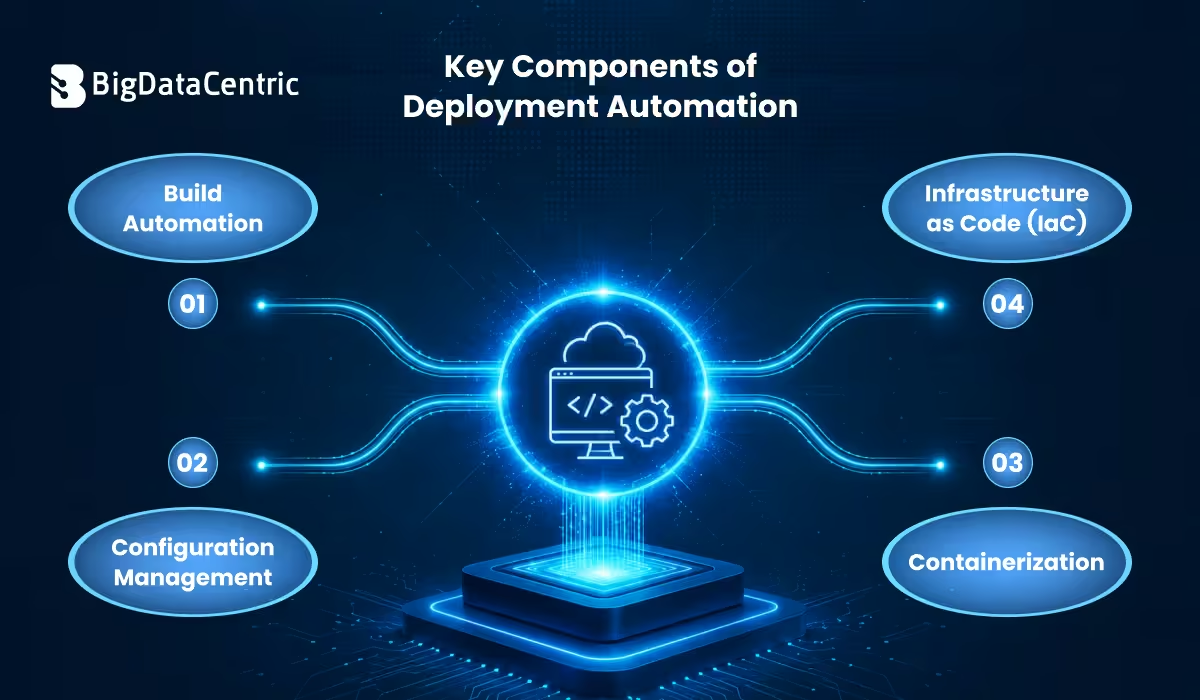
Build Automation
Compiles source code into deployable artifacts.
Examples:
- Maven
- Gradle
- npm
Configuration Management
Ensures servers and environments remain consistent.
Popular tools:
- Ansible
- Chef
- Puppet
Containerization
Containers package applications with dependencies.
Popular technologies:
- Docker
- Kubernetes
Infrastructure as Code (IaC)
Infrastructure is defined using code.
Examples:
- Terraform
- CloudFormation
Python Example: Simple Deployment Script
import os

print("Starting deployment...")

# Simulate deployment
os.system("echo Deploying application")

print("Deployment completed successfully")
This basic example demonstrates automated deployment execution.
Benefits of Deployment Automation
| Benefit | Description | Business Impact |
|---|---|---|
| Faster Releases | Deploy applications quickly | Accelerates product delivery and updates |
| Reduced Errors | Eliminates manual deployment mistakes | Improves application stability and reliability |
| Consistency | Uses the same deployment process across environments | Maintains uniform configurations and performance |
| Scalability | Handles multiple deployments efficiently | Supports growing applications and infrastructure |
| Reliability | Ensures stable and repeatable releases | Minimizes downtime and deployment failures |
Popular Deployment Automation Tools
Several tools are widely used for deployment automation:
- Jenkins – Open-source automation platform
- GitHub Actions – Repository-based workflow automation
- GitLab CI/CD – Integrated CI/CD solution
- Argo CD – Kubernetes GitOps deployment tool
- CircleCI – Fast continuous integration platform
- Azure DevOps – End-to-end DevOps services
These platforms help automate end-to-end deployment pipelines.
Deployment Automation in Cloud Environments
Cloud platforms support automated deployments using managed services.
Examples include:
- AWS CodeDeploy
- Azure DevOps
- Google Cloud Deploy
Cloud automation enables:
- Auto-scaling
- Zero-downtime deployment
- Infrastructure provisioning
Types of Deployment Strategies
Blue-Green Deployment
Two environments are maintained:
- One active
- One standby
Switch traffic after successful deployment.
Canary Deployment
Release updates to a small group of users first.
Rolling Deployment
Gradually replace old application instances.
Recreate Deployment
Stops the old version before deploying the new one.
Challenges in Deployment Automation
Despite its advantages, deployment automation has challenges:
- Complex pipeline setup
- Security risks
- Tool integration issues
- Infrastructure compatibility
- Learning curve for teams
Proper planning and governance are essential.
Security in Deployment Automation
Security best practices include:
- Secure credential management
- Role-based access control
- Secret scanning
- Automated vulnerability testing
- Signed deployment artifacts
Security should be integrated into the CI/CD pipeline.
Python Example: Automated Health Check
import requests

response = requests.get("https://example.com")

if response.status_code == 200:
   print("Application is healthy")
else:
   print("Deployment issue detected")
Health checks help validate deployments automatically.
Future Trends in Deployment Automation
Emerging trends include:
- AI-driven deployment optimization
- GitOps workflows
- Serverless deployments
- Self-healing infrastructure
- Policy-as-code automation
Automation is becoming more intelligent and autonomous.
Automate Your Software Deployments
Improve release speed and reliability with deployment automation solutions.
Conclusion
So, what is deployment automation?
Deployment automation is the practice of using tools and scripts to automatically deploy applications and infrastructure changes across environments.
By implementing deployment automation, organizations can:
- Deliver software faster
- Reduce deployment failures
- Improve consistency
- Enable scalable DevOps operations
In today’s fast-paced software landscape, deployment automation is a critical part of modern application delivery and cloud-native development.


Jayanti Katariya is the CEO of BigDataCentric, a leading provider of AI, machine learning, data science, and business intelligence solutions. With 18+ years of industry experience, he has been at the forefront of helping businesses unlock growth through data-driven insights. Passionate about developing creative technology solutions from a young age, he pursued an engineering degree to further this interest. Under his leadership, BigDataCentric delivers tailored AI and analytics solutions to optimize business processes. His expertise drives innovation in data science, enabling organizations to make smarter, data-backed decisions.