MongoDB Databricks Integration: A Guide with Spark

 Total View: 65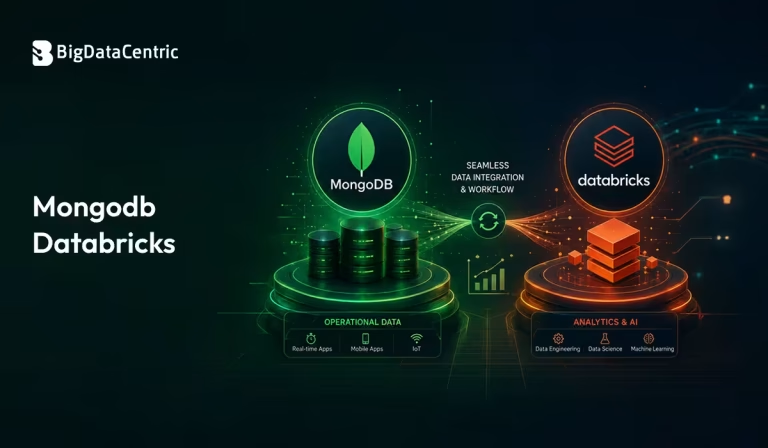
Submitting the form below will ensure a prompt response from us.
MongoDB and Databricks are two powerful technologies that complement each other in modern data engineering and analytics workflows. MongoDB is a popular NoSQL database designed to store flexible, document-oriented data, while Databricks is a cloud-based analytics platform built on Apache Spark that enables large-scale data processing, machine learning, and AI.
Integrating MongoDB with Databricks allows organizations to analyze operational data, build real-time ETL pipelines, train machine learning models, and generate business insights from large datasets. The integration is commonly achieved using the MongoDB Spark Connector, which enables Apache Spark to read from and write to MongoDB collections efficiently.
In this guide, you’ll learn how MongoDB Databricks integration works, its architecture, setup process, practical code examples, and best practices.
Why Integrate MongoDB with Databricks?
Organizations integrate MongoDB and Databricks to combine operational data with advanced analytics.
Key benefits include:
- Real-time analytics
- Scalable data processing
- AI and machine learning workflows
- ETL and ELT pipeline development
- Data lake integration
- Improved business intelligence
This combination enables organizations to process large volumes of semi-structured data efficiently.
How MongoDB Databricks Integration Works?
A typical integration workflow follows these steps:
- Data is stored in MongoDB collections.
- Databricks connects to MongoDB using the MongoDB Spark Connector.
- Apache Spark loads the data into DataFrames.
- Data is cleaned, transformed, and analyzed.
- Results are stored back in MongoDB or another data platform.
This architecture supports both batch and near real-time analytics.
How to Connect MongoDB with Databricks?
Prerequisites
Before connecting MongoDB and Databricks, ensure you have:
- A MongoDB database (MongoDB Atlas or self-managed)
- A Databricks workspace
- Apache Spark cluster
- MongoDB Spark Connector installed
- Appropriate network and authentication settings
- Read/write permissions on the MongoDB database
Configure MongoDB Connection
The following example shows how to configure a MongoDB connection in Databricks.
mongo_uri = "mongodb+srv://:@cluster.mongodb.net"

spark.conf.set(

"spark.mongodb.read.connection.uri",

mongo_uri

)

spark.conf.set(

"spark.mongodb.write.connection.uri",

mongo_uri

)
Replace the placeholders with your MongoDB connection details.
Read Data from MongoDB
Once the connection is configured, you can load a MongoDB collection into a Spark DataFrame.
df = spark.read.format("mongodb") \

.option("database", "sales_db") \

.option("collection", "customers") \

.load()

df.show()
Sample Output
| ID | CustomerName | Country |
|---|---|---|
| 101 | Alice Brown | USA |
| 102 | David Smith | Canada |
Transform Data Using Spark
Databricks makes it easy to transform MongoDB data using Apache Spark.
from pyspark.sql.functions import upper

updated_df = df.withColumn(

"CustomerName",

upper(df.CustomerName)

)

updated_df.show()
Spark transformations are distributed across the cluster, enabling high-performance processing.
Write Data Back to MongoDB
After processing, write the transformed data back to MongoDB.
updated_df.write \

.format("mongodb") \

.mode("append") \

.option("database", "sales_db") \

.option("collection", "customers_processed") \

.save()
This creates or updates the target collection.
Machine Learning with Databricks
Once MongoDB data is available in Spark DataFrames, it can be used for machine learning.
Typical applications include:
- Customer segmentation
- Sales forecasting
- Fraud detection
- Recommendation engines
- Predictive maintenance
- Churn prediction
Databricks supports ML libraries such as:
- MLlib
- TensorFlow
- PyTorch
- XGBoost
Common Use Cases
Customer Analytics
Analyze customer behavior stored in MongoDB using Databricks notebooks and dashboards.
ETL Pipelines
Extract data from MongoDB, transform it using Spark, and load it into a data warehouse.
AI Model Training
Use MongoDB operational data to train machine learning models at scale.
Real-Time Reporting
Build dashboards using processed MongoDB data for faster business insights.
Fraud Detection
Analyze transaction data stored in MongoDB to identify suspicious activities using machine learning algorithms.
MongoDB Databricks Architecture
A typical architecture includes:
- MongoDB Atlas or MongoDB Server
- MongoDB Spark Connector
- Databricks Workspace
- Apache Spark Cluster
- Delta Lake
- Machine Learning Models
- BI and Visualization Tools
This architecture enables organizations to build scalable, cloud-native data platforms.
Best Practices
Use MongoDB Atlas
MongoDB Atlas simplifies cloud connectivity, security, and scalability.
Optimize Spark Partitions
Configure Spark partitions appropriately to improve processing performance.
Secure Database Credentials
Store MongoDB credentials securely using Databricks Secrets instead of hardcoding them in notebooks.
Filter Data Before Loading
Retrieve only the required collections and documents to reduce processing time. Following database optimization best practices helps minimize unnecessary data scans and improves query performance.
Monitor Cluster Performance
Track Spark jobs, memory usage, and query performance to optimize workloads.
Common Mistakes to Avoid
Loading Unnecessary Data
Avoid reading entire MongoDB collections if only a subset of records is needed.
Use filters to improve performance and reduce resource consumption.
Hardcoding Credentials
Incorrect approach:
mongo_uri = “mongodb+srv://admin:password@cluster.mongodb.net”
Instead, use Databricks Secret Scopes or another secure credential management solution.
Ignoring Partitioning
Improper partitioning can slow Spark jobs and increase execution time.
Optimize partition strategies for large datasets.
Build Intelligent Data Platforms with MongoDB & Databricks
Our data engineering experts develop scalable analytics and AI solutions by integrating MongoDB with Databricks for real-time insights.
Conclusion
Integrating MongoDB with Databricks enables organizations to combine the flexibility of a NoSQL database with the scalability of Apache Spark for advanced analytics, ETL pipelines, and machine learning. Using the MongoDB Spark Connector, developers can seamlessly read, transform, and write data between MongoDB and Databricks, making it easier to process large datasets and generate actionable insights.
Whether you’re building customer analytics platforms, AI-powered applications, fraud detection systems, or enterprise data pipelines, MongoDB Databricks integration provides a robust foundation for modern data engineering.
By following best practices such as secure credential management, optimized Spark configurations, and efficient data loading strategies, organizations can maximize performance, scalability, and reliability in their data workflows.


Jayanti Katariya is the CEO of BigDataCentric, a leading provider of AI, machine learning, data science, and business intelligence solutions. With 18+ years of industry experience, he has been at the forefront of helping businesses unlock growth through data-driven insights. Passionate about developing creative technology solutions from a young age, he pursued an engineering degree to further this interest. Under his leadership, BigDataCentric delivers tailored AI and analytics solutions to optimize business processes. His expertise drives innovation in data science, enabling organizations to make smarter, data-backed decisions.