Cloud Engineer Roadmap: A Practical Guide for Beginners

 Total View: 60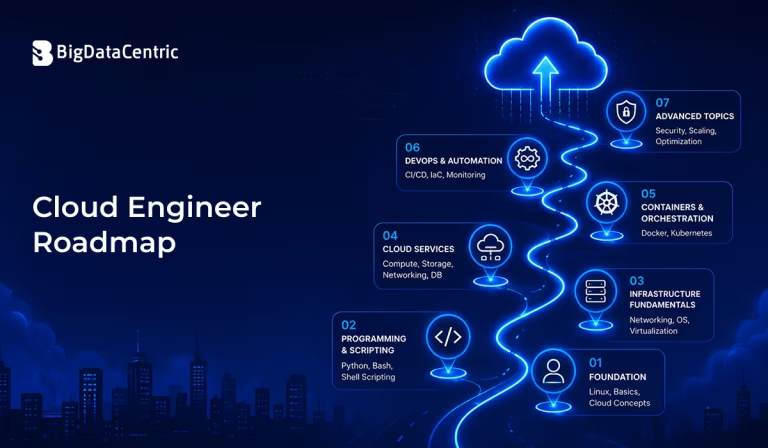
Submitting the form below will ensure a prompt response from us.
Cloud computing has become an essential part of modern software infrastructure, making cloud engineering an increasingly important technology career. A Cloud Engineer Roadmap provides a structured path for learning the technical skills, tools, platforms, and practices required to design, deploy, maintain, and optimize cloud-based infrastructure.
Cloud engineers work with platforms such as Amazon Web Services (AWS), Microsoft Azure, and Google Cloud Platform (GCP). Their responsibilities can include infrastructure management, cloud migration, networking, security, automation, monitoring, and DevOps.
However, becoming a cloud engineer requires more than learning a single cloud platform. A strong foundation in operating systems, networking, programming, databases, security, and automation provides the technical foundation needed to work effectively with cloud environments.
This roadmap explains the major stages of becoming a cloud engineer and the technologies worth learning along the way.
What Does a Cloud Engineer Do?
A Cloud Engineer is responsible for designing, implementing, maintaining, and optimizing cloud infrastructure.
Typical responsibilities include:
- Designing cloud architectures
- Deploying applications and services
- Managing virtual machines and containers
- Configuring cloud networks
- Implementing security controls
- Automating infrastructure
- Monitoring cloud resources
- Managing cloud migrations
- Optimizing performance and costs
- Supporting disaster recovery
Depending on the organization, a cloud engineer may specialize in cloud infrastructure management, DevOps, security, networking, or cloud architecture.
11 Essential Steps in a Cloud Engineer Roadmap
Learn the Fundamentals of Cloud Computing
The first stage of the roadmap is understanding basic cloud computing concepts.
Learn about:
- Cloud computing models
- Public, private, and hybrid clouds
- Infrastructure as a Service (IaaS)
- Platform as a Service (PaaS)
- Software as a Service (SaaS)
- Virtualization
- Containers
- Regions and availability zones
- Scalability and elasticity
- High availability
You should understand why organizations use cloud platforms and how cloud infrastructure differs from traditional on-premises infrastructure.
Build Strong Linux Skills
Linux is widely used for cloud servers and infrastructure, so understanding Linux administration is an important part of a cloud engineer roadmap.
Learn:
- File systems
- User and group management
- Permissions
- Processes
- Services
- Package management
- SSH
- Shell scripting
- Logs
- Networking commands
For example, you can check running processes with:
ps aux
You can monitor disk usage using:
df -h
Basic Bash scripting can also help automate repetitive administration tasks.
#!/bin/bash

echo "Checking disk usage..."

df -h
Learn Networking Fundamentals
Cloud infrastructure heavily depends on networking. A cloud engineer needs to understand how different resources communicate securely.
Important concepts include:
- IP addresses
- Subnets
- Routing
- DNS
- TCP/IP
- HTTP and HTTPS
- Firewalls
- NAT
- VPN
- Load balancing
- Network security groups
You should understand how traffic moves from a user’s device through the internet to an application hosted in a cloud environment.
Learn a Programming or Scripting Language
Cloud engineers do not necessarily need to become software developers, but programming and scripting skills are extremely useful.
Popular choices include:
- Python
- Bash
- PowerShell
- JavaScript
Python is particularly useful for automation and cloud tooling.
Example:
import boto3

ec2 = boto3.client("ec2")

response = ec2.describe_instances()

for reservation in response["Reservations"]:

for instance in reservation["Instances"]:

print(instance["InstanceId"])
The example demonstrates how Python can interact programmatically with cloud infrastructure.
Choose a Cloud Platform
Once you understand the fundamentals, choose one major cloud platform and learn it deeply.
The three major platforms are:
Amazon Web Services (AWS)
Learn services such as:
- EC2
- S3
- IAM
- VPC
- RDS
- Lambda
- CloudWatch
Microsoft Azure
Important services include:
- Azure Virtual Machines
- Azure Storage
- Azure Virtual Network
- Microsoft Entra ID
- Azure SQL
- Azure Functions
- Azure Monitor
Google Cloud
Learn services such as:
- Compute Engine
- Cloud Storage
- VPC
- Cloud SQL
- Cloud Functions
- Google Kubernetes Engine
You don’t need to master all three platforms initially. Building strong expertise in one platform is generally a better starting point.
Learn Infrastructure as Code
Infrastructure as Code (IaC) allows engineers to define and manage infrastructure through configuration files rather than manually creating resources.
Popular tools include:
- Terraform
- AWS CloudFormation
- Azure Bicep
- Pulumi
A simple Terraform configuration might look like:
resource "aws_s3_bucket" "example" {

bucket = "cloud-engineering-example"

}
IaC improves repeatability, automation, and infrastructure management.
Learn Containers and Kubernetes
Containers are widely used to package and deploy applications consistently across environments.
Start with:
- Docker
- Container images
- Dockerfiles
- Container registries
- Docker Compose
Then learn Kubernetes concepts such as:
- Pods
- Deployments
- Services
- ConfigMaps
- Secrets
- Namespaces
- Ingress
Managed Kubernetes services include Amazon EKS, Azure Kubernetes Service (AKS), and Google Kubernetes Engine (GKE)
Learn DevOps and CI/CD
Cloud engineers frequently work alongside DevOps teams and use automation throughout the software delivery lifecycle.
Learn:
- Version control with Git
- Continuous Integration
- Continuous Deployment
- Automated testing
- Build pipelines
- Deployment automation
- Infrastructure automation
Popular CI/CD tools include:
- GitHub Actions
- GitLab CI/CD
- Jenkins
- Azure DevOps
A basic Git workflow might include:
git add .

git commit -m "Update cloud infrastructure"

git push origin main
Understand Cloud Security
Security should be included throughout the entire cloud engineering roadmap rather than treated as a final step.
Important concepts include:
- Identity and access management
- Least-privilege access
- Encryption
- Secrets management
- Network security
- Security monitoring
- Logging
- Compliance
- Vulnerability management
For example, cloud permissions should be designed so that users and applications receive only the access they actually need.
Learn Monitoring and Observability
Cloud infrastructure must be continuously monitored to identify performance issues and failures.
Learn about:
- Metrics
- Logs
- Traces
- Alerts
- Application monitoring
- Infrastructure monitoring
- Resource utilization
Examples of monitoring platforms include:
- Amazon CloudWatch
- Azure Monitor
- Google Cloud Operations
- Prometheus
- Grafana
Build Hands-On Cloud Projects
Practical experience is one of the most important parts of the roadmap.
Beginner projects can include:
Project 1: Deploy a Website
Deploy a simple website using cloud storage, a virtual machine, or a managed hosting service.
Project 2: Build a Cloud API
Create a Python or Node.js API and deploy it to a cloud platform.
Project 3: Infrastructure as Code
Use Terraform to provision cloud resources.
Project 4: Containerized Application
Create a Docker image and deploy it using a managed container platform.
Project 5: CI/CD Pipeline
Build a Git-based pipeline that automatically tests and deploys an application.
These projects help turn theoretical knowledge into practical cloud engineering skills.
Cloud Engineer Roadmap at a Glance
| Stage | Focus Area | Skills / Tools to Learn |
|---|---|---|
| 1 | Cloud Fundamentals | Cloud Computing Fundamentals |
| 2 | Operating Systems | Linux |
| 3 | Networking | Networking |
| 4 | Programming & Scripting | Python, Bash, or PowerShell |
| 5 | Cloud Platforms | AWS, Azure, or Google Cloud |
| 6 | Infrastructure as Code | Terraform and IaC |
| 7 | Containers | Docker and Kubernetes |
| 8 | DevOps | Git and CI/CD |
| 9 | Security | Cloud Security |
| 10 | Monitoring | Monitoring and Observability |
| 11 | Practical Experience | Hands-On Projects |
Certifications for Cloud Engineers
Certifications are optional, but they can help validate your knowledge and provide a structured learning path.
Depending on your chosen platform, you can explore certifications from:
- `AWS
- Microsoft Azure
- Google Cloud
- Kubernetes
- HashiCorp
For beginners, it is generally better to develop practical skills alongside certification preparation rather than relying exclusively on exam-based learning.
Best Practices for Following a Cloud Engineer Roadmap
Focus on Fundamentals
Don’t jump directly into advanced Kubernetes or multi-cloud architecture without understanding networking, Linux, and cloud basics.
Practice Regularly
Build and deploy small projects instead of only watching tutorials.
Learn One Cloud Platform First
Developing strong knowledge of one platform gives you a solid foundation before expanding into other cloud ecosystems.
Automate Repetitive Tasks
Use Bash, Python, Terraform, and CI/CD tools to develop practical automation skills.
Understand Security from the Beginning
Apply secure identity, networking, access, and secrets-management practices throughout your learning journey.
Build Scalable Cloud Solutions with Expert Engineers
Our cloud experts help businesses design, develop, migrate, and optimize secure and scalable cloud infrastructure.
Conclusion
A Cloud Engineer Roadmap provides a structured approach to developing the skills required for modern cloud infrastructure and operations. Start with cloud computing fundamentals, Linux, networking, and scripting before moving into platforms such as AWS, Azure, or Google Cloud.
As you progress, add Infrastructure as Code, containers, Kubernetes, DevOps, security, monitoring, and automation to your skill set. Most importantly, gain hands-on experience by building and deploying real projects.
Cloud engineering is a continuously evolving field, so the learning process does not end after mastering a particular platform or earning a certification. By combining strong fundamentals, practical projects, automation skills, and continuous learning, you can build the technical foundation needed to pursue a successful career in cloud engineering.


Jayanti Katariya is the CEO of BigDataCentric, a leading provider of AI, machine learning, data science, and business intelligence solutions. With 18+ years of industry experience, he has been at the forefront of helping businesses unlock growth through data-driven insights. Passionate about developing creative technology solutions from a young age, he pursued an engineering degree to further this interest. Under his leadership, BigDataCentric delivers tailored AI and analytics solutions to optimize business processes. His expertise drives innovation in data science, enabling organizations to make smarter, data-backed decisions.